
PUMA Biotechnology Elevates Earnings Despite Sales Plateau: Challenges in Sustaining Momentum
Examining PUMA Biotechnology’s earnings growth amid steady revenues and how pipeline development and capital constraints influence its future prospects.
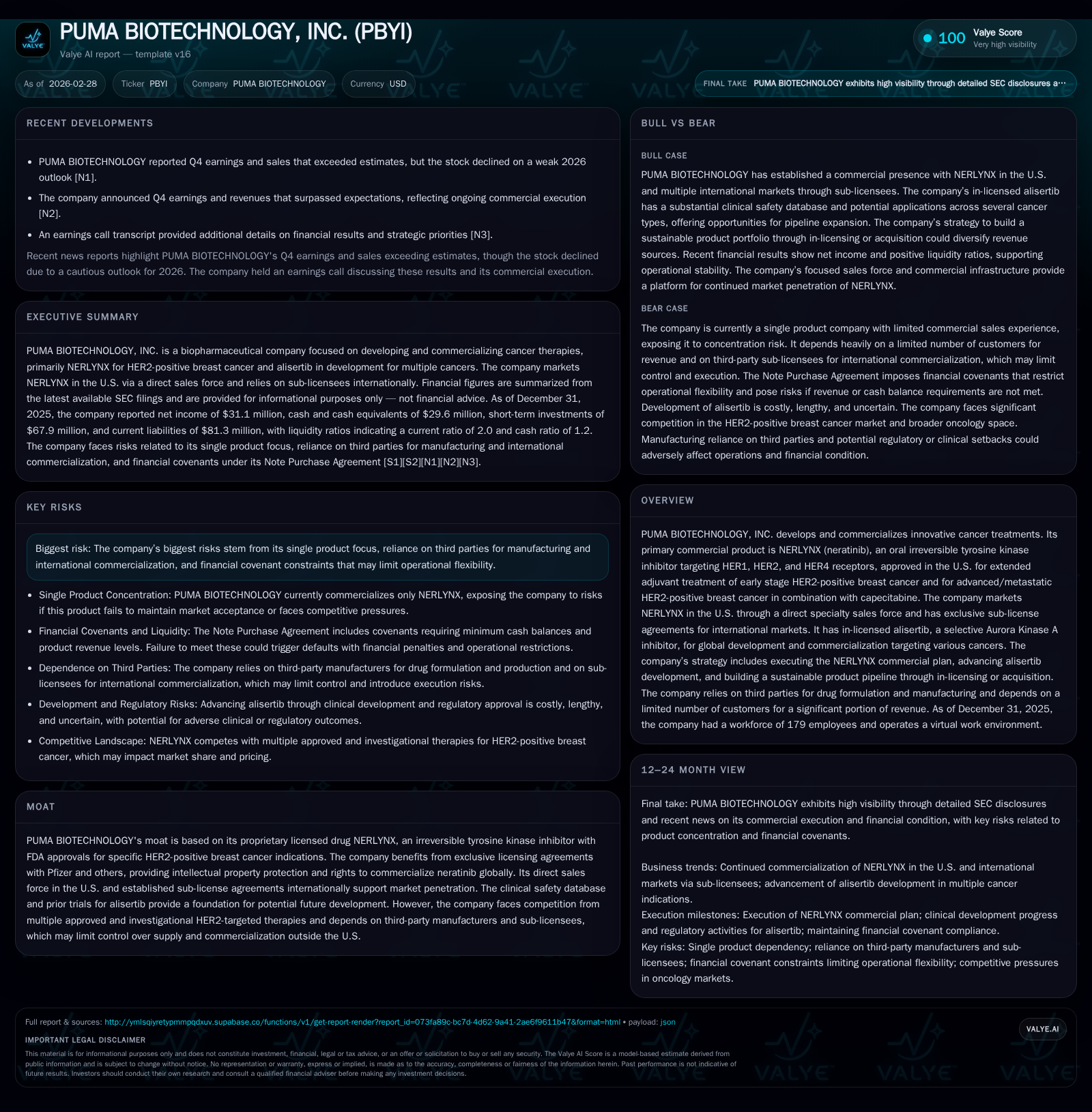
PUMA Biotechnology reported a notable increase in operating income and net income through 2025 despite flat revenue largely supported by sales of its flagship drug NERLYNX. The company’s strategic reliance on NERLYNX’s U.S. sales, combined with sub-license agreements abroad, underpins its commercial footprint but limits global control. Development of alisertib represents a potential growth avenue yet comes with significant clinical and capital risks. Investor caution persists given subdued forward guidance and the financial covenants impacting operational flexibility. Sustaining profitability amid these constraints will depend on efficient capital allocation, pipeline progress, and navigating regulatory and competitive pressures.
Strong Operating Income Growth Amid Flat Revenue: A Historical Overview
PUMA Biotechnology’s financial trajectory from FY2022 through FY2025 reflects a paradox of stagnant revenues alongside improving profitability metrics. The company’s latest available revenue figure dates from FY2017 at approximately $21.6 million [F1], with no more recent updates indicating top-line expansion since then. However, operating income has demonstrated substantial improvement, rising from $23.7 million in 2022 to $37.3 million in 2025 — a gain of approximately 20.5% year-over-year [F1]. Net income similarly climbed from a minimal $2,000 in 2022 to $31.1 million in 2025 [F1], suggesting enhanced cost controls or better operational gearing.
This dynamic is consistent with leveraging fixed costs over time or refining the product mix that favors higher-margin activities, such as ramping NERLYNX sales via efficient specialty sales channels. Operating cash flow corroborated this trend with growth from negative $15.8 million in 2022 to positive $41.8 million in 2025, signaling improved cash conversion efficiency alongside controlled capital expenditure, which remained low at $71,000 in 2025 [F1].
The historical financial summary captures this progression:
Historical performance (annual)
| FY | Net ($mm) | CFO ($mm) | OpInc ($mm) | Capex ($) | Net YoY |
|---|---|---|---|---|---|
| 2025 | 31 | 42 | 37 | 71000 | +2.8% |
| 2024 | 30 | 39 | 31 | 56000 | +40.2% |
| 2023 | 22 | 27 | 33 | 140000 | +1079450.0% |
| 2022 | 0 | -16 | 24 | 0 |
Source: SEC companyfacts cache [F1].
Capital returns and efficiency (annual)
| FY | FCF ($mm) | ROE% |
|---|---|---|
| 2025 | 42 | 23.9 |
| 2024 | 39 | 32.9 |
| 2023 | 27 | 40.4 |
| 2022 | -16 | 0.0 |
Source: SEC companyfacts cache [F1].
Note: Revenue is last reported for FY2017 as no recent published figures were available.
Commercial Execution of NERLYNX and International Licensing Dynamics
NERLYNX (neratinib), an oral irreversible tyrosine kinase inhibitor targeting HER family receptors HER1/2/4 approved for specific HER2-positive breast cancer indications by the FDA [S1], remains the cornerstone of PUMA's commercial efforts. The product enjoys exclusivity secured via Pfizer-licensed intellectual property rights [S13], allowing PUMA to conduct direct specialty sales within the United States.
The direct sales force focuses on penetrating the niche extended adjuvant treatment segment for early-stage HER2-positive breast cancer as well as advanced metastatic settings when combined with capecitabine [S1]. While U.S.-based marketing is internally managed enabling tighter control over messaging and physician engagement strategies, outside the country PUMA depends heavily on sub-license agreements for commercialization [S22]. These agreements span key regions including Europe (excluding Ukraine), Australia, Canada, China and others.
This dependence curtails PUMA's operational command internationally and exposes it to execution risk based on sublicensees’ commitment levels or regulatory challenges abroad [S22]. Furthermore, the competitive environment within HER2-targeted therapies has intensified with multiple approved agents eroding potential market share gains for NERLYNX [S1]. This intensifies pressure on pricing and promotional effectiveness.
Alisertib Development: Investment Needs Versus Clinical and Regulatory Hurdles
Alisertib is positioned as PUMA’s major future pipeline asset [S1]. This selective Aurora Kinase A inhibitor holds promise across various oncology indications but remains at an early stage requiring extensive additional clinical trials for safety and efficacy validation [S1].
Company SEC disclosures warn of the high expense and unpredictability inherent in alisertib's development path including regulatory hurdles that could materially impact business prospects if unsuccessful [S1]. Given alisertib's developmental infancy relative to NERLYNX, significant R&D investment will be necessary before any commercial return might materialize—all while managing ongoing marketing expenses for NERLYNX [S1].
Operating cash flow strength (~$41.8M in FY2025) provides some internal funds to support these activities without immediate external financing; however, alisertib's timeline remains uncertain with no explicit milestone dates publicly provided yet [S1][N3]. The broad oncology pipeline context reminds that Aurora Kinase inhibitors historically face stiff competition and mixed clinical success rates.
2026 Forward Guidance and Market Expectations: Investor Reactions Explained
Despite reporting Q4 and full-year FY2025 earnings beats relative to consensus expectations [N1][N2], PUMA’s stock experienced downward pressure tied primarily to cautious guidance going into calendar year 2026 [N1]. Management conveyed concern about plateauing revenue growth beyond established market penetration levels for NERLYNX, and acknowledged challenges ahead related to pipeline readouts and international commercialization execution risks [N3].
This dynamic underscores a typical "sell-the-news" phenomenon prevalent within clinical-stage biotech sectors where near-term top-line profit excellence may obscure underlying uncertainties linked with sustaining innovation-driven growth [N3]. Investors appear wary that operating leverage gains seen thus far might not continue without successful pipeline advancement or geographic expansion.
Balancing Capital Allocation: Cash Flow Strength and Debt Covenants
PUMA reports robust operating cash flow generation ($41.8 million in FY2025), significantly exceeding nominal capital expenditures (~$71k for FY2025), manifesting a strong free cash flow position approximating $41.7 million annually [F1]. This cash flow profile theoretically equips PUMA with organic resources to fund incremental R&D investments or opportunistic business development without immediate reliance on dilutive equity raises.
Nonetheless, the company's liquidity management is notably constrained by terms embedded within its Note Purchase Agreement with Athyrium Opportunities IV Co-Invest LP maturing mid-2026 [$22.5M principal outstanding as of Dec-31-25] [S6][S10]. Covenants restrict discretionary dividends or buybacks, impose minimum revenue thresholds for additional borrowing capacity, and necessitate maintaining defined cash balances subject to deposit account control agreements [S6][S10]. This structure imposes operational discipline but constrains flexibility especially if unforeseen financing needs arise.
Operating Leverage, ROE Trends, and Profitability Sustainability Analysis
Return on equity offers a distilled metric capturing shareholder value creation efficiency; PUMA registered approximately a 23.9% ROE in FY2025 calculated by dividing net income ($31.1M) over equity ($130M) per reported figures [F1]. This elevated ROE despite largely static revenues reflects disciplined cost management coupled with operating leverage effectuated over fixed cost bases.
However, the entrenched dependency upon single product revenues amplifies concentration risks that could abruptly undermine margins if competitive dynamics shift or patent protections erode [S1]. Although PUMA exhibits competent capital stewardship presently, momentum sustainability demands successful diversification via alisertib progression or acquisition-led portfolio expansion.
Risk Factors from Business Concentration and Third-Party Dependencies
PUMA confronts several structural vulnerabilities deriving principally from its limited product portfolio anchored exclusively by NERLYNX sales [S1]. Reliance on third-party manufacturers for drug formulation imposes supply chain risks potentially disrupting production schedules or raising costs unexpectedly [S1]. Internationally, dependence on sub-licensees subjects revenue streams to counterparties whose commitment or regulatory compliance cannot be fully controlled by PUMA itself [S22].
Regulatory complexities amplify these concerns—participation mandates under federal Medicaid Drug Rebate Program (MDRP), the Public Health Service's complex 340B pricing program governing outpatient drug ceiling prices, and obligations under Veterans Affairs Federal Supply Schedule programs constrain pricing strategies while exposing the company to stringent audit regimes with possible financial penalties in case of reporting inaccuracies or compliance lapses [S4][S5][S18][S27].
Additional legal frameworks including federal Anti-Kickback Statute, federal False Claims Act provisions, and emerging state-level drug price transparency laws exert further compliance burdens that could invite penalties or damage the company’s reputation if violated inadvertently [S6][S15][S21][S26][S27].
What to Watch: Catalyst Timeline and Milestones in Drug Development and Market Expansion
With alisertib embodying PUMA’s key growth optionality beyond NERLYNX's currently mature markets, a primary investor focus centers on its clinical trial progressions and any FDA regulatory submissions or approvals announced during the next quarters [N3][S1]. Additionally, the company’s ability to either expand international sublicensing networks successfully or internally assume further geographic control constitutes an important variable informing future revenue trajectories given global HER2-positive breast cancer prevalence scenarios [S22].
Absent explicit forecast disclosures, investors must monitor public disclosures regarding pivotal trial data releases for alisertib along with corporate updates on milestone achievements under existing license agreements that materially influence valuation sentiment.
Disclaimer: This analysis synthesizes publicly disclosed financial data from company filings and recent news sources without offering any investment recommendations or price forecasts. Readers should consider additional sources when evaluating investment decisions concerning PUMA Biotechnology.
Disclaimer: This is research-only, informational analysis and not investment advice. It may include AI-generated interpretation and general industry context. Always verify important details using primary sources.

Comments