
PJT Partners' Robust 2025 Growth Powered by Integrated Advisory Model and Client Diversification
PJT Partners delivered strong revenue and net income growth in 2025, leveraging its integrated advisory platform amid favorable market activity.
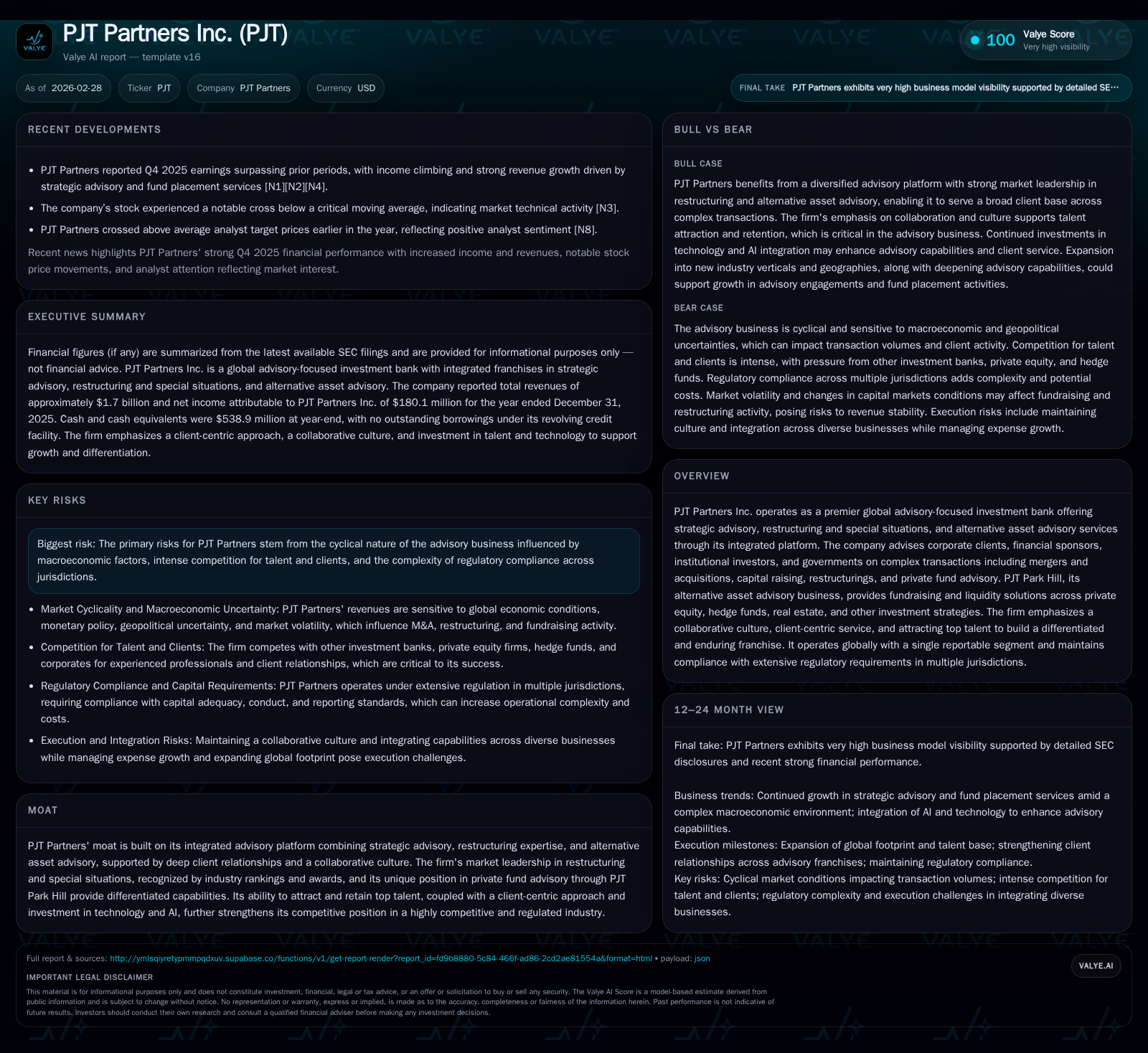
PJT Partners Inc. reported a notable 14.8% revenue increase to $1.71 billion and a 34% rise in net income to $180 million for 2025, driven by broad-based demand across strategic advisory, restructuring, and alternative asset advisory services. The firm’s well-integrated business model, combined with its global reach and deep client relationships, underpinned this robust performance despite the advisory industry’s inherent cyclicality and regulatory challenges. Going forward, sustained momentum in global M&A, elevated restructuring activity, and selective private capital solutions are key growth drivers, while competition for talent and macroeconomic uncertainties pose constraints.
Overview
PJT Partners Inc. operates as a premier global advisory-focused investment bank offering an integrated platform combining strategic advisory, restructuring and special situations, and alternative asset advisory services. This comprehensive model facilitates servicing corporate clients, financial sponsors, institutional investors, and governments on complex cross-border transactions including mergers and acquisitions (M&A), capital raising activities, restructurings, and private fund advisory. The firm's culture emphasizes collaboration and client-centric service which supports its competitive moat in an intensely competitive and regulated investment banking landscape [S1][S21][S22].
Historical Financial Performance
Fiscal year 2025 was a banner year for PJT Partners with top-line revenues climbing to $1.71 billion—up by approximately 14.8% relative to the prior year’s $1.49 billion [F1]. Net income exhibited an even more marked increase of roughly 34%, reaching $180 million in 2025 compared to $134 million in 2024 [F1]. This strong earnings progression helped elevate the firm’s approximate return on equity (ROE) to a robust 58.4%, reflecting efficient capital utilization against equity of $308 million at year-end 2025 [F1].
Operating cash flow held steady at about $526 million for FY2025 versus $531 million the previous year; however capex surged over twelvefold to around $46 million as the firm increased investments in technology infrastructure and AI capabilities to maintain differentiation [F1][S21]. Capital returns have consistently been prioritized through dividends averaging around $24–25 million annually with significant share repurchases totaling $195 million in fiscal 2025—down slightly from the prior year's buyback level but still substantial [F1].
Historical performance (annual)
| FY | Rev ($mm) | Net ($mm) | CFO ($mm) | Capex ($mm) | Rev YoY | Net YoY |
|---|---|---|---|---|---|---|
| 2025 | 1714 | 180 | 526 | 46 | +14.8% | +34.0% |
| 2024 | 1493 | 134 | 531 | 3 | +29.5% | +64.3% |
| 2023 | 1153 | 82 | 442 | 4 | +12.5% | -9.6% |
| 2022 | 1026 | 91 | 243 | 3 |
Source: SEC companyfacts cache [F1].
Capital returns and efficiency (annual)
| FY | Div ($mm) | Buybacks ($mm) | FCF ($mm) |
|---|---|---|---|
| 2025 | 25 | 195 | 480 |
| 2024 | 24 | 235 | 528 |
| 2023 | 24 | 117 | 438 |
| 2022 | 25 | 109 | 239 |
Source: SEC companyfacts cache [F1].
Table reflects consolidated annual financial results sourced from SEC filings [F1].
Drivers of Past Growth
The firm’s historical growth has been fueled by several key dynamics:
- Strategic Advisory: Serving marquee clients on complex M&A transactions and activations of shareholder engagement strategies.
- Restructuring & Special Situations: Maintaining leadership in an elevated restructuring cycle globally with recognized expertise in liability management, bankruptcy proceedings, and distressed M&A.
- Alternative Asset Advisory: Through PJT Park Hill, the company has captured sizable mandates involving fund placement and private capital solutions despite challenging fundraising markets.
- Geographic Reach & Client Diversity: Revenues showed geographic expansion with U.S., UK, and other international offices contributing proportionately [S12], reducing concentration risk.
- Cultural Differentiators: A collaborative culture attracting top-tier talent enhances deal flow quality and client retention [S21][S22].
These elements enabled not only volume growth but also fee rate expansion owing to complexity of engagements—a critical differentiator in investment banking.
Future Growth Prospects
Looking forward, several factors could drive PJT’s continued expansion:
- Ongoing momentum in global M&A activity as seen in reported +49% increase in announced volumes during calendar year 2025 over prior year according to LSEG data cited by management [S1][S2]. This favorable external environment is expected to persist into early-to-mid-2026 barring abrupt shifts.
- Sustained elevated levels of financial distress across industries underpin persistent demand for the firm’s restructuring expertise amid evolving liability management demands [S1][S2].
- Demand for private capital solutions remains robust given pressures for liquidity among general partners (GPs) and limited partners (LPs), providing upside potential for PJT Park Hill despite broader fundraising challenges [S1][S2].
- Continued strategic expansion via talent acquisition into new industry verticals and geographies could deepen engagement pipelines and broaden client coverage [S21].
- The firm is investing heavily into technology including artificial intelligence tools aimed at enhancing advising capabilities which could yield long-term productivity gains [S21].[N1]
However, growth is not without limits:
- The cyclical nature of advisory compels cautious outlook as macroeconomic variables like monetary policy changes or geopolitical turbulence can swiftly dampen deal-making appetite.
- Fund placement activity faces high investor selectiveness amid realizations slowdown impeding new capital flow velocity [S1][S2].
- Competitive pressure for elite talent from other bulge bracket banks or boutiques could challenge margin expansion or client coverage intensification.
- Complex regulatory requirements across multiple jurisdictions impose compliance costs that may limit operational flexibility or heighten legal risk exposure [S17][S18][S23][S24].
Overall, while intermediate-term prospects appear constructive under current market assumptions documented by management commentary [N1][N2], vigilance on macro and competitive fronts remains essential.
Forecasts, Milestones & What to Watch
The company does not provide granular public guidance due to transactional variability inherent to advisory businesses but has highlighted several markers worth monitoring:
- Quarterly trends in deal volumes globally remain a barometer for pipeline health given their direct correlation with fee generation.
- Frequency and size of announced restructurings will be strong indicators of the continuing special situations cycle vitality.
- Fundraising activity metrics from the alternative assets sector—notably commitments closed by Park Hill advisors—will reveal appetite shifts impacting that vertical.
- Talent hiring announcements particularly senior-level lateral moves influence strategic positioning.
- Technology adoption milestones related to AI integration reported during earnings calls could affect service differentiation.
Market observers should also track shifts in regulatory frameworks impacting broker-dealer operations across PJT’s UK, US, Hong Kong, Japan and Middle East offices given multi-jurisdictional compliance burdens detailed in filings [S16][S29].
Returns & Capital Allocation Strategy
PJT demonstrates disciplined capital stewardship balancing reinvestment with shareholder returns:
- Approximate ROE stood at a robust ~58.4% for FY2025—signaling highly effective equity leverage driven by both profit growth and maintained capital efficiency [F1].
- Operating cash flow was resilient at approximately $526 million; after elevated capex spend largely related to technology upgrades ($45.9 million), free cash flow remained healthy near $480 million [F1].
- Dividends have maintained consistency around $24–25 million annually since at least FY2022 illustrating stable income distribution commitment.
- Repurchase activity is significant with share buybacks totaling nearly $200 million demonstrating active capital return policy whilst absorbing stock dilution factors [F1].
- Balance sheet liquidity is strong with cash equivalents exceeding $538 million at year-end supported by no outstanding borrowings on revolving credit facilities capped at $100 million emphasizing conservative leverage stance [F1][S9][S10].
These financial priorities echo a mature organization intent on sustaining shareholder value while investing prudently for future competitive advantage.
Industry & Competitive Context (Analysis)
Within the investment banking advisory space, PJT operates as a smaller yet highly specialized player distinguished by its integrated product lines combining strategic advice with restructuring prowess alongside private fund advisory capabilities—the latter being a niche few rivals offer cohesively under one roof. Its mid-sized stature enables entrepreneurial agility often lacking at bulge brackets while allowing access to large-scale transactions via deep sectoral expertise. Regulatory landscapes are tightening globally post-financial crises leading firms like PJT to commit substantial resources ensuring compliance without compromising client-facing innovation. The cyclical industry faces secular shifts such as tech-enabled deal origination tools augmenting traditional relationship models—a development PJT appears engaged with via recent AI investments.
Risks & Legal Matters
Key risks identified stem primarily from:
- Macroeconomic fluctuations impacting M&A deal pipeline unpredictably given volatile monetary or geopolitical climates causing sudden reticence among clients [S17][S18][S20].
- Intense competition for top-level advisers can pressure compensation costs affecting margins; this factor also influences client win rates particularly against larger firms boasting wider resources [S21].
- Regulatory complexity carries potential for costly enforcement actions or operational disruption should compliance lapses occur adversely affecting reputational capital especially given the firm’s broker-dealer status across multiple jurisdictions including US SEC/FINRA rules and UK FCA requirements plus Asian regulators’ scrutiny [S23][S24][S29].
- Legal proceedings currently not material but inherently hard to predict due to ongoing investigations or litigations typical in transactional businesses which require continuous management attention within provisions already recorded per disclosures [S24][S25]. Furthermore, a material tax receivable agreement requires careful monitoring as it generates contractual obligations contingent upon exchanges of partnership units with potential financial implications beyond statutory reporting periods [S18][S20][S27].
Conclusion
PJT Partners has demonstrated commendable momentum through fiscal year 2025 marked by double-digit revenue growth complemented by even stronger profitability gains driven by its integrated advisory platform addressing diverse client needs worldwide. Its ability to attract premier talent underpins both execution quality and innovation aspirations such as AI adoption bolstering its competitive moat amid complex global markets. Risks typical of the cyclical investment banking sector including economic headwinds and intense talent competition underscore the need for ongoing operational discipline while regulatory demands continue shaping firm strategy especially given its multi-jurisdictional footprint. Capital allocation balances between rewarding shareholders via dividends/buybacks while investing aggressively into technology. Vigilant monitoring of incoming transaction flows across M&A, restructuring workloads, and fund placement volumes will be crucial signals of sustaining this trajectory into the near future.
Disclaimer: This is research-only, informational analysis and not investment advice. It may include AI-generated interpretation and general industry context. Always verify important details using primary sources.

Comments