
Procaccianti Hotel REIT: Concentrated Select-Service Portfolio Weighs Liquidity Against Stable Cash Flows
Procaccianti Hotel REIT, Inc. operates a focused, non-traded portfolio of five select-service hotels, funding distributions primarily from property cash flows.
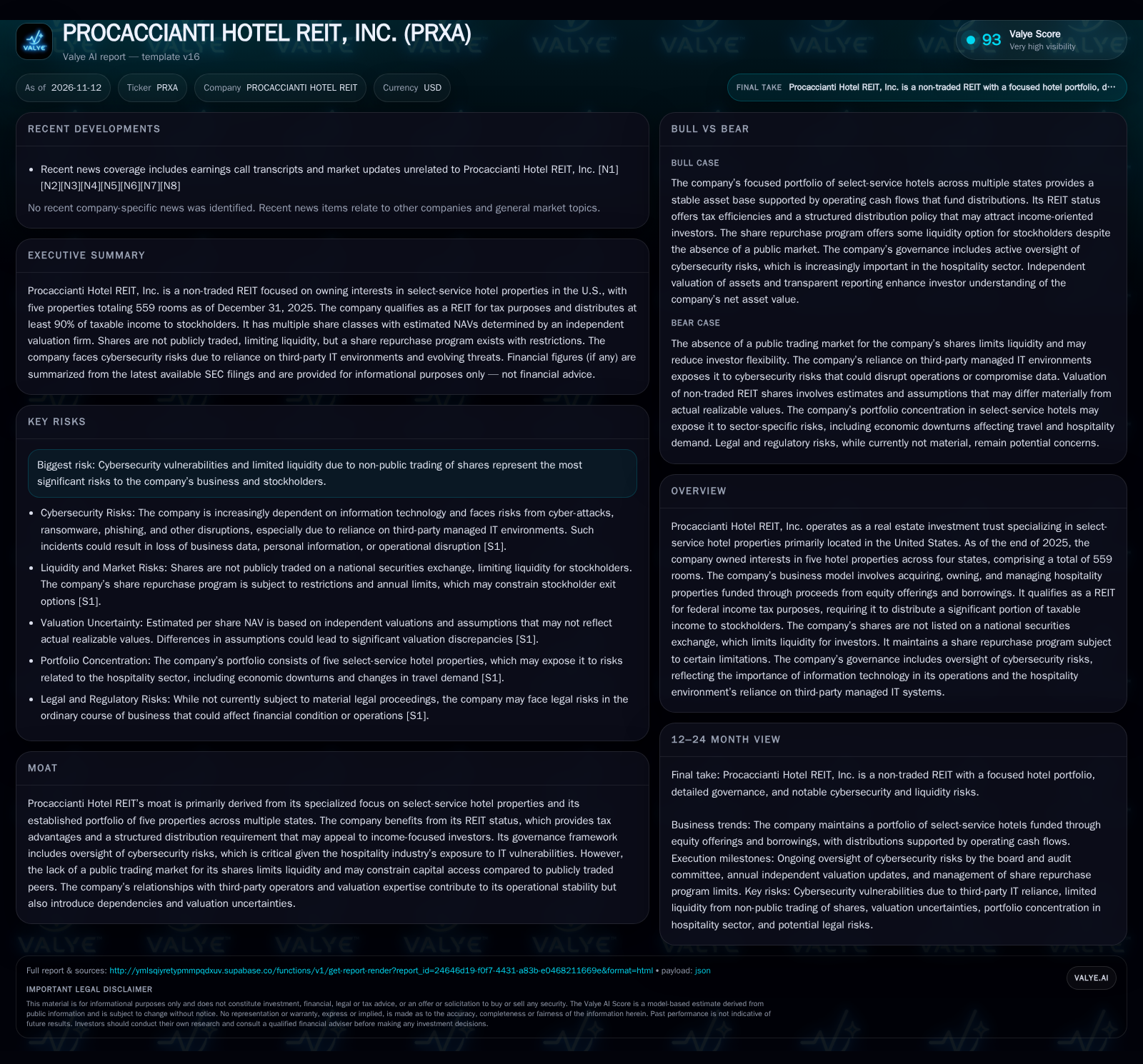
Procaccianti Hotel REIT, Inc. owns five select-service hotels in four states, distributing most taxable income to stockholders as required by REIT rules. Distributions are funded mainly from hotel cash flows, but valuation uncertainties and sector concentration add further risk. The REIT's income appeal is balanced by these structural limitations and operational dependencies. [S1] [S2]
Procaccianti Hotel REIT, Inc. exemplifies the trade-offs inherent in non-traded real estate investment trusts: a concentrated portfolio of select-service hotels offers relatively stable, cash-flow-backed distributions, but the lack of public market liquidity and dependence on independent valuation introduce investor friction. The company’s strict REIT compliance and distribution policy may attract income-oriented investors, yet its reliance on third-party IT systems for property operations heightens cybersecurity exposure—a risk increasingly salient in the hospitality sector. As the REIT sector faces evolving market dynamics, Procaccianti’s ability to balance stable distributions with operational and structural vulnerabilities will define its long-term appeal.
Latest Developments: Portfolio Size, Distribution Mechanics, and Structural Constraints
As of December 31, 2025, Procaccianti Hotel REIT, Inc. owned interests in five select-service hotel properties, totaling 559 rooms across four U.S. states [S1]. The company distributed approximately $3.79 million to stockholders during 2025, with funding drawn primarily from operating cash flows generated by its hotel properties rather than asset sales or external borrowings [S1]. Shares remain non-traded, and liquidity for investors is restricted to a share repurchase program with annual limits and pricing based on estimated NAV, itself determined by an independent valuation firm and approved by the audit committee [S1]. The portfolio is funded by a mix of equity capital from offerings and borrowings, with an aggregate initial purchase price of about $78.4 million [S1]. The board and audit committee receive regular reports on cybersecurity risk, reflecting heightened awareness of operational vulnerabilities in third-party managed IT environments [S1].
How the Select-Service Hotel REIT Model Drives Cash Flows and Investor Returns
Procaccianti Hotel REIT’s economics hinge on the acquisition and management of select-service hotels, which generally offer moderate amenities and streamlined staffing compared to full-service hotels, resulting in a lower cost structure and potentially more resilient operating margins in mid-tier travel markets. Revenue is primarily generated from room occupancy and limited ancillary services; the select-service segment typically benefits from a mix of business and leisure travelers seeking value, and tends to show less volatility than luxury or convention-focused assets during economic cycles.
The company’s REIT structure compels it to distribute at least 90% of taxable income to stockholders, creating a predictable cash-outflow requirement. This policy can attract income-oriented investors, but it also limits the company’s ability to retain earnings for reinvestment or to cushion against downturns. Funding for acquisitions comes from a blend of equity offerings and debt, with the company’s $78.4 million in aggregate hotel purchase prices reflecting a reliance on outside capital to scale [S1].
Operating leverage in the select-service segment is moderate: while fixed costs (property taxes, insurance, management fees) are meaningful, variable costs (housekeeping, utilities, consumables) scale with occupancy. The absence of public trading means capital raising is episodic and valuation-driven, not market-driven, and investor exits are constrained by the company’s limited share repurchase program. NAV is determined annually using independent appraisals, but realized asset values—should properties be sold—may diverge from these estimates, affecting both economic returns and investor confidence.
Portfolio Focus, Liquidity Trade-Offs, and the Challenge of Non-Traded REITs
Procaccianti Hotel REIT’s competitive position is shaped by its narrow focus on select-service hotels, a segment that offers operational simplicity and, in some demand environments, defensibility relative to higher-end or highly seasonal hospitality assets. However, the company’s small portfolio (five properties) lacks the geographic and asset-type diversification seen in larger, publicly traded hospitality REITs, exposing it to both local market shocks and sector-specific downturns.
The absence of a public listing is a double-edged sword: while it may insulate the company from public market volatility and short-term trading pressures, it also severely limits liquidity for existing investors and constrains the company’s ability to access fresh capital in adverse conditions. NAV-based share repurchases mitigate but do not eliminate the illiquidity discount that often plagues non-traded REITs.
The select-service focus means competition arises not only from other non-traded REITs but also from listed hotel REITs, private equity real estate funds, and direct hotel owners/operators. Publicly traded peers generally benefit from lower cost of capital, greater scale, and better access to transactional opportunities. In contrast, Procaccianti’s value proposition must rest on stable distributions, transparent governance, and the potential for NAV growth, all while managing the operational risks associated with third-party IT reliance and concentrated asset exposure.
What Would Unlock Value: Stable Occupancy, Margin Expansion, and a Robust NAV
In a favorable scenario, Procaccianti Hotel REIT’s properties maintain high occupancy and stable average daily rates (ADR), driving consistent operating cash flows sufficient to fund both distributions and modest reinvestment. If U.S. travel demand remains robust—particularly in mid-tier, business-travel-heavy markets—select-service hotels can outperform luxury peers during economic uncertainty, supporting resilient margins.
Should independent annual valuations reflect rising property values, NAV per share could improve, enhancing the attractiveness of distributions and supporting higher share repurchase prices. Disciplined cost management, limited capex needs typical of select-service formats, and successful navigation of cybersecurity risks (with no major incidents) would further bolster confidence.
Confirmation of this scenario would include: upward-trending occupancy and ADR data (if disclosed), growing or stable NAV per share, regular fully funded distributions, and no material cybersecurity or operational disruptions. Evidence of above-market performance relative to peers—such as higher occupancy or lower expense ratios—would further validate the upside thesis.
Managing for Steady-State Returns Amid Sector Cyclicality and Structural Constraints
The most plausible medium-term outcome is that Procaccianti Hotel REIT continues to operate its five-property portfolio with moderate fluctuations in occupancy and cash flows tied to broader economic cycles. Distributions remain funded by property-level operations, with NAV per share reflecting incremental changes in underlying real estate valuations rather than outsized appreciation.
reported liquidity position, with investor exits primarily through the share repurchase program, subject to annual caps and NAV-based pricing. The board’s ongoing cybersecurity oversight mitigates, but does not eliminate, the risk of operational disruption from IT incidents. The company’s small scale and non-traded status constrain its ability to pursue opportunistic acquisitions or to rapidly pivot in response to market shifts.
Confirmation would come from steady distribution levels, stable NAV estimates, and absence of material cybersecurity or legal events. Falsification would include a marked drop in property cash flows, significant NAV writedowns, or a disruptive cyber incident impacting operations or data security.
How Disruption Could Erode Value: Sector Downturn, Cyber Incident, or NAV Shock
A negative scenario could be triggered by a downturn in the U.S. hospitality sector—such as a recession, regional travel pullback, or oversupply in select-service markets—leading to reduced occupancy, falling ADR, and declining property cash flows. As operating income contracts, the company may be forced to reduce distributions, undermining its core investment appeal.
If cybersecurity defenses prove insufficient, a major cyber-attack or IT breach could disrupt hotel operations, result in data loss or regulatory penalties, and erode both cash flow and reputation. The reliance on third-party managed IT environments amplifies this risk, given the increasing sophistication of attacks targeting hospitality companies.
A significant negative swing in independent property valuations—driven by market comparables or deteriorating fundamentals—could result in lower NAV per share, directly impacting share repurchase pricing and investor confidence. If asset sales are required to meet obligations or fund distributions, realized values below NAV could crystallize losses. Confirmation would include declining distribution levels, NAV writedowns, reported cyber incidents, or delays/limits in share repurchases.
Signals That Will Shape Procaccianti Hotel REIT’s Long-Term Investor Value Proposition
Annual changes in estimated NAV per share, including methodology adjustments or significant valuation swings.
Quarterly or annual occupancy rates and average daily rates (ADR) for each property, if disclosed, as indicators of portfolio health and cash flow stability.
Distribution coverage ratio: how operating cash flows compare to distributions paid—would help test sustainability.
Incidence and severity of cybersecurity events, including any material disruptions or required SEC disclosures.
Updates to share repurchase program limits, participation rates, or pricing—especially if investor redemption demand increases.
Additions or sales of hotel properties, signaling growth, portfolio rebalancing, or liquidity-driven asset sales.
Changes in the mix or cost of debt and equity financing, which may affect future acquisition capacity and risk profile.
Board or audit committee commentary on risk management practices, particularly regarding cybersecurity and third-party IT reliance.
Disclaimer: This is research-only, informational analysis and not investment advice. It may include AI-generated interpretation and general industry context. Always verify important details using primary sources.

Comments