
Petros Pharmaceuticals Advances Platform Amid Financial Uncertainty and Regulatory Complexity
Petros Pharmaceuticals progresses its integrated SaaS and SaMD platform targeting the Rx-to-OTC switch market while facing significant liquidity and regulatory challenges.
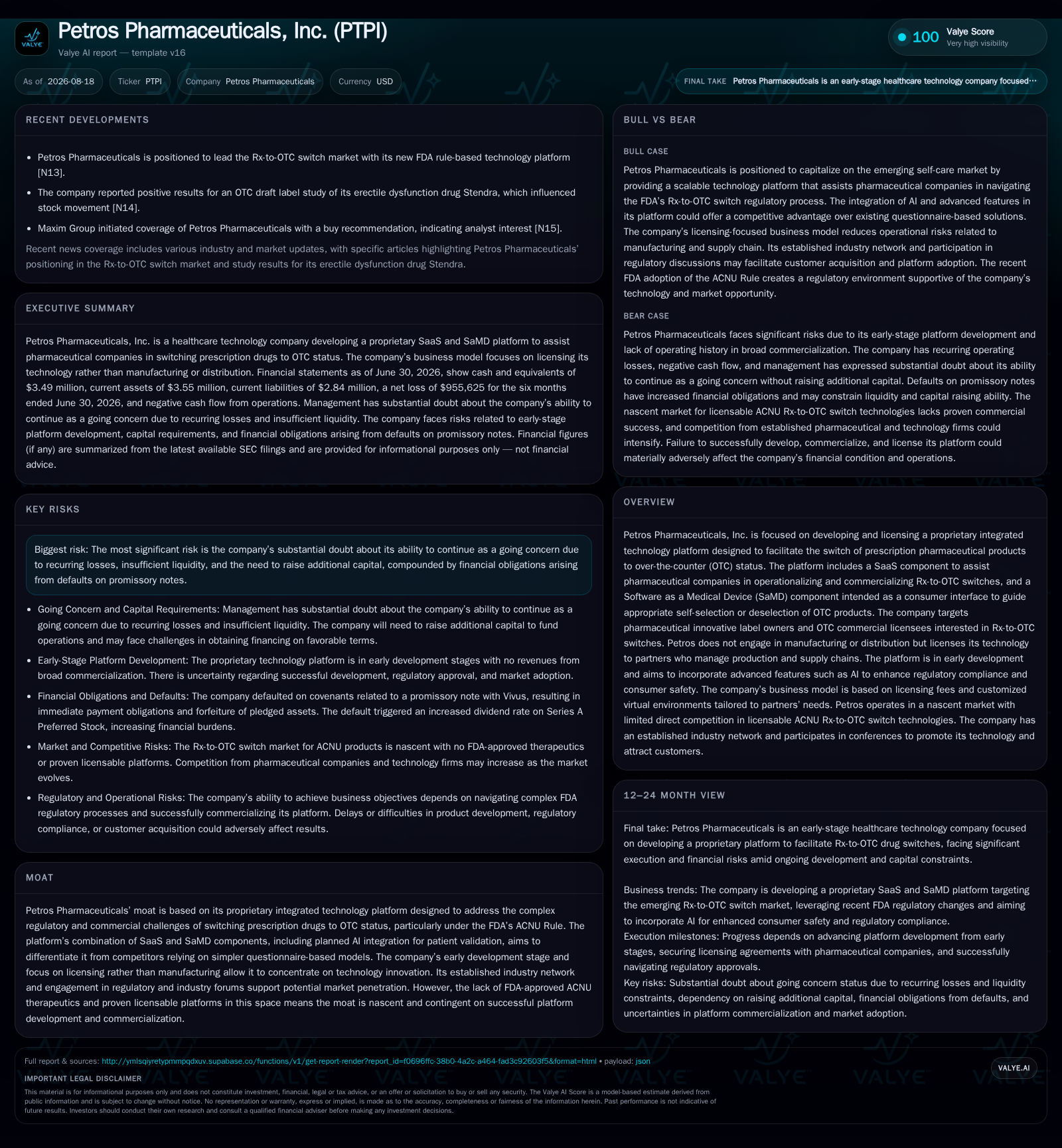
Petros Pharmaceuticals is developing a proprietary technology platform aimed at facilitating prescription-to-over-the-counter (Rx-to-OTC) drug switches through a combination of SaaS and Software as a Medical Device (SaMD) components. The latest quarterly filing underscores ongoing cash burn and substantial doubt about the company's ability to continue as a going concern, characteristic of early-stage pharmaceutical technology licensors dependent on capital raises. Regulatory complexity, especially surrounding FDA's ACNU Rule, both drives demand for and constrains adoption of Petros’s platform. The company’s model hinges on licensing partnerships with pharmaceutical innovators rather than direct manufacturing, with growth contingent on regulatory milestones and commercial traction.
The company reported cash used in operations of approximately $1.65 million over the first six months of 2026 while ending Q2 with $3.49 million in cash and equivalents [S2][F1]. This limited liquidity combined with current assets of $3.55 million against current liabilities of $2.84 million yields a current ratio near 1.25 — pointing to tight working capital conditions [F1].
Integrated SaaS & SaMD Platform Targets Operationalizing Rx-to-OTC Switch Challenges
Petros's core value creation proposition rests on its dual-component integrated platform designed specifically to address the regulatory-commercial complexity involved in switching prescription pharmaceuticals to OTC status. The platform combines a Software as a Service (SaaS) offering tailored for pharmaceutical innovators with Software as a Medical Device (SaMD) capabilities geared toward consumer self-selection guidance [S1]
The SaaS layer functions as a digital host facilitating secure data exchanges and providing tools for regulatory compliance management aligned with the FDA’s evolving ACNU Rule framework. It helps pharma partners manage labeling guidance and optimize market access strategies essential when navigating the stringent requirements associated with Rx-to-OTC switch approvals [S1]. Meanwhile, the SaMD component acts as an interface directly interacting with consumers to ensure appropriate product selection or deselection — an essential safety mechanism under FDA guidelines where consumer self-care decisions must be validated digitally rather than solely relying on physical packaging or pharmacist intervention.
This dual architecture reflects an understanding that operationalizing Rx-to-OTC transitions demands coordination across pharmaceutical commercialization workflows internally while simultaneously addressing end-user safety externally via advanced digital health interfaces. The approach is differentiated versus simpler questionnaire-based OTC self-selection tools prevalent in the marketplace which lack integrated pharma workflow linkage or AI-enhanced validation features currently under development by Petros.
Navigating the Regulatory Maze: The FDA ACNU Rule as Both Opportunity and Barrier
The FDA’s Amendment III to the Consumer Update Rule (ACNU Rule) represents both impetus and obstacle for Petros’s platform strategy. Regulatory trends increasingly encourage shifting appropriate prescription drugs OTC to broaden consumer self-care access but impose strict stipulations around ensuring safe use without healthcare professional oversight. This creates demand for sophisticated technological solutions capable of demonstrating compliance robustly throughout the product lifecycle.
Petros targets this niche by embedding regulatory compliance functions within its SaaS framework while concurrently pursuing clearance paths for its SaMD modules designed as medical devices requiring independent regulatory approval [S1]. Achieving these green lights is critical; successful regulatory endorsements would substantiate Petros’s moat as an integrated licensor versus competitors relying on rudimentary self-assessment approaches lacking formal FDA acceptance.
However, the sector's nascency means that no ACNU Rule-compliant therapeutics coupled with fully approved digital licensing platforms exist yet broadly commercially viable — underscoring elongated timelines before tangible royalties or license revenues emerge from operationalized switches. This uncertainty amplifies risks around timing, adoption rates by risk-averse pharmaceutical innovators, and valuation based on future potential rather than current cash flows.
Competitive Landscape: Integrated Platforms Versus Simplified Questionnaire-Based Tools
Within pharmaceutical technology platforms focusing on Rx-to-OTC switches, Petros occupies a specialized upstream position providing licensing-enabled operationalization rather than downstream manufacturing or product retailing. Peer sets encompass digital health software companies developing SaMD products alongside regulated compliance solution vendors serving pharma commercialization needs broadly.
Where Petros strives to differentiate is its holistic integration of SaaS tools aligned tightly with pharma workflows coupled with consumer-facing AI-augmented SaMD modules aimed at both increasing adherence to regulatory standards and minimizing liability related to consumer misselection [S1]. This positions it ideally against simpler questionnaire-only OTC advisory tools which may fall short in evidentiary rigor required under FDA scrutiny.
Peer benchmarks such as Pro Medicus or Artelo Biosciences serve as rough analogs in adjacent digital health biotech spaces emphasizing growth in SaaS recurring revenue streams tied to platform adoption and regulatory milestones. However, Petros’s application specifically targets bridging prescription drug lifecycle modernization via tech licensing models — an emerging frontier still unproven commercially but conceptually promising.
Capital Raising Imperative: Financial Sustainability Challenges Typical of Early-Stage Licensing Firms
The financial profile revealed in recent SEC filings confirms recurring operating losses consistent with developmental investment phases common across next-generation pharmaceutical technology licensors [S2][F1]. Despite some net income shown historically at fiscal year end, underlying operating loss remains pronounced ($4.64 million operating income deficit reported end 2025), underscoring lack of substantive commercialization scale presently [F1].
Cash runway considerations compel ongoing dependence on equity or debt financing rounds — efforts implicitly referenced by management cautioning about capital needs beyond currently available funds [S2]. Elevated research & development expenditures intrinsically linked to evolving software capabilities including AI-driven validation justify this outflow but prolong path to breakeven.
Failure to achieve licensing deals generating sustainable recurring revenues from SaaS subscriptions or SaMD royalties places further strain on solvency prospects amidst competitive pressures from legacy tools requiring lower upfront investment by pharma companies seeking Rx-to-OTC switch facilitation.
Growth Drivers Shaping Future Prospects
Growth potential for Petros hinges fundamentally on multiple converging factors: increasing FDA encouragement towards Rx-to-OTC switches aimed at expanding consumer self-care access; rising pharmaceutical industry interest in technology-enabled market access optimization; advances in AI facilitating sophisticated patient validation within SaMD frameworks; growing SaaS adoption among pharmaceutical commercialization teams seeking process efficiency; alongside prospective approvals of ACNU Rule-compliant therapeutics creating actual platform deployment opportunities.
Successful formation of licensing partnerships will provide quantifiable metrics such as monthly recurring revenue buildup from SaaS subscriptions, expansion of licensed partner base, positive regulatory clearances validating SaMD safety profiles, improved customer renewal rates signaling platform stickiness, and ultimately measurable acceleration in time-to-market for switched products using Petros’s tools.
Risks and Watchpoints
Key risks persistently shadow Petros’s outlook: evolving FDA guidance continues exerting uncertainty over acceptance criteria delaying commercial scalability; technical hurdles exist around obtaining formal device clearances necessary for SaMD components; slow partner onboarding limits revenue momentum; competition from simpler questionnaire solutions imposes pricing pressure; substantial financing requirements impose dilution threat if capital markets are unreceptive; conservative culture within pharma may resist operational process shifts favoring integrated digital platforms; potential liability arising from consumer self-selection errors if validation algorithms fail also looms large.
Investors watching Petros should closely monitor announcements related to new licensing deals indicating ecosystem traction; progress reports on FDA filings and approvals validating AI-enabled SaMD functionality; R&D spending trends reflective of technical roadmap execution; quarterly burn rate changes signaling cost control efficacy; plus fresh disclosures around fundraising initiatives clarifying runway extension prospects.
What to Watch Next
Near-term milestones naturally focus on advancing regulatory approval processes for the SaMD component—a crucial step towards differentiating technological credibility under the ACNU Rule framework. Securing initial licensing contracts with prominent pharmaceutical innovators would mark critical proof points validating go-to-market strategy.
Tracking quarterly trends in SaaS subscription revenues or contract backlog could reveal momentum building beyond early pilot phases. Similarly,R&D spend intensity signals ongoing commitment to feature enhancements including planned AI-driven patient validation capabilities vital for competitive differentiation.
Finally, management commentary addressing liquidity status post-latest capital raises will provide tangible insights into survival horizon amid persistent operating losses.
Financial Profile Discussion
As of June 30, 2026, Petros Pharmaceuticals held approximately $3.49 million in cash and equivalents against current liabilities totaling roughly $2.84 million—a current ratio near 1.25—suggesting liquidity is adequate only over a short horizon barring immediate capital infusions [F1]. Over the first half of 2026, operational cash outflows reached roughly $1.65 million underscoring significant burn consistent with developmental-stage expenditures including R&D investments required for iterative platform enhancements [S2][F1].
Management explicitly articulated substantial doubt about continuing as a going concern absent successful capital raises within the next twelve months—an acknowledgment echoing endemic financial sustainability challenges faced across peers similarly positioned at this juncture between innovation mandate and commercial proof-of-concept realization [S2]. Therefore, securing additional funding emerges as an immediate imperative underpinning ongoing platform development efforts and enabling transition toward license-driven revenue generation.
Disclaimer: This is research-only, informational analysis and not investment advice. It may include AI-generated interpretation and general industry context. Always verify important details using primary sources.

Comments