
SPINDLETOP OIL & GAS Q2 2026: Reserve Growth Supports Operations Amid Capital and Market Challenges
SPINDLETOP OIL & GAS funds capital spending mainly from operating cash flow but faces risks from commodity prices, regulatory costs, and market sentiment.
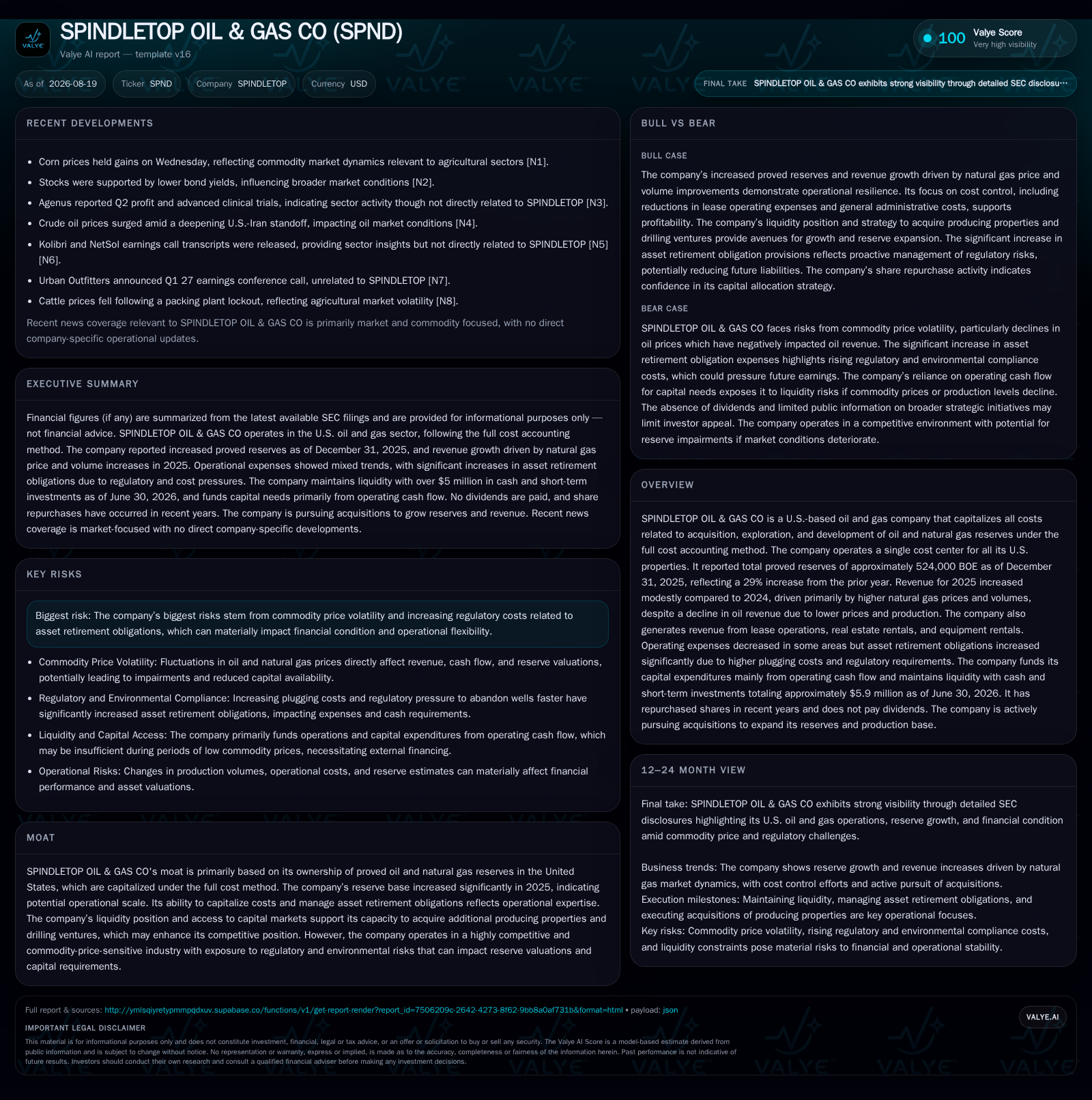
In its Q2 2026 10-Q filing, SPINDLETOP OIL & GAS reported that its capital expenditures continue to be primarily financed through cash flow from operations. The company’s proved reserves increased by 29% as of December 31, 2025, offering a foundation for potential production growth. However, rising asset retirement obligations and a downgrade to the OTC Markets Pink Limited market introduce financial and liquidity risks. Negative shifts in investor sentiment toward the oil and gas sector may further constrain access to capital, challenging the company’s ability to sustain its current capital spending and operational scale.
Latest Quarterly Operating and Financial Update
SPINDLETOP OIL & GAS CO's Q2 2026 10-Q filing dated August 19, 2026, reveals that the company continues to fund its operating capital needs and capital spending primarily from cash flow generated by its operations [S2]. However, the company explicitly states that it cannot assure sufficient future cash flow to maintain current capital spending levels due to variability in production volumes and commodity prices. This uncertainty raises the possibility that SPINDLETOP may need to seek additional third-party financing to support its exploration and development activities.
As of June 30, 2026, the company reported cash and cash equivalents of $5.13 million and current assets of $8.43 million against current liabilities of $6.22 million, resulting in a current ratio of 1.36 [F1]. This indicates moderate short-term liquidity but leaves limited cushion if operating cash flow declines or capital needs increase.
The filing also notes a downgrade of SPINDLETOP’s stock to the OTC Markets Pink Limited market, which is expected to reduce stock liquidity and make it more difficult for investors to trade the shares [S2]. This downgrade could adversely affect the company’s ability to raise debt and equity capital, particularly in a sector where investor sentiment has grown increasingly negative.
Annual Reserve Growth and Operational Scale
A key positive development for SPINDLETOP is the significant increase in its total proved reserves. As of December 31, 2025, total proved reserves rose approximately 29% to 524,000 barrels of oil equivalent (BOE) compared to the prior year [S1]. This reserve growth provides a structural foundation for potential production growth and revenue expansion, which are critical for sustaining cash flow and funding capital expenditures over the longer term.
In the oil and gas exploration and production industry, proved reserves are a fundamental indicator of future production capacity and revenue potential. A 29% increase suggests that SPINDLETOP may be positioned to expand its operational scale if it can effectively convert these reserves into production.
Regulatory and Market Risks Impacting Capital Access
SPINDLETOP’s financial outlook is complicated by rising asset retirement obligations, which have increased significantly due to higher plugging costs and evolving regulatory requirements. These obligations represent future liabilities related to well plugging and site reclamation, which can constrain free cash flow and require additional capital allocation, thereby impacting profitability and liquidity [S1]. Furthermore, the downgrade to the OTC Markets Pink Limited market may exacerbate financing challenges by reducing stock liquidity and investor access [S2]. Given the broader negative shift in some segments of the investment community’s attitudes toward the oil and natural gas industry, SPINDLETOP faces a risk that its ability to raise debt and equity capital could be materially impaired. This sector-wide investor sentiment shift is driven by lower relative equity returns and changing market indices representation.
Financial Position and Capital Allocation
SPINDLETOP’s balance sheet as of June 30, 2026, shows moderate liquidity with $5.13 million in cash and equivalents and a current ratio of 1.36 [F1]. While this level of liquidity supports near-term operational needs, the company’s reliance on operating cash flow to fund capital expenditures makes it vulnerable to commodity price volatility and production fluctuations [S2].
The economics of this model depend heavily on commodity prices, production volumes, operating expenses, and regulatory costs [S2]. However, the company’s explicit caution regarding future cash flow variability underscores the sensitivity of its operations to commodity price swings and production levels. If prices decline or production falters, cash flow could fall short of capital spending needs, forcing reliance on external financing, which may be difficult or costly given the current market sentiment and stock trading limitations.
Watchpoints for Investors
Investors should monitor several key indicators to assess SPINDLETOP’s operational and financial trajectory:
- Quarterly operating cash flow trends and capital spending levels: Sustained cash flow generation is critical to fund ongoing capital programs without excessive external financing.
- Commodity price movements and production volumes: Stability or growth in these metrics supports cash flow and reserve conversion.
- Changes in asset retirement obligations and regulatory cost disclosures: Increases could pressure free cash flow and capital allocation.
- Liquidity ratios and announcements of new financing: Deteriorating liquidity or costly capital raises would signal financial strain.
- Stock market listing status and trading liquidity: Any further downgrades or liquidity reductions could impair capital access.
Scenarios
One possible scenario is that SPINDLETOP maintains stable commodity prices and production volumes, enabling sufficient operating cash flow to fund capital spending without significant external financing [S1][S2][F1]. This could constrain capital spending and production growth and would be indicated by declining cash flow, announcements of unfavorable financing, and production curtailments.

Comments