
Sealed Air Corp Posts Modest Revenue Decline as Merger and Cost Pressures Shape 2025
The packaging specialist edges down in sales but rebounds in profitability amid a pending acquisition and raw material volatility.
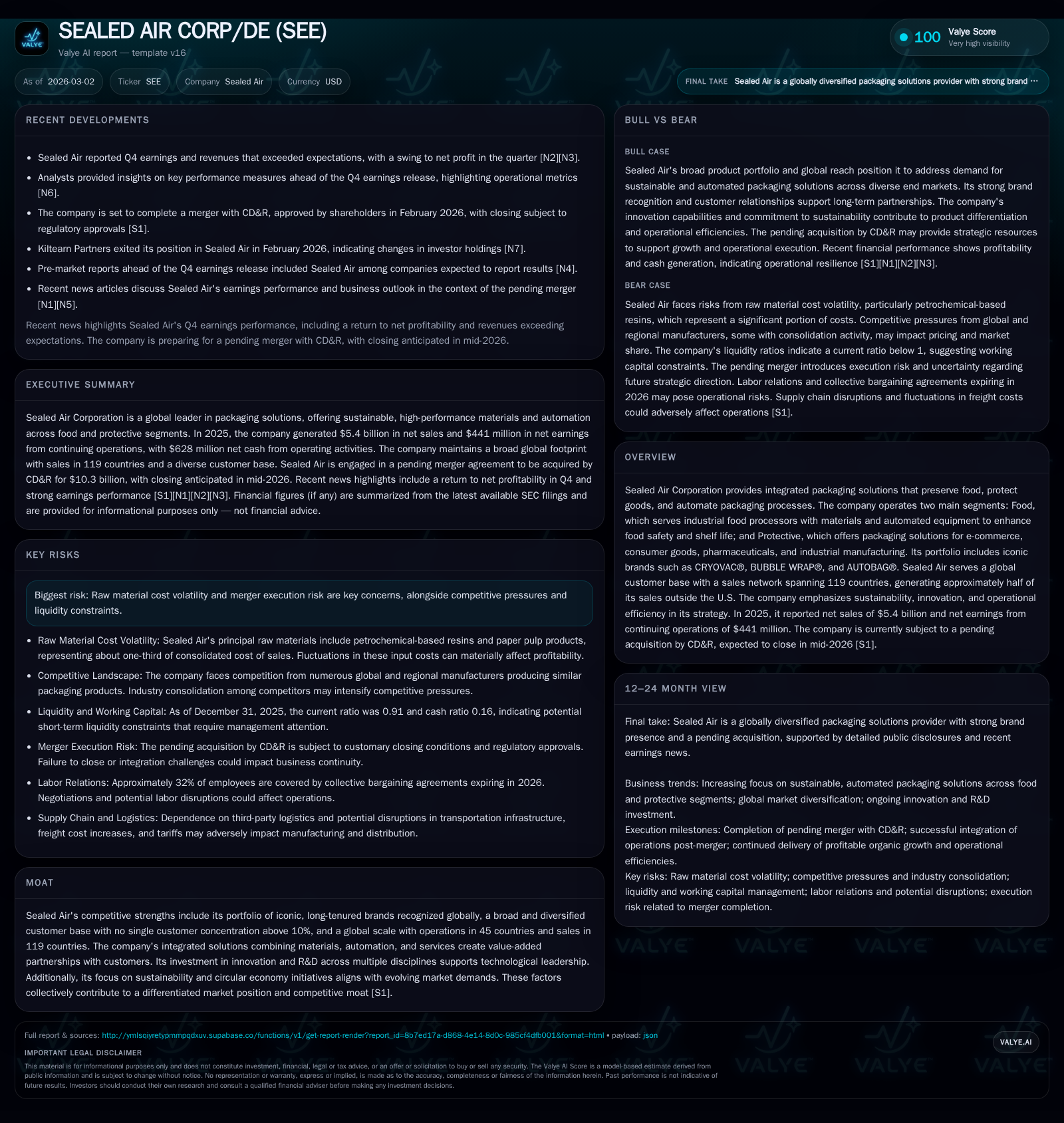
Sealed Air Corporation reported nearly flat net sales of $5.36 billion in 2025, reflecting a slight volume decline across both Food and Protective segments. Operating income moderated to $726 million while net income surged to $506 million, aided by tax benefits and debt management. The company remains focused on automation, sustainability, and innovation while navigating input cost pressures and integration risks related to its pending $10.3 billion acquisition by CD&R. Strong cash flow generation supports capital expenditures of approximately $170 million and steady dividend payouts, with zero share repurchases year-over-year. Going forward, regulatory approvals for the merger and input cost trajectory will be key milestones to monitor.
Historical Performance and Growth Drivers
Sealed Air Corporation, a leading provider of integrated packaging solutions including preservation materials, protective cushioning, and automated systems, reported near-stable revenues in fiscal year 2025 despite macroeconomic headwinds [F1][S1]. Net sales totaled approximately $5.36 billion, marking a modest decline of 0.6% relative to the prior year’s $5.39 billion [F1]. This dip largely reflected volume decreases across both its two main segments — Food and Protective — stemming from ongoing recovery challenges in the Protective business within North America and softer demand in certain industrial food-processing verticals [S1][S9].
Operating income also saw a slight contraction of 1.4%, totaling roughly $726 million compared with about $736 million in 2024 [F1]. Nevertheless, net income from continuing operations more than doubled, reaching $506 million in 2025 versus $265 million in the previous year [F1]. This improvement was driven primarily by favorable tax developments and effective debt management reducing interest expenses [S1][S18].
The company maintained a strong operating cash flow (CFO) generation profile at approximately $628 million for the year, down about 14% from $728 million in 2024 but sufficient to cover investments and sustain dividend payments [F1][S18]. Capital expenditures were reduced notably by 23%, from roughly $220 million to $170 million as part of prudent balancing between growth investments and financial discipline [F1][S18]. Free cash flow — defined as CFO less capex — stood near $458 million [F1].
Sealed Air’s balance sheet strengthened relative to equity that climbed substantially from about $625 million to almost $1.24 billion by end-2025 [F1], reflecting deleveraging efforts as total debt decreased from approximately $4.4 billion to about $4 billion during the year [F1][S19]. The company ended with a liquidity position bolstered by cash reserves of approximately $344 million evenly split between domestic holdings and overseas balances largely unrestricted for operational needs [S8].
No share repurchase activity took place throughout the year despite prior moderate buybacks totaling nearly $80 million in 2023 [F1][S18]. Instead, capital returned to shareholders flowed through consistent dividends paid at around $119 million annually over recent years [F1], reflecting a focus on maintaining payout stability amid ongoing strategic initiatives.
Business Overview: Segments and Market Positioning
Sealed Air operates two reportable segments: Food solutions targeting industrial food processors with materials designed to extend shelf life and enhance safety; and Protective solutions focusing on cushioning products widely used across e-commerce, logistics, pharmaceuticals, and consumer goods sectors [S1][S9][S13]. Iconic brand assets such as CRYOVAC® barrier films for food preservation, BUBBLE WRAP® cushioning products, LIQUIBOX® liquid handling systems, and AUTOBAG® automated packaging equipment underpin customer loyalty globally.
The company sells directly largely in the Food segment while leveraging distributors extensively in Protective markets (circa 60% via channels) [S9][S13]. Importantly, no single customer accounted for more than 10% of consolidated revenue over the last three years evidencing broad diversification [S9]. Approximately 45% of Food sales are formula-based pricing contracts that lag raw material costs by an average six months primarily across North America and APAC regions [S9], which partially mitigates margin erosion from sudden petrochemical feedstock price swings.
Industry Context: Innovation Amid Cost Pressures
Competition is intense against global manufacturers offering plastic films, molded pulp cushions, foam packaging alternatives, corrugated products, and complete integrated systems tailored for automation or sustainability attributes [S9][S22]. Innovation is central — Sealed Air invested nearly $82 million into R&D during 2025 encompassing food science advancements, material engineering including recycled content development, digital printing technologies for packaging personalization, software-enabled automation controls, and microbiology applications for food safety [S17].
Raw material costs remain volatile with petrochemical resin input prices being significant cost drivers constituting around one-third of total production expenses [S22]. Supply chain constraints including transportation disruptions add cost uncertainty although geographical diversification spanning operations in over 45 countries helps smooth localized shocks [S9][S12].
Pending Merger: Strategic Implications and Risks
On November 16, 2025 Sealed Air entered into a definitive merger agreement with CD&R affiliated Sword Purchaser LLC valued at a total enterprise consideration of approximately $10.3 billion paid fully in cash [S1][S3]. The transaction—subject to customary regulatory approvals already favored by early antitrust clearance—and shareholder vote passed February 25th—is expected to close contingent on remaining conditions such as absence of material adverse effect events [S1].
While this buyout offers potential benefits such as access to private equity operational expertise and direct investment capacity enhancing innovation rate or expansion initiatives—there exists inherent execution risk common with large transactions including integration challenges alongside financing environment uncertainties given prevailing credit market dynamics [S10][S14]. Increased leverage levels due to acquisition funding could pressure credit ratings which are currently mixed investment grade for secured instruments but speculative below investment grade for unsecured debt post-announcement [S6][S19].
Capital Allocation Strategy: Balancing Growth With Strengthening Financials
Sealed Air emphasizes disciplined capital allocation aimed at generating profitable organic growth while maintaining an attractive return on invested capital (ROIC) complemented by shareholder returns via dividends rather than buybacks currently withheld pending strategic clarity post-merger [S25][F1]. The approximate return on equity calculated from last annual net income over equity stands robust near 41%, indicative of efficient capital deployment albeit influenced by current equity base expansion post-debt reduction efforts [F1].
Liquidity forecasts remain adequate with revolving credit facility availability intact at one billion dollars unused plus access to accounts receivable securitization programs providing flexibility amid fluctuations in working capital tied partly to changes in customer seasonality patterns — typically slower first quarter cadence followed by pickup ahead of holiday fulfilment surges impacting the Protective segment especially [S6][S12][S22].
What To Watch Forward (Analysis)
Absent explicit company guidance beyond headline merger milestones released through SEC filings no formal earnings forecast has been disclosed yet—observers should monitor:
- Successful completion of merger including final regulatory approvals and financing closure.
- Raw material resin pricing trends impacting margin recovery or erosion given lagged price contracts.
- Innovations continuing delivery into automation solutions that target labor shortages particularly across developed food processing regions.
- Integration progress relative to CD&R’s track record managing industrial packaging assets.
- Dividend stability under new ownership structures or potential return-of-capital policy changes.
- Effects of global trade policies or tariffs especially affecting cross-border supply chains given geopolitical complexities outlined broadly in risk disclosures.
Summary Table: Key Annual Financials (USD millions)
Historical performance (annual)
| FY | Rev ($bn) | Net ($mm) | CFO ($mm) | OpInc ($mm) | Rev YoY | Net YoY |
|---|---|---|---|---|---|---|
| 2025 | 5.4 | 506 | 628 | 726 | -0.6% | +91.0% |
| 2024 | 5.4 | 265 | 728 | 736 | -1.8% | -22.5% |
| 2023 | 5.5 | 342 | 516 | 755 | -2.7% | -30.5% |
| 2022 | 5.6 | 492 | 613 | 945 |
Source: SEC companyfacts cache [F1].
Capital returns and efficiency (annual)
| FY | Div ($mm) | Buybacks ($mm) | FCF ($mm) |
|---|---|---|---|
| 2025 | 119 | 0 | 459 |
| 2024 | 118 | 0 | 508 |
| 2023 | 118 | 80 | 272 |
| 2022 | 119 | 280 | 376 |
Source: SEC companyfacts cache [F1]. | Note: Revenue YoY compares current year vs prior year; Net YoY shows net income annual change percentage based on reported data.[F1]
Disclaimer: This analysis is informational only based on publicly available data up to March 2nd, 2026, including SEC filings and news sources cited herein; it does not constitute investment advice or recommendations regarding securities of Sealed Air Corporation or its affiliates.
Disclaimer: This is research-only, informational analysis and not investment advice. It may include AI-generated interpretation and general industry context. Always verify important details using primary sources.

Comments