
How Spok Leverages Its Healthcare Communication Moat Amid Sector Challenges
Spok Holdings combines legacy wireless infrastructure with integrated clinical communication software to maintain a resilient position in evolving healthcare workflows.
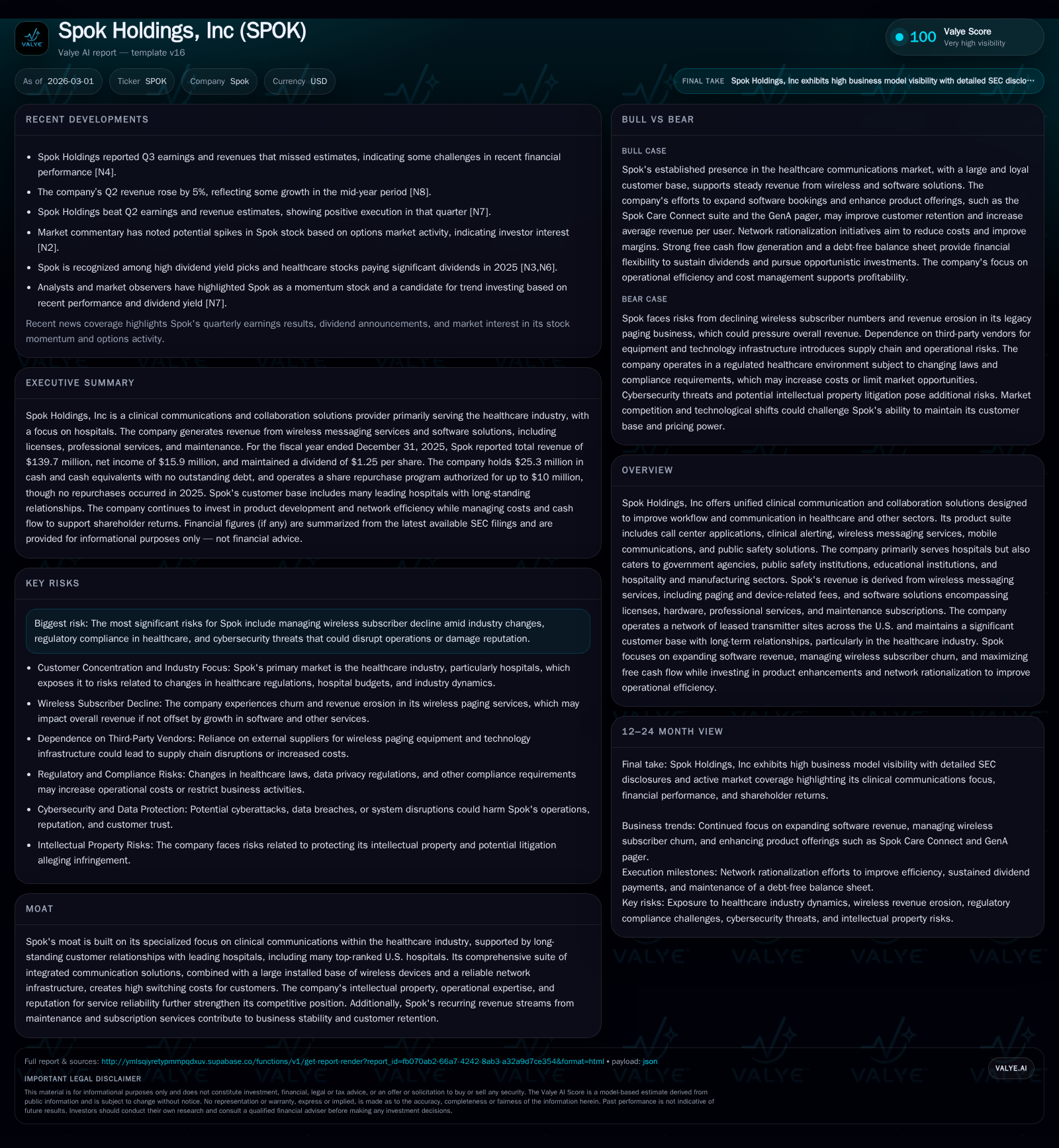
Spok Holdings, Inc operates a specialized clinical communications platform primarily serving the healthcare industry, blending legacy paging networks with software-based collaboration tools. Revenue showed a slight decline while operating and net income margins improved, reflecting operational efficiencies and cost control. Future growth depends on expanding software adoption and managed services, offsetting declines in wireless subscribers; disciplined capital allocation supports consistent dividends backed by strong free cash flow. Key indicators include subscriber trends, client integrations, and investments in network consolidation and cybersecurity.
Historical Performance: Tracking Revenue and Profit Dynamics
Spok Holdings has maintained relative top-line stability with a slight downward trend during changing market conditions. Annual revenue declined by approximately 0.9% year-over-year as of FY2025 [F1], reflecting decreases in wireless messaging demand partially offset by gains in software offerings. Despite this, operating income increased by 3.9% to $19.7 million, while net income rose by 6.1% to $15.9 million due to operational efficiencies and cost discipline [F1].
Operating cash flow remained stable at approximately $28.9 million for FY2025 compared to the prior year, supporting liquidity [F1]. Capital expenditures increased about 17%, mainly directed toward network maintenance and software development [F1]. The resulting free cash flow was roughly $25.2 million, reinforcing financial flexibility.
Historical performance (annual)
| FY | Net ($mm) | CFO ($mm) | OpInc ($mm) | Capex ($mm) | Net YoY |
|---|---|---|---|---|---|
| 2025 | 16 | 29 | 20 | 4 | +6.1% |
| 2024 | 15 | 29 | 19 | 3 | -4.5% |
| 2023 | 16 | 26 | 21 | 3 | -28.3% |
| 2022 | 22 | 6 | 0 | 4 |
Source: SEC companyfacts cache [F1].
Capital returns and efficiency (annual)
| FY | FCF ($mm) | ROE% |
|---|---|---|
| 2025 | 25 | 10.8 |
| 2024 | 26 | 9.7 |
| 2023 | 23 | 9.6 |
| 2022 | 3 | 12.7 |
Source: SEC companyfacts cache [F1].
Rev YoY %, OpInc YoY %, etc., represent year-over-year changes; revenue amounts for recent years are not available in the data source.
Operational Drivers Behind Financial Trends
Spok's revenue is derived primarily from two sources: wireless messaging services—covering traditional paging fees and device sales—and software solutions encompassing licenses, maintenance subscriptions, professional services, and hardware sales [S4][S19]. Wireless revenues revolve around one-way or two-way messaging services offered locally to nationally for healthcare providers, often bundled with device agreements [S2]. Software revenues benefit from license arrangements combined with managed services that provide implementation support and ongoing system upkeep—helping establish recurring revenue streams [S8].
Cost containment efforts are evident through reductions in technology operations expenses driven by site lease consolidations alongside improved sales productivity to sustain unit placements despite wireless subscriber losses [S9][S17]. Compliance with healthcare regulations adds operational overhead.
Core Business Segment: Clinical Communication Solutions
Though reported as a single segment for management purposes [S4], Spok integrates its wireless infrastructure with an expanding clinical communication software suite tailored for complex hospital workflows [S21][S26]. Solutions include secure texting platforms, clinical alerting systems, and call center applications enabling centralized communication critical to patient care coordination.
The legacy paging network remains essential for emergency notifications due to its reliability; Spok operates approximately 2,869 active transmitters leased across U.S.-based broadcast towers ensuring broad coverage [S1]. Customer preferences are shifting towards richer software-driven communication tools offering enhanced collaboration beyond simple messaging.
This blend of proven network resilience with enterprise-grade software creates high switching costs linked to integration complexity and embedded workflows—the foundation of Spok’s healthcare market moat.
Growth Outlook and Industry Headwinds
Growth prospects focus on accelerating adoption of Spok’s unified clinical communication platform amid declining paging subscribers [S23]. Targeting smaller hospitals alongside large medical centers aims to shorten sales cycles while expanding managed services extends contract durations and smooths revenue recognition.
Challenges include rigorous healthcare regulatory compliance increasing operational burden; heightened cybersecurity risks threatening service disruption or reputational harm; plus technological obsolescence pressures on traditional wireless revenues necessitating continued innovation investments [S23].
Mitigation efforts include network consolidations preserving coverage quality while reducing costs and investments in host-based software enhancing clinical collaboration capabilities—supporting sustainable growth amid digital transformation.
Key Milestones & Monitoring Metrics
While specific forward guidance is limited publicly [S3], key indicators include:
- Subscriber count trends assessing net disconnects versus activations impacting wireless revenue sustainability.
- New hospital partnerships or expansions signaling market penetration.
- Capital expenditure efficiency aligned with network rationalization without compromising service.
- Quarterly dividend declarations reflecting cash distribution confidence.
- Backlog growth in professional services indicating future revenue visibility. Tracking these will gauge how well Spok balances its transition from legacy paging toward modern clinical communications.
Capital Allocation: Dividends & Cash Flow
Spok maintains disciplined capital management marked by consistent dividends totaling roughly $26.8 million annually including payouts related to restricted stock units under its Equity Plan—equating to about $1.25 per share per year sustained over time [F1][S24]. Operating cash flows robustly support these distributions; FY2025 operating cash flow stood near $28.9 million against $3.75 million capex yielding free cash flow above $25 million demonstrating solid internal generation capacity [F1].
Despite a Board-authorized share repurchase program up to $10 million since February 2022, recent buybacks have been minimal indicating prioritization of dividends over repurchases consistent with maintaining yield appeal amid slow core market growth [F1][S12][S24].
Balance Sheet & Liquidity Position
As of December 31, 2025, Spok held $25.3 million in cash and equivalents with current assets near $57.9 million against current liabilities about $49.1 million producing a current ratio of approximately 1.18—a comfortable liquidity buffer for short-term obligations [F1][S10].
The extensive transmitter network comprises nearly three thousand active leased sites across multiple states facilitating dependable message delivery—an essential asset underpinning customer retention amid technological shifts [S1][S14]. Lease terms vary generally between one month to five years; management actively pursues lease consolidations seeking cost savings without sacrificing coverage quality alongside relocating corporate headquarters from Virginia to Texas in late 2024 [S1][S24].
Risks & Regulatory Considerations
Key risks include:
- Wireless Subscriber Decline: Ongoing erosion of paging subscribers could pressure recurring revenues despite contract retention efforts within core healthcare clients [S23].
- Healthcare Regulatory Compliance: Operating within heavily regulated environments requires substantial investments to maintain HIPAA compliance; failures risk legal or financial penalties.
- Cybersecurity Threats: As a critical communications provider for clinical environments including emergencies, vulnerabilities could cause outages or breaches undermining trust necessitating proactive defenses.
- Market Evolution & Switching Costs: High switching costs currently support client stickiness but may slow adoption of emerging alternatives risking long-term relevance if innovation lags competitors. These underscore the need for vigilant risk management coupled with agile product development aligned with evolving healthcare needs.
This analysis synthesizes publicly available SEC filings up to early 2026 augmented by recent disclosures but does not speculate beyond documented data.
Disclaimer: This is research-only, informational analysis and not investment advice. It may include AI-generated interpretation and general industry context. Always verify important details using primary sources.

Comments