
How TriCo Bancshares Balances Technological Challenges With Shareholder Returns
TriCo Bancshares’ consistent earnings growth is underpinned by disciplined capital allocation and risk management within a competitive California banking market.
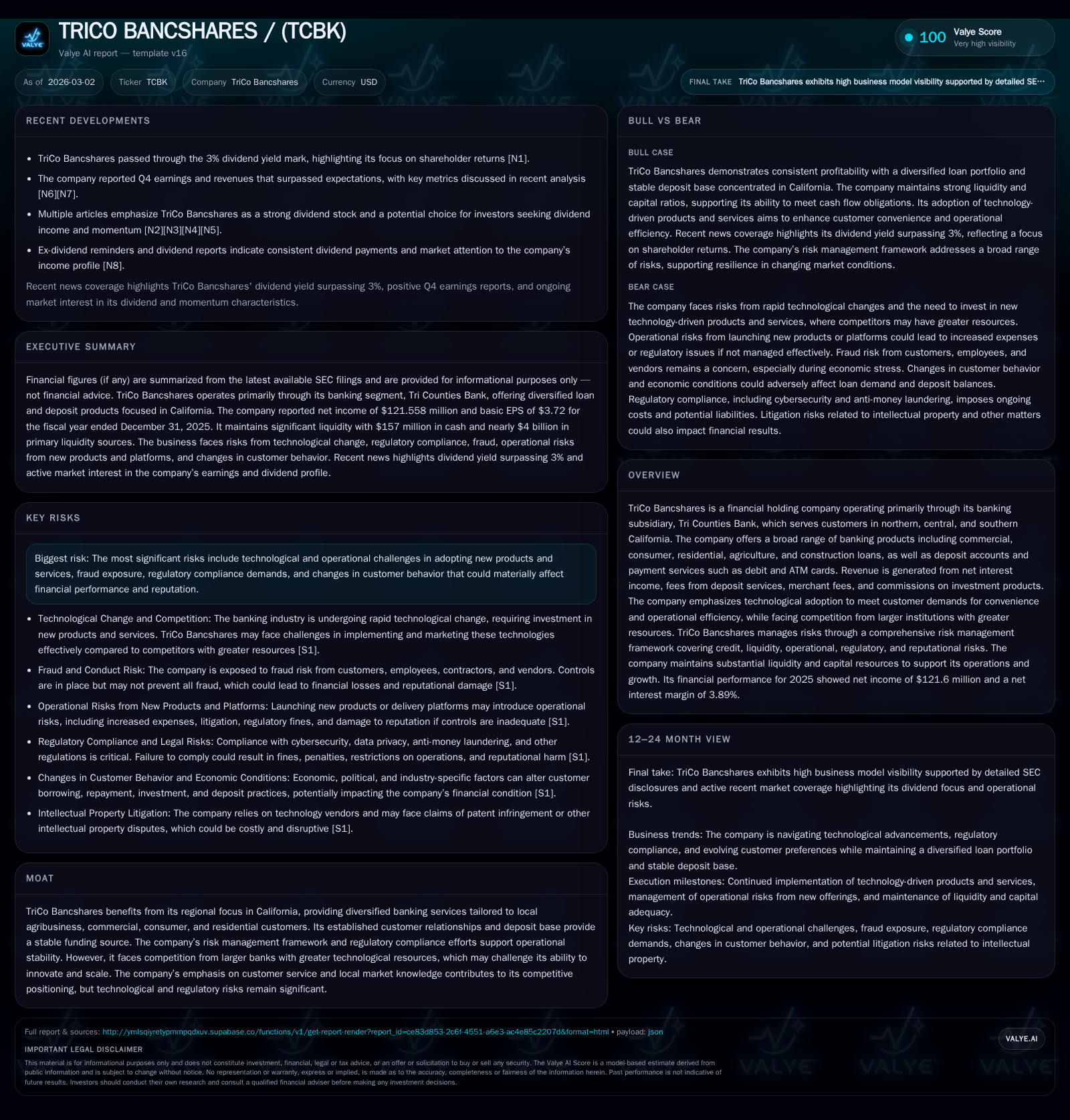
TriCo Bancshares, through its banking subsidiary Tri Counties Bank, demonstrated steady net income growth in recent years driven by loan portfolio expansion and diversified fee income. The company faces competitive pressure from larger banks with deeper technology budgets yet pursues selective technological adoption to meet evolving customer demands. Capital allocation remains disciplined, featuring growing dividends and share repurchases supporting shareholder returns. Key risks include regulatory compliance costs and operational risks related to cybersecurity and fraud. Future growth hinges on managing these challenges while leveraging established regional relationships across California’s agricultural, commercial, and residential sectors.
TriCo’s Earnings Growth and Operational Drivers: A Historical Perspective
TriCo Bancshares recorded net income of $121.6 million for fiscal year 2025, marking a solid increase of approximately 5.8% compared with $114.9 million in 2024 [F1]. This upward trajectory reflects sustained expansion in loan balances alongside incremental fee income streams such as deposit service fees and merchant-related commissions. Operating cash flow improved markedly by about 21.5%, reaching $133.3 million in 2025 versus $109.7 million the prior year, signaling effective cost management relative to revenue growth [F1],[N1]. The company’s operational profile benefits from its deep regional penetration within California, harnessing local knowledge to drive commercial lending and consumer banking services.
Expanding Loan Portfolios and Diversified Revenue Streams Amid Regional Market Focus
Tri Counties Bank operates across three primary geographic subdivisions of California: northern, central, and southern regions encompassing 32 counties with 65 traditional branches complemented by nine loan production offices and three in-store branches [S1],[S5]. This layout enables targeted penetration into agricultural enterprises—a key local industry—as well as non-owner occupied commercial real estate ventures and residential lending. Portfolio diversification is notable with segments including commercial loans, agriculture loans, construction loans, consumer loans, and residential mortgages attaining balanced proportions of total assets [S6]. The bank leverages extensive customer relationships typical of regional institutions to promote product uptake beyond loans into deposit accounts and payment services such as debit cards.
Technological Adoption and Competitive Constraints in Regional Banking
While TriCo has undertaken initiatives to enhance digital channels—encompassing mobile, online banking platforms, automated teller capabilities—its scale constraints present challenges compared to national banks equipped with larger technology budgets [S1],[S12]. The company acknowledges risks associated with implementing new platforms including cyberattack exposures underscored by a notable security incident in early 2023 which temporarily disrupted systems and resulted in sensitive information disclosures [S4]. TriCo's branch network optimization strategies may involve selective branch closures or reconfigurations as customer preferences increasingly favor digital convenience over physical interactions; however, this also introduces risks of customer attrition if transitions are not seamless [S1]. Fraud exposure remains an area of vigilance given the complexity of fraud risks arising from multiple stakeholder groups including customers, third parties, employees, and contractors [S11].
Future Growth Outlook and Regulatory Environment Impacts
Looking ahead, TriCo faces a regulatory environment that is evolving towards stricter cybersecurity laws, privacy regulations concerning personally identifiable information (PII), and increased compliance costs—pressures that could constrain operational flexibility or require significant system overhauls should regulations diverge unexpectedly from current practices [S12],[S27]. Amid these headwinds, the firm's capital position remains robust with Common Equity Tier 1 capital ratio comfortably above regulatory minimums at 13.24% as of end-2025 providing room to absorb loan portfolio growth or unexpected contingencies [S5],[S7]. Loan demand will remain sensitive to broader economic cycles prevalent within California while competition for deposit funds intensifies requiring superior customer service execution [S8],[N2].
Capital Allocation Philosophy: Dividends, Buybacks, and Return on Equity
Capital deployment reflects thoughtful balancing between returning cash to shareholders via dividends—recently declared quarterly dividends raise yield beyond the meaningful 3% threshold—and share repurchases executed opportunistically under board-authorized plans [N3],[N4],[S10],[S16]. For fiscal year 2025, dividends paid amounted to $45.0 million while buybacks totaled about $32.0 million representing nearly doubling repurchase activity compared to prior year levels [F1]. This disciplined capital management supports an approximate return on equity (ROE) near 9.2%, a level aligned with moderate risk banking franchises operating regionally without excessive leverage or aggressive growth levers [F1].[N4]
Risk Management Framework: Cybersecurity, Fraud, and Compliance Challenges
The bank maintains an integrated risk management framework covering credit risk controls down to liquidity parameters but places increasing emphasis on operational risk domains encompassing conduct risk mitigation programs addressing fraud detection controls alongside cybersecurity safeguards developed post-2023 criminal cyberattack incident highlighted in filings [S4],[S11],[S27]. Regular internal reviews identify potential compliance issues that may prompt corrective measures including remediation payments to impacted customers; although none have currently risen to material adverse effects at enterprise level noted [S4],[S15]. Conduct risk stemming from employee actions or third-party vendor relations also receives ongoing scrutiny given the reputational stakes involved.
Financial Metrics at a Glance: Key Indicators from Recent Years
Historical performance (annual)
| FY | Net ($mm) | CFO ($mm) | Capex ($mm) | Net YoY |
|---|---|---|---|---|
| 2025 | 122 | 133 | 5 | +5.8% |
| 2024 | 115 | 110 | 5 | -2.1% |
| 2023 | 117 | 139 | 5 | +223.0% |
| 2022 | 36 | 163 | 4 |
Source: SEC companyfacts cache [F1].
Capital returns and efficiency (annual)
| FY | Div ($mm) | Buybacks ($mm) | FCF ($mm) |
|---|---|---|---|
| 2025 | 45 | 32 | 128 |
| 2024 | 44 | 16 | 105 |
| 2023 | 40 | 9 | 134 |
| 2022 | 36 | 27 | 159 |
Source: SEC companyfacts cache [F1].
Free cash flow (operating cash flow minus capex) stood at approximately $128 million in FY2025 reflecting healthy internal funding capacity for operations or capital returns without eroding liquidity reserves [F1]. The balance sheet showed equity growth consistent with retained earnings accumulation supporting capital ratios.
What Investors Should Monitor Going Forward
Key indicators include how effectively TriCo manages ongoing investments in technology platforms amid intensifying competition for digital-first consumers alongside any shifts in credit quality metrics driven by economic conditions in its core service regions across California’s diverse economy [N3],[N7]. Regulatory developments especially related to cybersecurity frameworks will require monitoring given their potentially significant impact on cost structure or permissible business models [S12],[N3]. Dividend policy evolution will bear watching as the company balances shareholder return expectations with capital needs supporting loan portfolio growth; changes here might influence valuation narratives tied to the stock’s momentum appeal after surpassing the notable dividend yield threshold recently reported [N3],[N6]. Finally, operational execution minimizing fraud losses while optimizing branch footprint amidst changing customer engagement trends will be crucial determinants of future performance sustainability.
This analysis is based on publicly available SEC filings and recent news reports as of March 2026; it is intended solely for informational purposes without any investment advice or recommendations.
Disclaimer: This is research-only, informational analysis and not investment advice. It may include AI-generated interpretation and general industry context. Always verify important details using primary sources.

Comments