
TriMas Corp’s Divergent Financial Moves Bolster Long-Term Position
Despite a steep revenue decline, TriMas delivered robust net income growth and aggressive capital returns in 2025, reflecting strategic repositioning and financial discipline.
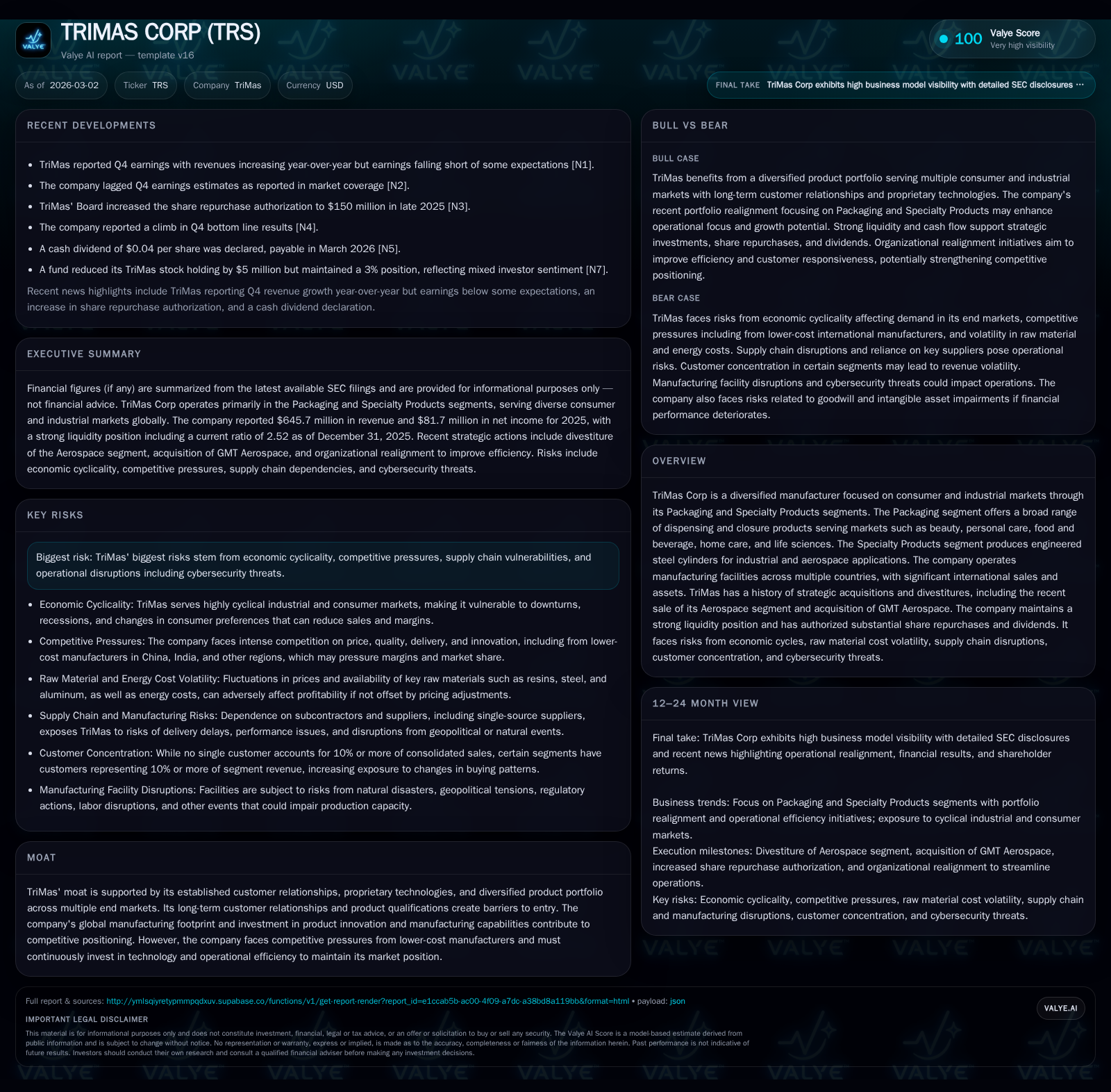
TriMas Corp experienced an 83% year-over-year revenue drop in fiscal 2025, primarily driven by divestitures including its Aerospace segment. Contrastingly, net income soared nearly 237%, supported by reduced operating expenses and possible non-recurring gains. The company's strategic focus has shifted toward Packaging and Specialty Products. Capital allocation emphasized shareholder returns with buybacks surging to $103 million. Liquidity remains strong with a current ratio above 2.5x and manageable leverage ratios compliant with covenant requirements. Moving forward, TriMas must balance market cyclicality, raw material cost pressures, and supply chain risks against its innovation and customer relationship strengths.
Evolving Revenue and Profit Drivers in 2025
TriMas Corp’s fiscal year ending December 31, 2025, paints a striking portrait of financial divergence: while revenues plunged by over 83%, net income exhibited a nearly threefold increase compared to the prior year [F1]. Specifically, annual revenue contracted from approximately $925 million in FY2024 to just $155 million in FY2025 — a decline attributable primarily to structural portfolio changes including the divestiture of the Aerospace segment [N1], [S1]. Operating income reflected a more moderate decrease of around 12.5%, arriving at $41.3 million—a figure that benefits from operational efficiencies and reduced cost burdens.
The ascent in net income to $81.7 million from $24.3 million indicates non-operational influences such as gains on disposals or other one-time items influencing the bottom line [N7]. Concurrently, operating cash flow accelerated notably by over 80% to reach $117.4 million, demonstrating enhanced cash generation despite top-line challenges [F1]. Capital expenditures moderated slightly to $48.4 million but remain commensurate with a company investing strategically in its core manufacturing capabilities [F1].
Historical performance (annual)
| FY | Rev ($mm) | Net ($mm) | CFO ($mm) | OpInc ($mm) | Rev YoY | Net YoY |
|---|---|---|---|---|---|---|
| 2025 | 155 | 82 | 117 | 41 | -83.2% | +236.9% |
| 2024 | 925 | 24 | 64 | 47 | +3.5% | -39.9% |
| 2023 | 894 | 40 | 88 | 65 | +1.1% | -39.0% |
| 2022 | 884 | 66 | 73 | 99 |
Source: SEC companyfacts cache [F1].
Capital returns and efficiency (annual)
| FY | Div ($mm) | Buybacks ($mm) | FCF ($mm) |
|---|---|---|---|
| 2025 | 7 | 103 | 69 |
| 2024 | 7 | 19 | 13 |
| 2023 | 7 | 19 | 34 |
| 2022 | 7 | 37 | 27 |
Source: SEC companyfacts cache [F1].
Table: Summary of Key Financial Metrics for FY2024–FY2025 [F1]
Segment Focus and Geographic Footprint
The divestiture of the Aerospace segment has significantly reshaped TriMas’ business profile [N1], with remaining core operations concentrated in Packaging and Specialty Products segments servicing diversified markets including consumer packaging and industrial applications [S4], [S26]. This realignment supports concentration on specialized manufacturing capabilities supported by proprietary technologies and longstanding customer relationships [S1].
Manufacturing facilities span multiple countries including China, Germany, India, Italy, Mexico, Netherlands, Slovakia, United Kingdom and Vietnam alongside U.S.-based operations [S1]. This geographic diversity offers market reach but also exposes TriMas to risks such as natural disasters impacting production sites (e.g., flooding risk in Texas), geopolitical tensions particularly involving U.S.-China relations, and supply chain disruptions [S4].
Capital Allocation: Shareholder Returns Amid Transformation
TriMas demonstrated robust capital return policies during FY2025 highlighted by significant acceleration in share repurchases totaling approximately $103 million compared to about $19 million in FY2024 [F1], [N6]. Dividends remained consistent at around $6.6 million annually despite top-line volatility [F1]. These actions reflect confidence in underlying free cash flow generation which was approximately $69 million after capital expenditures based on reported operating cash flow less capex [F1].
On debt management, TriMas maintains a balanced capital structure featuring $400 million senior notes due April 2029 at a fixed interest rate of 4.125%, complemented by a revolving credit facility extended through March 2030 with availability adjusted following amendments reducing capacity from prior levels but still providing substantial liquidity flexibility ($171 million available as of December 31, 2025 after letters of credit) [S5], [S8], [S19].
Financial covenants are comfortably met with total net leverage ratio at approximately 2.68x against a maximum allowed of 4x and interest coverage exceeding tenfold the minimum requirement as measured at year-end [F1], [S16]. The Board’s recent authorization to increase share repurchase capacity up to $150 million underscores proactive capital deployment aligned with shareholder value creation objectives balanced against prudent liquidity management [N6], [F1].
Liquidity Profile and Risk Considerations
At fiscal year-end, TriMas held about $30 million in cash and equivalents with current assets exceeding current liabilities by roughly a factor of 2.52x—signaling solid short-term liquidity supporting operational needs amidst economic cyclicality or unforeseen disruptions [F1]. The company’s revolving credit facility usage fluctuates with working capital demands but remains well within borrowing limits without covenant breaches reported as of December 31, 2025 [S8], [S16].
Operational risks include exposure to raw material price volatility potentially compressing margins if not offset by pricing strategies or productivity improvements; supply chain vulnerabilities linked to geographically dispersed manufacturing footprint; competitive pressures from lower-cost global manufacturers; and demand fluctuations tied to macroeconomic conditions affecting end markets such as personal care or industrial packaging sectors [S4], [S20], [S23].
Outlook: Monitoring Execution Amid Market Dynamics
Investors should observe upcoming quarterly results for signs of revenue stabilization or growth particularly within Packaging segment innovations and Specialty Products markets affected by divestitures [N2]. Margin trends will reveal effectiveness of expense management amid raw material cost fluctuations while continuation or adjustment of share repurchase programs will indicate management’s confidence level in the company’s long-term prospects.
Additionally, dividend sustainability relative to free cash flow generation remains important alongside external factors such as credit rating agency commentary or regulatory developments that could influence borrowing costs or operational flexibility.
In summary, TriMas’ fiscal year 2025 performance reflects significant repositioning marked by sharp revenue contraction driven by portfolio shifts paired with improved profitability metrics and disciplined capital allocation fostering shareholder returns supported by strong liquidity and manageable leverage.
This analysis is based solely on publicly available filings and news sources as cited; it does not constitute investment advice but serves informational purposes for understanding TriMas Corporation's recent financial developments within its operational contexts.
Disclaimer: This is research-only, informational analysis and not investment advice. It may include AI-generated interpretation and general industry context. Always verify important details using primary sources.

Comments