
Twist Bioscience Advances Synthetic DNA Platform While Managing Operational Losses
Innovative silicon-based synthesis drives product expansion amid ongoing financial challenges.
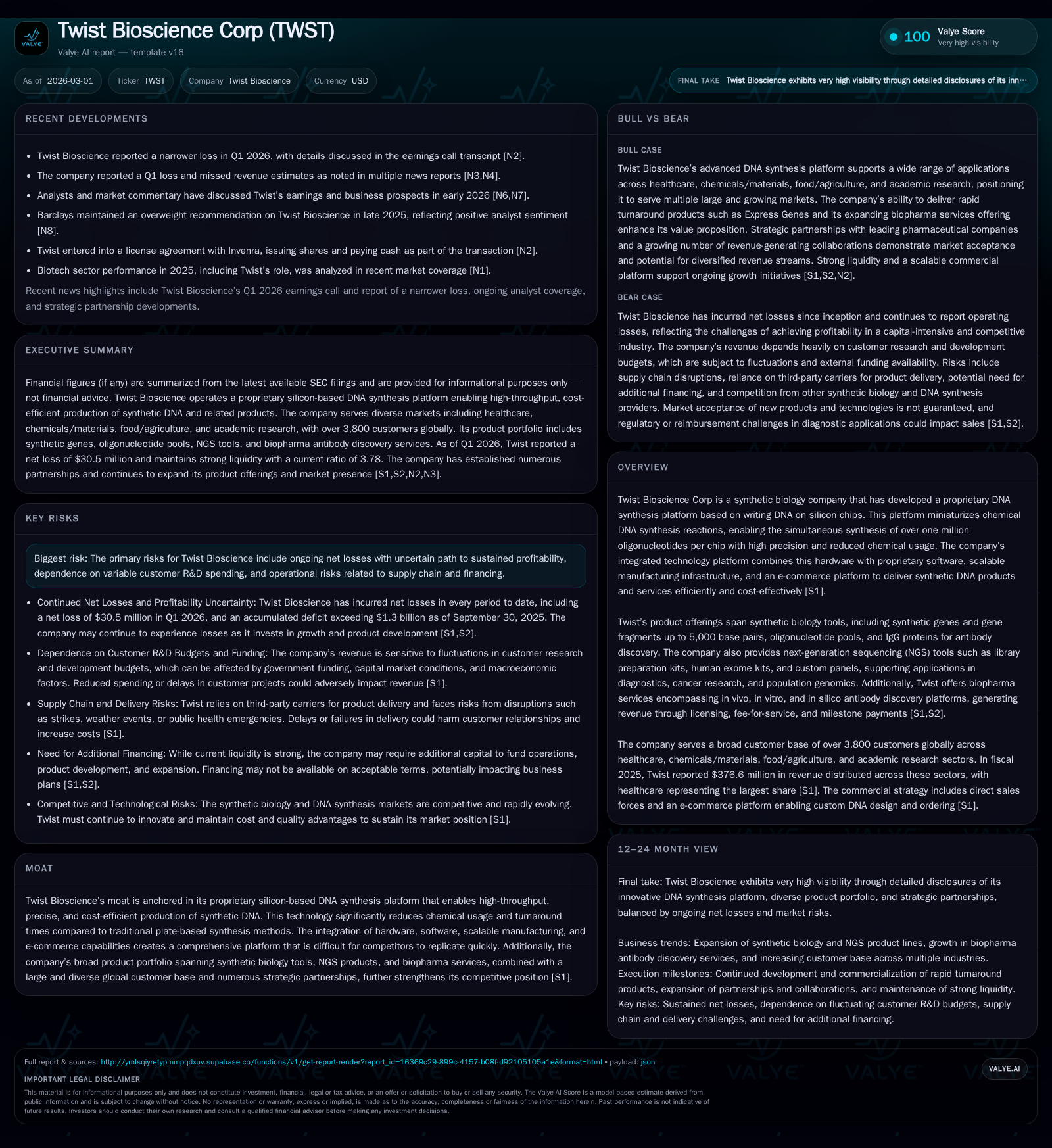
Twist Bioscience Corp leverages its proprietary silicon chip DNA synthesis platform to achieve differentiated growth across synthetic biology, next-generation sequencing (NGS) tools, and biopharma services. Despite notable revenue gains and technology-driven efficiencies, the company continues to record significant net losses and negative operating cash flow owing to heavy ongoing investments in R&D, market expansion, and operational scaling. Future growth hinges on broadening market adoption, expanding antibody discovery services through strategic partnerships such as Invenra, and managing supply chain and competitive pressures in a complex industry landscape.
Company Overview and Technology
Twist Bioscience Corp operates at the forefront of synthetic biology with a pioneering technology platform that synthesizes DNA directly on silicon chips [S1]. The company miniaturizes traditional chemical DNA synthesis reactions to produce over one million oligonucleotides per chip—each roughly the size of a large mobile phone—with remarkable precision while reducing chemical consumption by nearly 99.8% compared to plate-based synthesis [S1]. This proprietary integration of chemistry, fluidics, automation hardware, software algorithms, scalable manufacturing infrastructure, and a streamlined e-commerce platform establishes an end-to-end solution facilitating rapid order placement, real-time pricing quotes, and efficient delivery [S4], [S12].
Beyond individual oligonucleotides, Twist manufactures synthetic genes ranging up to 5,000 base pairs along with tools tailored for next generation sequencing (NGS), including sample preparation kits and human exome enrichment panels. It also extends into IgG proteins used in antibody discovery workflows within biopharma [S1], [S11]. This diversification reflects a strategic effort to serve expansive markets spanning healthcare research and drug development to industrial chemicals/materials, agriculture biotech innovations, and academia [S4], [S19].
Historical Growth and Financial Performance
The company has demonstrated substantial revenue growth over recent years driven principally by adoption in healthcare applications (notably drug discovery and diagnostics), chemicals/materials specialty production (e.g., spider silk analogs), academic research use cases, and smaller contributions from food/agriculture sectors [S4], [S19]. Notably in fiscal year 2025, Twist recorded $376.6 million in total revenue distributed primarily between healthcare ($215.1 million) and chemicals/materials ($93.2 million) segments alone [S4], [S19].
However, profitability remains elusive. Operating income improved year-over-year from a loss of $220.8 million in FY2024 to about -$136.3 million in FY2025—a significant 38% improvement—but still substantially negative while net losses narrowed from approximately -$208.7 million to -$77.7 million for the same period [F1]. Operating cash flow similarly improved yet stayed negative at roughly -$47.6 million in FY2025 compared to -$64.1 million previously [F1]. Capital expenditures rose sharply by over fourfold year-over-year ($28.0 million versus $5.1 million), reflecting investments aimed at expanding manufacturing capacity and technology development [F1]. Equity declined somewhat sequentially but remains robust at nearly $473 million by FY2025 year-end [F1]. The company maintains a strong liquidity position as evidenced by a current ratio near 3.78x at December 31, 2025 [F1], signaling ample working capital against short-term liabilities.
Historical performance (annual)
| FY | Net ($mm) | CFO ($mm) | OpInc ($mm) | Capex ($mm) | Net YoY |
|---|---|---|---|---|---|
| 2025 | -78 | -48 | -136 | 28 | +62.8% |
| 2024 | -209 | -64 | -221 | 5 | -2.0% |
| 2023 | -205 | -142 | -217 | 28 | +6.1% |
| 2022 | -218 | -124 | -235 | 102 |
Source: SEC companyfacts cache [F1].
Capital returns and efficiency (annual)
| FY | FCF ($mm) | ROE% |
|---|---|---|
| 2025 | -76 | -16.4 |
| 2024 | -69 | -44.2 |
| 2023 | -170 | -32.8 |
| 2022 | -226 | -27.6 |
Source: SEC companyfacts cache [F1].
Note: Revenue detailed breakdown only available for FY2025; prior-year revenue figures not reported explicitly.
Product Portfolio and Market Segments
Twist’s synthetic biology portfolio includes custom synthetic genes/gene fragments widely used by biotech/pharma companies conducting therapeutic discovery programs as well as chemical/material firms creating sustainable specialty compounds such as biodegradable nylon alternatives or novel fragrances that mimic natural products at high precision [S4], [S19]. Academic institutions also leverage the products for gene editing research and basic molecular biology investigations.
The NGS suite encompasses library preparation kits optimized for liquid biopsy testing modalities including minimal residual disease (MRD)—a growing clinical application where assay sensitivity is paramount—alongside human exome capture reagents vital for population genomics research [S1], [S11]. These products bridge fundamental research tools with emerging diagnostic workflows.
In parallel, Twist’s biopharma services provide comprehensive antibody discovery utilizing integrated "discovery trifecta" platforms combining in vivo, in vitro and computational approaches enabling rapid lead identification enhanced by AI-derived analytics underpinned by extensive characterization assays [S11]. These capabilities are bolstered through partnerships with leading pharmaceutical companies worldwide such as Bayer and Takeda [S10], underpinning recurring collaboration-driven revenue streams.
Growth Prospects and Strategic Developments
Twist aims to grow primarily via expansion of its customer base beyond the current ~3,800 global clients across multiple industries while deepening penetration into existing accounts through upselling complementary products and services [S4], [S7]. It pursues new market opportunities including mRNA and protein synthesis leveraging the same core silicon writing technology platform.
A significant recent milestone is the strategic partnership with Invenra Inc., announced February 2026, wherein Twist agreed on licensing terms entailing issuance of common shares totaling over 600K along with a $5 million cash payment for transfers of technologies that enhance their antibody discovery platform capabilities [N3], [S27]. This move is positioned to strengthen biopharma services via access to expanded antibody engineering toolsets.
On the NGS front, growth is anticipated from increasing clinical adoption of liquid biopsy tests where Twist samples serve critical quality control roles; however reimbursement risks exist as coverage policies evolve regionally in complex regulatory environments especially concerning MRD applications [S28].
Further organic growth depends upon maintaining leadership in synthetic DNA cost-efficiency while broadening product complexity—such as extended oligo lengths or combinatorial libraries—and improving automation throughput to reduce turnaround times relative to competitors like GenScript or Integrated DNA Technologies who possess deeper legacy distribution channels but lack fully integrated chip-based platforms that combine hardware/software/e-commerce advantages in-house.
Returns and Capital Allocation
Currently Twist Bioscience operates without dividend payments or share repurchases preferring reinvestment into R&D capacity buildouts and product innovation programs consistent with its pre-profit growth stage status [S8], [S17]. Based on FY2025 financials an approximate return on equity is negative ~16%, calculated from net losses relative to shareholders’ equity around $473M as of September 30, 2025 [F1]. Free cash flow remains persistently negative due to capex outlays exceeding operating cash inflow.
Capital stewardship focuses on building out manufacturing automation lines capable of supporting expanded silicon chip production volumes necessary for scale economies coupled with sustaining personnel recruitment especially within R&D functions where headcount exceeded 90 scientists/technologists mid-2025 dedicated solely to process/product improvements leveraging AI-driven optimization among other emerging tools [S22], [S23].
Future financing needs remain an area requiring vigilance given continued net losses; however management's ability to secure financing was supported recently through stock purchase agreements linked with strategic transactions such as those involving Invenra which also introduce board representation rights further aligning interests with partner innovation ecosystems [N3], [S27] .
Competitive Positioning & Risk Factors
Twist’s moat arises from its unique silicon chip-based synthesis that delivers distinct cost advantages through material savings (~99% less reagent use per gene compared to plate methods), faster throughput due to parallelization over millions of oligos per chip alongside integrated e-commerce channels allowing immediate customer self-service ordering—this technical sophistication erects barriers against rivals reliant on legacy synthesis chemistry technologies combined with conventional plate arrays or microfluidic systems lacking such scale precision amalgamation [S1], [S20].
Notwithstanding this moat, the company faces substantial competition from both well-known incumbents like Thermo Fisher Scientific or Illumina in NGS tools spaces as well as specialized contract research organizations (CROs) active in antibody discovery services which wield greater financial resources plus entrenched IP protections complicating entry paths or pricing power for Twist despite superior technology merits [S20]. Customers typically exercise cautious budget allocation impacted by broader biotech funding cycles impacting purchasing behavior unpredictably; no long-term binding volume contracts reduce revenue visibility while client concentration risk persists given dependence on relatively few large customers whose order timing can fluctuate materially causing periodic volatility in revenues recognized quarter-to-quarter or year-to-year [S28], [S29]. Supply chain exposure includes reliance upon singular suppliers for critical equipment components although mitigation efforts exist through reserve inventories or alternate vendor qualification but represent ongoing operational hazards potentially capable of constraining capacity ramp-up momentum if disrupted unexpectedly.
Cybersecurity-related threats present an intangible risk vector given centralized IT systems controlling order processing, inventory management and shipment logistics—any breaches could impair customer confidence or result in regulatory penalties thereby indirectly affecting operational continuity or revenue generation streams negatively[S28].
Furthermore legal risks pertain chiefly to patent infringement claims either asserted against Twist or its suppliers which may lead to litigation costs or forced licensing payments eroding margins if unfavorable judgments occur; intellectual property protection sustainability remains a foundational challenge inherent within fast-moving biotechnology innovation sectors where patent landscapes evolve dynamically constraining certainty beyond short-term horizons[S21],[S25].
What To Watch Next (Analysis)
- Tracking margin trajectory will be critical especially whether operating losses continue narrowing alongside improving gross margins reflective of scaling benefits realized from new manufacturing lines.
- Progression of biopharma service partnerships including pipeline advancements enabled through Invenra acquired tech licenses may signal monetization acceleration opportunities.
- Adoption rates for advanced NGS products tied particularly to liquid biopsy/MRD assays remain susceptible to payer coverage decisions which could have outsized effects considering sizable current contribution segment.
- Management execution on expanding direct sales force globally along with e-commerce enhancements bears watching given six-to-nine month standard onboarding delays before meaningful productivity accrual occurs[S13].
- Monitoring competitive responses particularly price erosion pressures alongside new competitor product introductions will inform sustainability prospects for Twist’s market share gains.
- Capital raising activities or equity issuances associated with partnership deals must be assessed regarding dilution impact versus technology empowerment benefits.
- Supply chain resilience measures must be evaluated post any minor disruptions disclosed in subsequent filings given dependency exposures articulated previously.
This analysis summarizes key aspects drawn exclusively from validated regulatory filings and publicly sourced corporate disclosures without conjecture beyond stated information provided herein.
Disclaimer: This document is prepared solely for informational purposes without offering investment advice or recommendations regarding stock transactions related to Twist Bioscience Corp.
Disclaimer: This is research-only, informational analysis and not investment advice. It may include AI-generated interpretation and general industry context. Always verify important details using primary sources.

Comments