
GeneDx Expands Pediatric Rare Disease Testing with Genomic Data Scale and AI Integration
GeneDx leverages its proprietary genomic dataset and AI to drive growth in exome and genome sequencing despite regulatory and operational challenges.
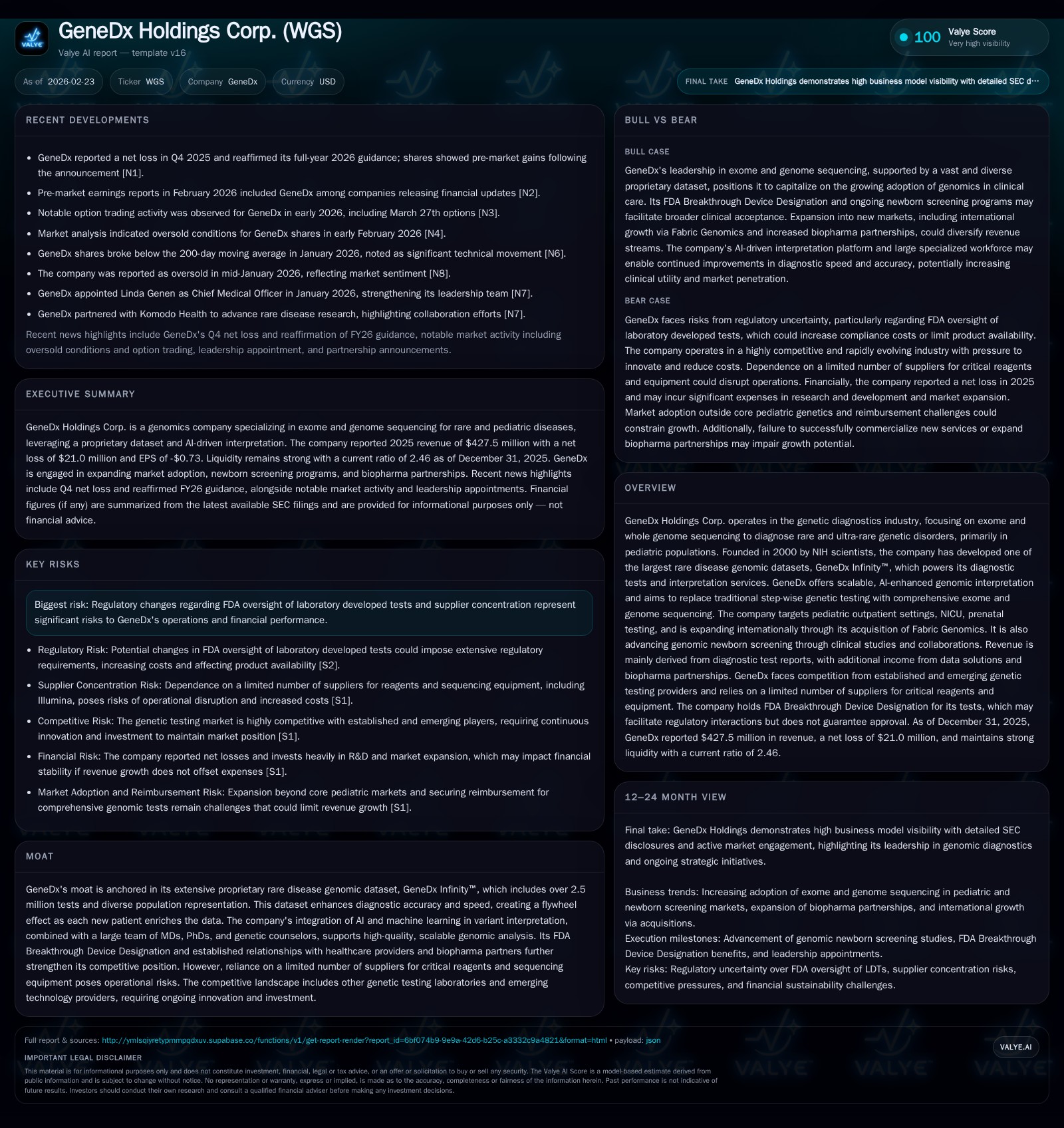
GeneDx Holdings Corp. has demonstrated steady growth in its core exome and genome sequencing business, driven by expansion of its rare disease genomic database, GeneDx Infinity™, and strategic acquisitions such as Fabric Genomics. Operational improvements led to positive operating cash flow in 2025 after years of loss, supported by cost efficiencies and reimbursement progress. The company faces ongoing headwinds from evolving FDA oversight on laboratory-developed tests and supply chain concentration risks. Continued innovation in AI-enhanced variant interpretation and newborn genomic screening studies provide potential catalysts for longer-term growth, though these are balanced by reimbursement uncertainties and competitive pressures.
Company Overview
Founded in 2000 by National Institutes of Health scientists, GeneDx Holdings Corp. (Nasdaq: WGS) specializes in genetic diagnostic testing centered on exome and whole genome sequencing primarily for pediatric rare disease diagnosis. Its flagship proprietary dataset—GeneDx Infinity™—contains genomic profiles from over 2.5 million individuals tested to date, offering one of the largest rare disease databases worldwide. This data advantage powers AI-enhanced variant interpretation tailored to diagnosing ultra-rare genetic conditions.
The company's mission is rooted in accelerating genetic diagnosis to transform healthcare from reactive treatment to proactive precision medicine. Its ExomeDx™ and GenomeDx™ tests have received FDA Breakthrough Device Designations, underscoring regulatory confidence in the clinical utility of comprehensive genomic sequencing over traditional multi-gene panels.
Historical Performance and Growth Drivers
GeneDx exhibited strong growth trends through recent years with significant increases in test volumes—a key operational metric closely correlated with database size and revenue expansion. The volume of resulted exome and genome tests nearly doubled from approximately 49,439 tests in fiscal year (FY) 2023 to 97,271 tests by FY 2025. This rise indicates progressive adoption within pediatric outpatient settings, NICUs, prenatal diagnostics, and other specialty areas where early genetic diagnosis can be life-changing.
Historical performance (annual)
| FY | Net ($mm) | CFO ($mm) | OpInc ($mm) | Capex ($mm) | Net YoY |
|---|---|---|---|---|---|
| 2025 | -21 | 33 | -13 | 19 | +59.8% |
| 2024 | -52 | -28 | -23 | 5 | +70.3% |
| 2023 | -176 | -180 | -181 | 5 | +68.0% |
| 2022 | -549 | -319 | -668 | 7 |
Note: Omitted columns lack sufficient annual XBRL coverage in the provided tags (need ≥2 annual points): Rev, Div, Buybacks. Source: SEC companyfacts cache [F1].
Capital returns and efficiency (annual)
| FY | FCF ($mm) | ROE% |
|---|---|---|
| 2025 | 14 | -6.8 |
| 2024 | -34 | -21.3 |
| 2023 | -185 | -77.1 |
| 2022 | -326 | -216.4 |
Source: SEC companyfacts cache [F1].
Note: Revenue figures are not publicly available but qualitative disclosures indicate substantial growth tied to increasing test volumes.
The steep operating loss reduction reflects improved gross margins achieved through economies of scale, enhanced reimbursement rates negotiation, streamlined workflows reducing reagent costs, and operational efficiency post integration of acquisitions such as Fabric Genomics (completed May 2025). Notably, operating cash flow turned positive for the first time at $33.3 million in FY 2025 after historically negative cash generation driven by upfront investment phases.
Capital expenditures surged over threefold to $19 million in FY25 relative to prior years as GeneDx invests heavily into expanding sequencing capacity infrastructure — crucial for accommodating growing test demand while maintaining rapid turnaround times that are clinically essential.
Market Position & Competitive Moat
GeneDx’s moat arises principally from its large-scale GeneDx Infinity™ rare disease genomic dataset which enables superior diagnostic accuracy due to enriched population-specific variant interpretation capabilities unavailable to many competitors relying on smaller or less diverse datasets.
This flywheel effect is reinforced by strategic integration of AI/ML technologies automating complex variant calling pipelines combined with expert review from a multidisciplinary team comprising MDs, PhDs, and certified genetic counselors capable of delivering highly personalized diagnostic reports.
The company also benefits from an extensive provider network including direct sales coverage plus laboratory partners extending geographic reach primarily within the U.S., complemented by initial international expansion efforts via Fabric Genomics’ software-enabled interpretation services aimed at hospitals and research institutions worldwide.
Its regulatory progress includes obtaining FDA Breakthrough Device Designations for its primary clinical diagnostic offerings which may accelerate review timelines and facilitate post-market data collection opportunities — key differentiators compared with panel-based test providers or pure software vendors lacking robust clinical data backing.
Key competitors comprise leading academic centers like Baylor Genetics as well as commercial entities including Tempus/Ambry Genetics and Variantyx that compete both on genetic testing breadth as well as interpretative analytics innovation.
Regulatory Environment & Risks
A pivotal risk factor remains the uncertain outcome surrounding FDA regulation of laboratory developed tests (LDTs). Though historically subject to enforcement discretion rather than formal premarket review obligations, FDA’s proposed framework outlined multiple phased approaches starting April 2024 intended to introduce stringent requirements for clinical validation submissions.
Following legal challenges resulting in invalidation of the final rule by a federal court earlier this year,[S2] full regulatory clarity remains pending with potential legislative reinterpretations under debate.[S10] GeneDx currently offers LDT versions ensuring market access while closely monitoring developments that may impose increased compliance costs or restrict product offerings impacting revenues.
Supplier concentration is another critical operational vulnerability—the company depends heavily on Illumina Inc., Twist Biosciences Corporation among a small group supplying sequencers and molecular reagents essential for high-throughput sequencing workflows.[S5] Disruptions or supply bottlenecks could materially affect test turnaround times and costs requiring delicate vendor management or technical revalidations if substitutions occur.
Reimbursement volatility also poses challenges given divergent payor policies assessing medical necessity criteria for broad adoption of costly exome/genome sequencing versus established panel testing modalities.[S10] Expanding coverage requires sustained payer engagement backed by health economics evidence gathered from clinical validations including ongoing newborn screening pilot studies with state health departments.[S6]
Future Outlook & Growth Catalysts
Strategic priorities center around scaling adoption of comprehensive genetic diagnostics across pediatric outpatient sectors while expanding into neonatal intensive care units (NICU) through rapid whole genome sequencing applications targeting prompt diagnoses critically impacting survival outcomes.
The Fabric Genomics acquisition brings complementary AI-powered software solutions used globally enabling cross-border revenue diversification albeit still modest at approximately 1.5% outside US currently but expected to rise.[S6]
Moreover, GeneDx’s clinical collaborations aspiring towards implementing genomic newborn screening programs signal early entry into preventive medicine markets potentially reshaping public health screening paradigms beyond conventional biochemical tests.[N11]
Innovation pipelines emphasize continuous R&D investments improving bioinformatics pipelines reducing costs per test with expectations that software sophistication yields higher throughput without proportional incremental staffing – addressing scalability constraints vital in this highly specialized sector.[S9]
Analysts note that successful reimbursement expansion along with further process automation could markedly improve financial results leading toward profitability milestones currently projected but not explicitly guided by management recently.[N2]
Capital Allocation & Financial Health
As of December 31, 2025 GeneDx maintains strong liquidity with combined cash and equivalents plus available-for-sale securities totaling approximately $171 million providing comfortable runway for ongoing operations absent near-term capital raises.[S11]
The company carries long-term debt secured under a senior loan facility totaling about $54.5 million maturing late-2028 with interest-only payments through maturity allowing financial flexibility during growth phases.[S4]
Return on equity remains negative at approximately -6.8%, reflecting net losses consistent with an expansion-stage business investing aggressively ahead of sustainable profits; nonetheless profitability trends indicate continual improvement YoY supporting positive operating cash generation.[F1]
No dividends have been declared or paid historically nor share repurchase programs noted evidencing reinvestment focus rather than cash returns to shareholders currently.
Conclusion & Monitoring Points (Analysis)
GeneDx Holdings Corp occupies a strong niche capitalizing on rare disease genomics leveraging proprietary data scale coupled with advanced AI analytics setting it apart amidst growing competition transitioning healthcare toward genetics-informed care standards. Risk factors inherent in shifting regulatory landscapes around LDTs alongside supplier dependencies underscore execution complexities needing vigilant risk mitigation strategies. Future milestones worth tracking include reimbursement expansions validating commercially viable pricing models; scaled newborn screening rollout demonstrating practical preventive health transformability; material international revenue growth exceeding current fractional contributions; further cost reductions underpinning improved profit margins; and any regulatory clarifications from the FDA that could redefine product approval requisites materially impacting cost structures or market access timing. Investors should note absence of explicit formal guidance calls for close watch on quarterly operational metrics surrounding test volume trajectories as a proxy for sustainable revenue growth. Overall trajectory points toward gradual advancement toward breakeven accompanied by continued investment facilitating leadership position sustained via unique data assets marrying clinical expertise with state-of-the-art technology platforms.
Disclaimer: This is research-only, informational analysis and not investment advice. It may include AI-generated interpretation and general industry context. Always verify important details using primary sources.

Comments