
Warby Parker’s Transition to Profitability Tests Growth and Operational Scaling
After years of operating losses, Warby Parker achieved a modest net profit in 2025, reflecting improved operational efficiency amid continued retail expansion and technological investment.
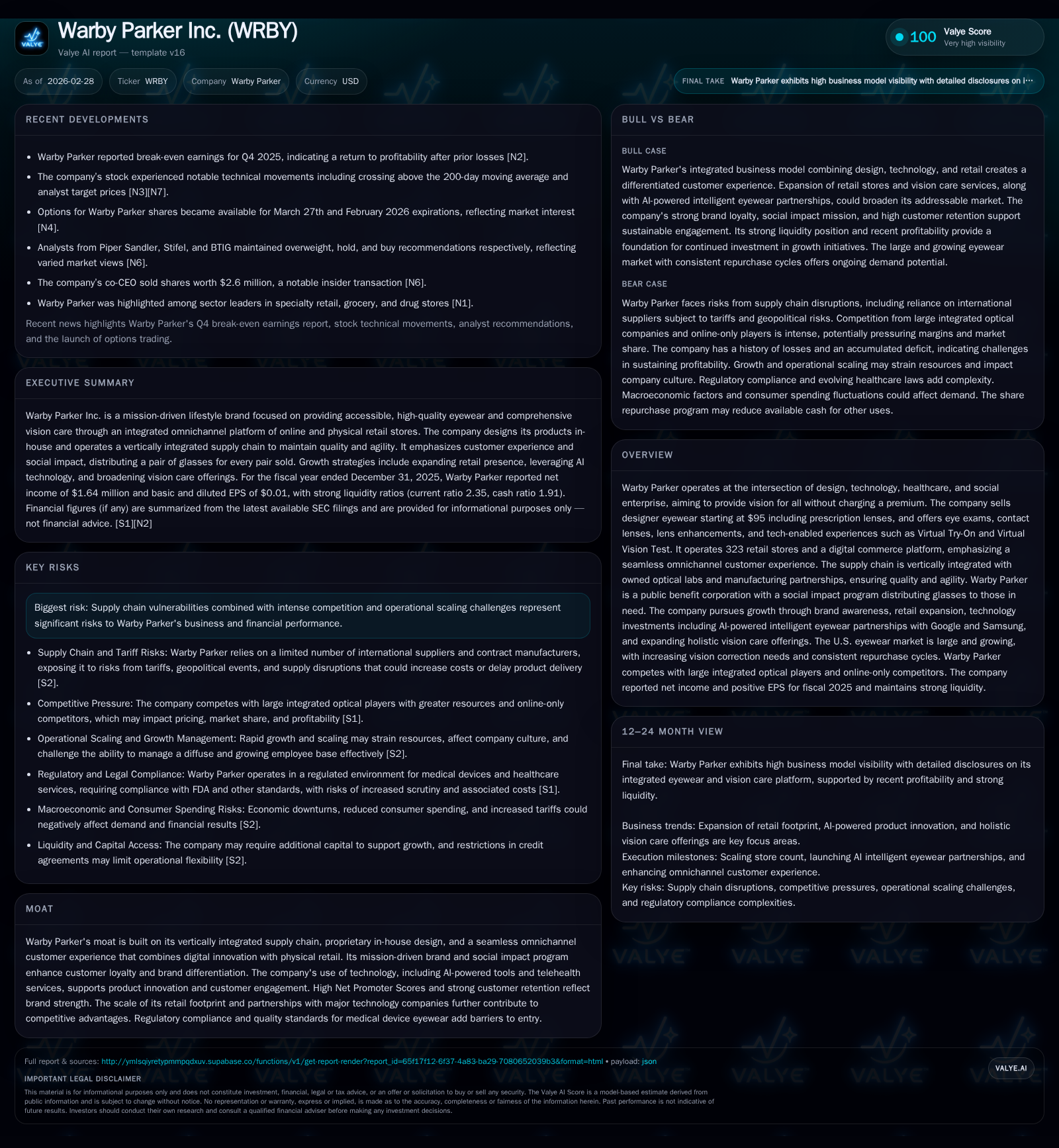
Warby Parker Inc. has shown a steady improvement in financial performance from 2022 through 2025, culminating in a slight positive net income for the first time in fiscal year 2025. This progress is underpinned by revenue growth of 13%, strong cash flow generation, and disciplined capital spending, even as the company scaled its retail footprint to more than 320 stores. Going forward, Warby Parker faces challenges related to supply chain dependencies, regulatory compliance, and competition in an evolving eyewear and vision care market. The firm emphasizes its vertically integrated supply chain, proprietary technology platforms, and social impact mission as differentiators. Monitoring the company’s ability to sustain profitability while expanding vision care services and digital capabilities will be key.
Historical Performance and Growth Drivers
Warby Parker has transitioned from significant net losses toward profitability over the four-year historical period ending FY2025 [F1]. Net revenue expanded from roughly $683 million in 2022 (extrapolated from YoY growth rates) to $871.9 million by the end of 2025, an increase of approximately 28% over four years.
This revenue progression reflects several key strategies: rapid expansion of physical retail presence (now at 323 stores), augmented offering mix including eye exams and contact lenses, and continued digital innovation such as virtual try-ons that integrate technology with physical distribution channels [S1][S19].
From an earnings perspective, operating income losses declined dramatically from -$111.2 million in FY2022 to just -$5.3 million in FY2025. Concurrently, net income swung from a substantial loss exceeding -$110 million to a small positive figure of $1.64 million by FY2025 [F1]. This represents an operating income improvement of over 80% year on year between FY2024 and FY2025 alone.
Supporting this profitability trend is robust operating cash flow growth: CFO rose from about $10 million in FY2022 to nearly $111 million in FY2025, a marked increase signaling effective working capital management and operational efficiency gains despite scale-up activity [F1]. Capital expenditures rose steadily but moderately over the same period (from ~$60M to ~$67M), underscoring ongoing investments principally aimed at retail infrastructure expansion, optical lab capacity enhancements, and technology development platforms [F1][S19].
Table: Warby Parker Annual Financial Highlights (FY2022-FY2025)
Historical performance (annual)
| FY | Net ($mm) | CFO ($mm) | OpInc ($mm) | Capex ($mm) | Net YoY |
|---|---|---|---|---|---|
| 2025 | 2 | 111 | -5 | 67 | +108.0% |
| 2024 | -20 | 99 | -30 | 64 | +67.7% |
| 2023 | -63 | 61 | -72 | 54 | +42.8% |
| 2022 | -110 | 10 | -111 | 60 |
Source: SEC companyfacts cache [F1].
Capital returns and efficiency (annual)
| FY | Buybacks | FCF ($mm) | ROE% |
|---|---|---|---|
| 2025 | 44 | 0.4 | |
| 2024 | 35 | -6.0 | |
| 2023 | 0 | 7 | -20.9 |
| 2022 | 0 | -50 | -38.5 |
Source: SEC companyfacts cache [F1].
*Note: Revenue figures specifically for prior years are not explicitly stated but are derived considering YoY commentary; currency USD.
Business Model Nuances
Warby Parker's vertically integrated approach—melding design, manufacturing partnerships, owned optical labs, wholesale logistics, and direct-to-consumer omni-channel retailing—serves as a competitive moat ensuring quality control and product agility [S19]. The company controls nearly every step from frame design at NYC headquarters through prescription lens fulfillment.
Its direct-to-consumer pioneering roots support transparent pricing starting at $95 with prescription lenses included—substantially lower than traditional branded competitors—helping democratize stylish eyewear access while maintaining healthy unit economics by sidestepping middlemen [S19].
Technology is central: beyond ecommerce platforms, features such as Virtual Try-On leverage augmented reality for product discovery online while Virtual Vision Test mobile app enables convenient at-home prescription renewals overseen by licensed ophthalmologists under contractual arrangements [S19][S26]. Partners like Google amplify smart eyewear ambitions integrating AI.
The social purpose embedded through Warby Parker's status as a public benefit corporation enriches brand identity via initiatives like "Buy a Pair, Give a Pair," which has distributed over twenty million glasses worldwide since inception; this strong mission alignment fosters customer loyalty reflected in above-industry Net Promoter Scores (NPS) and cohort retention metrics exceeding ~50% over two years [S19].
Future Growth Prospects
Warby Parker plans continued retail footprint expansion targeting both urban lifestyle centers and grocery-anchored malls alongside deeper integration of vision care services including broadening optometrist eye exam availability within stores [S1][S19]. KPIs include scaling customer acquisitions while increasing Vision Plan penetration beyond current cash-pay dominance.
Technological innovation remains pivotal—with AI-enabled products such as Google-partnered intelligent eyewear positioning Warby Parker at the frontier of emerging wearable tech markets [S14]. Enhanced personalization via data insights aims to tailor marketing spend dynamically across digital/physical channels, banking on operational leverage derived from proprietary customer data fully integrated end-to-end.
Nonetheless, growth drivers face caps stemming from macroeconomic pressures impacting discretionary consumer spending and increasing competition from entrenched incumbents like EssilorLuxottica SA who wield broader resources and multiple brand banners across optical retail segments [S24][S26]. Supply chain concentration risk persists notably due to dependency on select suppliers—particularly suppliers of cellulose acetate material primarily sourced from one provider—and reliance on manufacturing partners concentrated geographically including China Optical Labs facing potential tariff fluctuations raising input costs [S6][S20].
Regulatory complexity looms large given that eyewear qualifies as medical devices requiring FDA compliance encompassed by Quality Management System Regulation updates effective early 2026; additional state-level regulations covering vision care professionals’ licensing frameworks increase operational risk exposure [S4][S11][S18][S26]. Privacy laws governing sensitive health information—including HIPAA compliance—impose substantial data governance obligations critical for their telehealth offerings [S13][S26].
Forecasts, Milestones & Key Watchpoints
While explicit company-issued guidance beyond summary commentary was not present in filings or news releases up to early-2026 [N1][S3], key developments to monitor are:
- Expansion rate of new retail store openings beyond current levels (~323 stores); ability to staff stores with qualified vision care professionals.
- Adoption trajectory of AI-enabled products and related strategic partnerships.
- Margins evolution especially gross margin stability amidst cost headwinds from tariffs or raw material inflation.
- Customer retention trends measured via cohort analysis amid intensifying competitor marketing activity.
- Regulatory compliance progress particularly around FDA medical device remits affecting product labeling/submissions.
- Execution against the share repurchase program potentially impacting capital structure over medium term [S5].
Capital Allocation & Returns Trends
Warby Parker has displayed prudent capital allocation emphasizing reinvestment into growth rather than shareholder returns thus far; no dividends have been declared, nor have meaningful share repurchases occurred post FY2021 when around $8 million was returned prior to IPO era constraints [F1][S5].
Robust operating cash flow generation now substantially exceeds capex needs producing free cash flow approximating $43.7 million in fiscal 2025—a positive inflection supportive of balance sheet strength evidenced by a solid current ratio exceeding two times indicating liquidity resilience [F1]. Equity has steadily grown aligned with income improvement while leverage covenants impose discipline on incremental borrowings under credit facilities restricting financial flexibility somewhat during further expansion phases [S10][S22].
Return on Equity remains modest at about 0.4% but improved by virtue of shrinking losses turning slightly positive net income; sustainable profitability execution will be critical to unlocking higher shareholder returns over time given elevated investment base currently required for omnichannel growth initiatives [F1].
Risks Summary & Operational Challenges
Key risks cited include:
- Supply chain vulnerabilities arising from single-supplier dependencies for critical inputs like cellulose acetate frames and geopolitical tensions affecting China-based labs threatening timely delivery or cost escalation putting margin targets at risk [S6][S20].
- Competition intensity intensified by well-capitalized incumbents able to engage price promotions or broaden assortments limiting market share gains; need for ongoing R&D investment placing pressure on expense structure [S24].
- Regulatory environment complexity spanning federal/state healthcare statutes governing vision care provision/licensing along with FDA medical device compliance evolving standards including QMSR adoption raising cost/bureaucratic burden needing agile compliance teams to avoid sanctions or disruptions [S4][S11][S12][S15][S18].
- Data privacy/security risks inherent with collection/storage/processing of sensitive prescription/health records amplified by telehealth expansions necessitating continued investments guarding against breaches that could lead to fines or reputational damage undermining trust critical for direct consumer relationships [S13][S14][S26].
- Workforce challenges related to recruiting/retaining optometry professionals critical for expanding brick-and-mortar eye exam service capacity potentially constraining growth plans if unable to secure talent due to industry-wide shortages or wage inflation pressures impacting margins negatively [S1].[N1]
- Public benefit corporation status may entail tradeoffs between profit maximization versus social mission goals possibly constraining some strategic choices under market pressure conditions.
Conclusion & Outlook Considerations
Warby Parker’s trajectory points toward gradual maturation into a sustainably profitable enterprise balancing innovation-led differentiation with scale economies via its vertically integrated omnichannel platform backed by strong customer loyalty based on value pricing coupled with social impact ethos. Challenges remain substantial stemming from sector dynamics marked by supply chain concentration risks alongside complex evolving regulatory requirements enveloping consumer health data protection plus medical device compliance. The company's ability to judiciously invest capital in growth initiatives while maintaining operational discipline will dictate whether incremental profitability gains become durable rewards for stakeholders. Continuous monitoring should focus on margins under pressure scenarios, new store productivity metrics tied closely with optometrist recruitment effectiveness as well as success metrics around advanced technology deployment transforming customer experiences through AI capabilities. Given these dynamics documented through latest available SEC reports and recent earnings results confirming break-even achievement after years of losses ([N1],[F1],[S1]), Warby Parker embodies a transitioning growth company facing typical mid-growth scaling tensions needing seasoned execution moving forward.
This analysis is intended solely as an informational resource without any investment recommendation or advice expressed or implied.
Disclaimer: This is research-only, informational analysis and not investment advice. It may include AI-generated interpretation and general industry context. Always verify important details using primary sources.

Comments