
Archer Aviation Advances eVTOL Development Amid High Cash Burn and Capital Intensity
The company progresses toward certification and commercial operations while managing significant operating losses and strong liquidity.
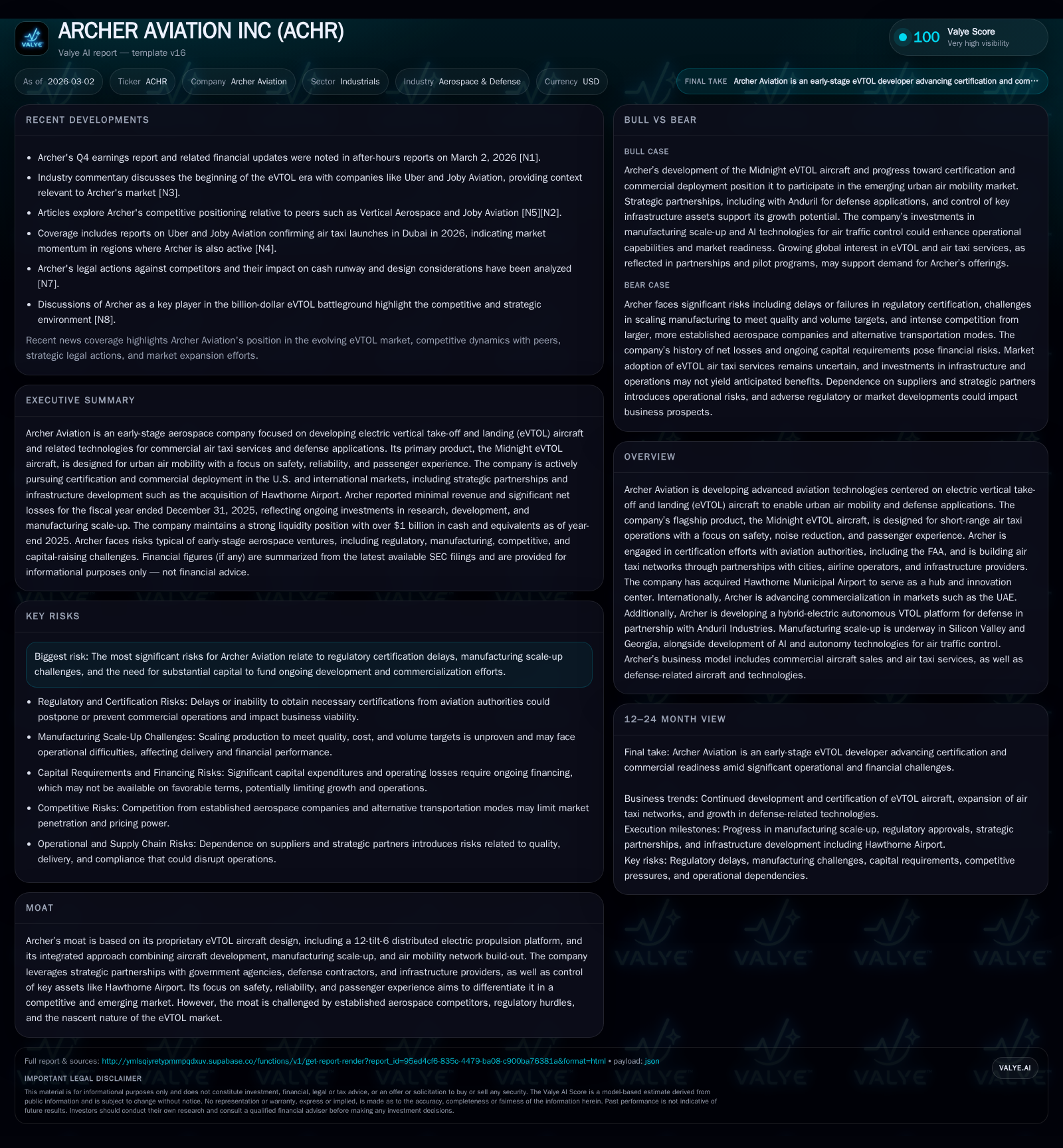
Archer Aviation continues developing its electric vertical takeoff and landing (eVTOL) aircraft, focusing on certification, manufacturing scale-up, and urban air mobility networks in the US and abroad. Despite nominal revenue from hangar subleases, the company remains unprofitable with substantial operating losses and cash burn driven by heavy R&D and administrative expenses. Archer's robust liquidity supports near-term operations; however, ongoing capital requirements and regulatory challenges remain key risks. Growth depends on FAA certification milestones, production ramp, market adoption for commercial air taxi services, and defense applications through strategic partnerships.
Company Overview
Archer Aviation is an early-stage aerospace technology company developing electric vertical takeoff and landing (eVTOL) aircraft for urban air mobility (UAM), including passenger air taxis and defense applications. Its primary product is the Midnight eVTOL designed for urban flight emphasizing safety, noise reduction, and passenger experience [S1].
The company is actively pursuing certification with the FAA in the US and the General Civil Aviation Authority (GCAA) in the United Arab Emirates. It is building air taxi networks via partnerships with airline operators, city governments across California, Florida, Texas, Georgia, New York, and infrastructure providers for vertiport development [S1]. Commercial launches are targeted within select metropolitan regions later this year.
Archer’s acquisition of Hawthorne Municipal Airport near Los Angeles provides an operational base for UAM activities as well as an innovation hub for AI-driven aviation technologies integrated with their vehicles [S1]. On the defense side, Archer collaborates with Anduril Industries to develop a hybrid-electric autonomous VTOL platform addressing military vertical lift needs while adaptable for commercial cargo and medical evacuation missions [S1].
Historical Performance
To date, Archer remains pre-revenue from its core business lines but generated nominal revenue of $0.3 million in FY2025 primarily from subleasing hangar space acquired with Hawthorne Airport [F1][S20]. The financial profile reflects heavy investment typical of aerospace startups advancing novel technologies.
Historical performance (annual)
| FY | Net ($mm) | CFO ($mm) | OpInc ($mm) | Capex ($mm) | Net YoY |
|---|---|---|---|---|---|
| 2025 | -618 | -433 | -729 | 79 | -15.2% |
| 2024 | -537 | -369 | -510 | 82 | -17.2% |
| 2023 | -458 | -272 | -447 | 44 | -44.3% |
| 2022 | -317 | -200 | -347 | 7 |
Source: SEC companyfacts cache [F1].
Capital returns and efficiency (annual)
| FY | FCF ($mm) | ROE% |
|---|---|---|
| 2025 | -512 | -28.1 |
| 2024 | -451 | -71.3 |
| 2023 | -316 | -124.7 |
| 2022 | -207 | -64.3 |
Source: SEC companyfacts cache [F1].
All figures represent fiscal years ended December 31.
Operating income declined by approximately 43% year-over-year in FY2025 due to escalating costs associated with design, development, certification efforts, workforce expansion, stock-based compensation, prototyping materials, and associated expenses [F1][S20][S6][S9]. Net losses expanded by over $80 million compared to FY2024.
Operating cash flow remained negative at $433 million reflecting continued cash burn during this pre-commercial phase [F1][S15]. Capital expenditures held steady near $79 million supporting scaling of manufacturing facilities after prior years’ ramp-up [F1][S6][S14].
Growth Outlook
Archer’s future growth hinges on several key factors:
- Certification Milestones: Progress toward FAA and international regulatory approvals for the Midnight aircraft is critical to enable commercial passenger flights [S1][N10].
- Manufacturing Scale-Up: Efficient production ramp at Silicon Valley "golden lines" and new Georgia facility underpins ability to meet launch demand without excessive costs or quality issues [S1][S6].
- Air Taxi Network Deployment: Building vertiport infrastructure and establishing initial city routes—especially around Los Angeles leveraging Hawthorne Airport—will define service footprint under initiatives like the White House eVTOL Integration Pilot Program (eIPP) [S1][N2].
- International Expansion: Regulatory engagement in UAE following hot weather flight testing supports market entry abroad through Launch Edition program [S1].
- Defense Applications: Partnership with Anduril broadens addressable markets by adapting eVTOL technologies for hybrid-electric military VTOLs alongside commercial cargo/medical missions [S1][S19].
Growth constraints include regulatory uncertainties that may delay certification or impose operational restrictions [S8], manufacturing complexity risks [S21], capital intensity requiring continuous financing [S25], competition from incumbents such as Joby Aviation or Vertical Aerospace [S16], and infrastructure rollout challenges.
The Hawthorne Airport acquisition offers a strategic advantage by combining operational control with integration of AI-enhanced traffic management systems—a frontier area within eVTOL ecosystems [S23]. However technological complexities around autonomy add timing risk.
Returns & Capital Allocation
Archer currently generates no operating profits or free cash flow given its pre-commercial stage; trailing twelve-month return on equity approximates negative 28%, reflecting accumulated net losses against a growing equity base funded mainly through equity issuances [F1].
Liquidity remains strong with roughly $1.02 billion in cash and equivalents at December 31, 2025 supported by multiple registered direct offerings totaling over $1 billion during 2025 alone [F1][S10]. These funds finance R&D including flight test programs, manufacturing tooling investments ($78.8M capex), the Hawthorne Airport acquisition (~$126M), plus operational overhead largely comprising stock-based compensation expense [S5][S15].
Debt levels are modest relative to equity capitalization: approximately $81 million secured real estate debt plus a fully drawn $65 million credit facility bear interest obligations but maintain low leverage; liquidity ratios remain strong (current ratio near 20x) [S4][S13]. Archer does not pay dividends or repurchase shares given reinvestment priorities during growth phase [F1].
Capital allocation emphasizes certification advancement alongside expansion of production capacity and development of software systems crucial for autonomous capabilities embedded in future compliance strategies.
Industry Context & Competitive Positioning
The urban air mobility sector lies at the confluence of electrified propulsion innovation, autonomy development, rigorous safety regulation compliance—and requires substantial R&D investment rarely seen outside legacy aerospace OEMs until recently.
Archer’s proprietary distributed electric propulsion system featuring tilt-wing configurations aims to deliver aerodynamic efficiencies reducing noise footprint—a key factor in public acceptance. Control over a physical airport hub near LAX differentiates Archer tactically by enabling direct integration of infrastructure versus competitors relying solely on third-party vertiports.
Competition includes established aerospace firms transitioning into eVTOL like Boeing-backed programs as well as emerging pure-play companies such as Joby Aviation which recently announced Dubai air taxi launches.[N4] Regulatory timing around electric aviation safety remains a dominant industry-wide challenge.
Risks Summary
Key risks include:
- Regulatory Delays: Procedural or political factors could slow FAA or global certification processes impacting timelines [S8].
- Manufacturing Ramp Challenges: Complex assembly scaling combined with supply chain disruptions may increase costs or delay deliveries [S21].
- Capital Requirements: Continued high cash burn necessitates frequent financing; failure to raise capital could stall progress [S25].
- Legal Proceedings & IP Risks: Ongoing litigation could divert management focus or threaten core technology rights if outcomes are unfavorable [S18].
- Competitive Pressure: Larger rivals’ resources may accelerate innovation beyond Archer's current capabilities allowing them market lead [S16].
- Market Adoption Uncertainties: Public acceptance depends on perceived safety, affordability, infrastructure availability beyond engineering success alone. These risks must be managed carefully as Archer scales toward commercial viability.
Conclusion
Archer Aviation stands at a pivotal juncture balancing technological progress against commercialization hurdles requiring deft navigation of certification milestones alongside manufacturing ramp-ups funded through significant recent equity raises.[F1][S10] Control over Hawthorne Airport offers logistical advantage merging hardware development with airspace management innovations.[S1] Nonetheless negative margin pressure persists reflected in widening operating losses ($729M in FY2025), highlighting capital intensity inherent to pioneering new transportation forms within regulated airspace.[F1][S15]
Success depends critically on timely FAA clearances enabling urban air taxi service launches domestically while parallel international deployments present diversification opportunities notably via Middle East relationships.[N2][N4] Defense collaborations further broaden potential revenue streams beyond consumer transit use cases.[S19]
Investors should closely monitor certification developments alongside manufacturing output metrics signaling transition from prototype phases toward sustainable airborne fleets potentially reshaping urban travel paradigms over the coming decade.
This analysis is based solely on publicly available information extracted from SEC filings dated March 2, 2026 ([F1],[S#]) supplemented by recent news articles ([N#]). It does not constitute investment advice or recommendations.
Disclaimer: This is research-only, informational analysis and not investment advice. It may include AI-generated interpretation and general industry context. Always verify important details using primary sources.

Comments