
StubHub’s Financial Crossroads: Weighing Growth Initiatives Against Intensifying Market Pressures
StubHub grapples with sustaining its dominant secondary ticket marketplace while pioneering original ticket issuance amid mounting operational losses and regulatory scrutiny.
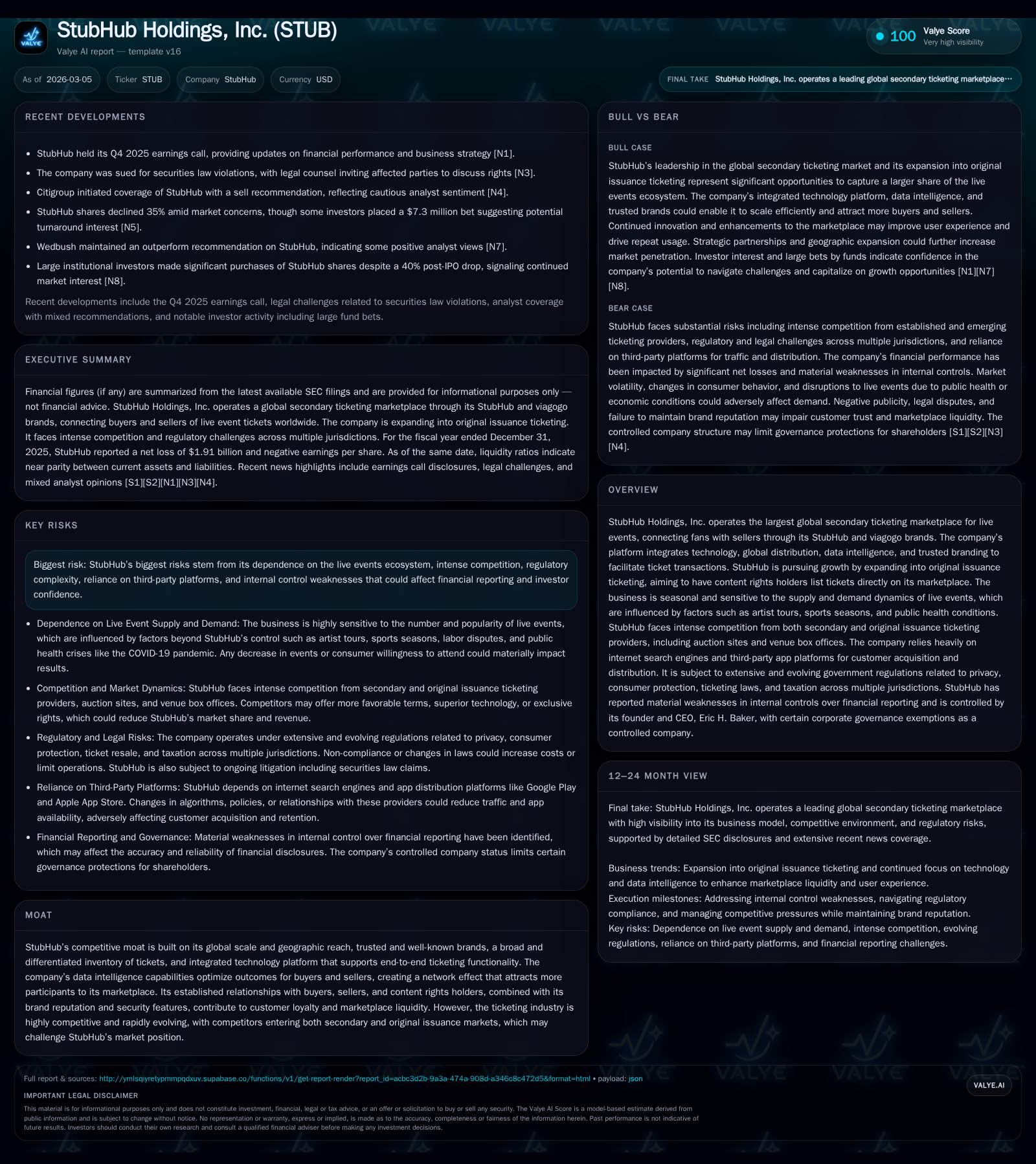
StubHub Holdings remains a leading player in the global secondary ticket marketplace, leveraging its technology and brand to connect buyers and sellers worldwide. However, FY2025 revealed steep operating losses nearing $1.34 billion and a widening net loss of over $1.9 billion, underscoring profitability challenges. The company's strategic pivot toward enabling content rights holders to issue tickets directly—original issuance—is an ambitious growth vector but faces considerable execution and adoption barriers. Additionally, intensifying competition, complex regulatory landscapes including securities litigation, and rising debt service obligations all weigh heavily on StubHub’s capacity to invest while managing liquidity.
Financial Trajectory Through 2025: Growth Drivers and Profitability Headwinds
StubHub Holdings, Inc. has solidified its position as the largest global secondary ticketing marketplace by leveraging its integrated technology platform, trusted brands StubHub and viagogo, and data intelligence capabilities that optimize buyer-seller outcomes. The past several years have experienced growth driven largely by increased live event attendance across sports, concerts, and theater. Despite these favorable drivers in top-line revenue—a testament to the company's expansive marketplace reach—StubHub's financial results in FY2025 tell a story of major profitability challenges.
In particular, the company reported an operating income loss exceeding $1.34 billion for fiscal year ending 2025 [F1]. This pronounced deficit was accompanied by a net loss of approximately $1.90 billion during the same period, highlighting sustained operating pressure from higher costs associated with scaling operations as a newly public company as well as ongoing investment in growth initiatives [F1]. These losses represent a significant deterioration compared to prior periods (see table below) reflecting both intensified spending on platform enhancements and increased general administrative expenses.
The seasonality intrinsic to the live events ecosystem heavily influences StubHub's financial cadence; high-demand periods aligned with major touring seasons or sports championships amplify marketplace activity temporarily, causing pronounced fluctuations quarter-to-quarter. While this has historically sustained strong gross transaction volumes during peak seasons, StubHub’s ability to translate volume gains into operating profits remains impaired.
Historical performance (annual)
| FY |
|---|
| 2025 |
Source: SEC companyfacts cache [F1].
Transitioning from Secondary to Original Issuance: Strategic Rationale and Execution Realities
Recognizing the limits of traditional secondary ticketing margins and seeking to harness a larger market opportunity, StubHub launched an ambitious strategic pivot toward original issuance ticketing—enabling content rights holders such as promoters or venues to list tickets directly on its platform as primary sellers [S1][N1]. This vertical expansion serves multiple objectives: enhancing marketplace liquidity through authentic direct listings; improving customer trust with clearer provenance; and capturing higher monetization potential by facilitating end-to-end transactions.
Operationalizing this vision entails significant hurdles. Adoption depends on convincing content rights holders accustomed to traditional box office or other primary platforms to migrate or hybridize distribution via StubHub. The company must also integrate complex inventory management workflows respecting diverse policy frameworks across numerous event categories and geographies.
From a sector perspective, direct issuance can invigorate marketplace network effects—a positive flywheel attracting more buyers and sellers—but only if liquidity thresholds cross critical mass without cannibalizing secondary volume or inducing seller conflicts. Thus far, progress remains early-stage with the company emphasizing incremental rollout combined with continued refinement of platform functionalities designed for issuer flexibility [S1][N1].
Market Competition and Regulatory Landscape: Challenges to Maintaining Leadership
The competitive terrain for StubHub is multifaceted and intensifies with entry of both established secondary platforms like SeatGeek alongside issuers expanding original ticket issuance capabilities such as Ticketmaster’s Verified Fan program or venue-specific sales channels [S1][S5][N5]. Beyond direct competitors, venue box offices offer consumers another channel often perceived as more trustworthy or cost-transparent.
Moreover, StubHub's dependence on internet search engine algorithms for customer acquisition introduces risk given potential algorithm shifts that could reduce organic traffic or increase paid search costs significantly [S1]. Restrictions imposed by third-party app platforms further complicate user access points.
Regulatory scrutiny compounds these pressures. Multiple state lawsuits target compliance with "all-in pricing" laws mandating inclusive fee disclosures at ticket purchase—a domain where StubHub has faced investigation both in New York and Pennsylvania jurisdictions resulting in ongoing legal disputes unresolved as of early 2026 [S5][N4]. Additionally, a securities class action related to disclosures tied to the recent IPO adds further litigation complexity impacting investor sentiment.
Combined competition and regulatory factors exert downward pressure on consumer price transparency expectations and supplier relations critical for maintaining marketplace liquidity.
Revenue Streams, Cost Structures, and Seasonal Influences in Ticketing Dynamics
StubHub’s revenue streams primarily derive from commissions on ticket sales facilitated through its platform across both secondary resale activity and emerging original issuance listings [S2]. Variations in supply stem from the scale of large-scale events which drive volume spikes seasonally—artist touring cycles and sport league schedules remain pivotal determinants.
On the cost side, increasing public company expenses have exacerbated margin compression. Significant investments in sales & marketing intended to grow user acquisition alongside enhanced R&D expenditures toward platform scalability are notable examples documented recently [S14][N1]. Such investments reflect an intent to sustain product competitiveness but simultaneously elevate short-term operating cost burdens.
Technology expenditures encompass data center expansions supporting AI-driven pricing analytics instrumental for maintaining dynamic marketplace balance between buyer demand elasticity and seller listing optimization.
Recent Earnings Review: Key Metrics from Q4 2025 and Year-End Performance
The quarterly earnings call held March 4th, 2026 reaffirmed full-year results with no material deviation from previously announced losses [N1][F1]. Revenue trajectory showed modest growth fueled by volume recovery post-pandemic disruptions but insufficient to offset increased operating expense levels.
Customer engagement metrics indicated stable active buyer populations but elevated churn rates amid competitive offers elsewhere necessitating further marketing investment.[N1]
Margins remained under pressure given mix changes toward lower-margin direct issuance rollout alongside elevated general administrative costs linked with public company compliance.
Ambitions vs. Liquidity: Capital Structure, Debt Profile, and Cash Flow Analysis
As of December 31, 2025 StubHub reported a cash balance of approximately $1.24 billion juxtaposed against total indebtedness nearing $1.54 billion under term loan facilities [F1][S4][S10]. The resulting current ratio approximates 1.04x indicating tight near-term liquidity.
Debt covenants under these credit arrangements impose restrictive conditions limiting additional borrowings or shareholder returns including dividends or buybacks absent lender consent—a material constraint from a capital allocation standpoint [S4].
Free cash flow remains positive at roughly $191 million after capital expenditures although offset strongly by interest expense requirements given variable rate debt exposure posing sensitivity to rising rates [F1][S10].
Equity investors endure negative return on equity estimated near -161% driven principally by wide net losses relative to shareholders’ equity base pointing towards structural profit challenges persisting until successful scaling of new monetization streams occurs [F1].
Legal Proceedings Impacting Investor Confidence and Corporate Governance
StubHub faces multiple ongoing legal challenges that have amplified governance risks visible to investors. Notably:
- A putative securities class action filed November 24th, 2025 alleges omissions related to vendor payments impacting IPO disclosures raising questions about internal controls over financial reporting [S5][N4].
- State-level lawsuits contest compliance with pricing transparency statutes focused on "all-in-pricing" features target Pennsylvania specifically following inquiry by New York’s Attorney General earlier [S5].
- Broader regulatory investigations touch on refund practices adopted during COVID-19 cancellations reflecting ongoing scrutiny by multiple agencies potentially resulting in fines or operational constraints [S7][S15].
Although management denies allegations vigorously emphasizing ongoing defense preparations there is inherent unpredictability regarding litigation outcomes which could materially affect operating conditions or require significant resource diversion hence exacerbating investor uncertainty.[S9]
Roadmap Ahead: Key Milestones, Market Signals, and Risks to Monitor
Looking forward beyond the early months of 2026 key elements industry participants will watch include:
- Pace of adoption for direct issuance tickets as content rights holders’ onboarding scale determines success in broadening liquidity without eroding legacy sales balance [N1][S1].
- Legal rulings regarding pending securities litigation along with resolution status of state pricing law cases which may set precedents affecting marketplace practices [S5][N4].
- Stability of referral traffic from dominant search engines amidst evolving advertising policies posing material risk impacting customer acquisition economics enabling or throttling growth trajectories.[S1]
- Operational execution around technology investments targeting improved AI-driven pricing accuracy preserving transactional fairness supporting sustainable network effects within buyer-seller matchmaking.
- Monitoring capital structure developments including potential refinancing activities while balancing debt servicing obligations against funding needs for innovation spend crucial for midterm competitive positioning.[S4]
Collectively these factors will define whether StubHub can transition from its current juncture of heavy investment burdens combined with external pressures towards durable profit generation anchored by diversified revenue sources integrated within a robust regulatory-compliant framework.
Disclaimer: This analysis is based solely on publicly available information cited herein including SEC filings and reputable news sources as of March 5th, 2026. It aims to provide an impartial assessment devoid of investment recommendations or price forecasts.
Disclaimer: This is research-only, informational analysis and not investment advice. It may include AI-generated interpretation and general industry context. Always verify important details using primary sources.

Comments