
Five Point Holdings: Strategic Land Sale Timing and Capital Structure Refinement Amid Revenue Volatility
Five Point Holdings experienced a sharp revenue decline in 2025 driven by intentional residential land sale deferrals and regulatory complexities, while advancing fee-based asset management and strengthening its capital structure.
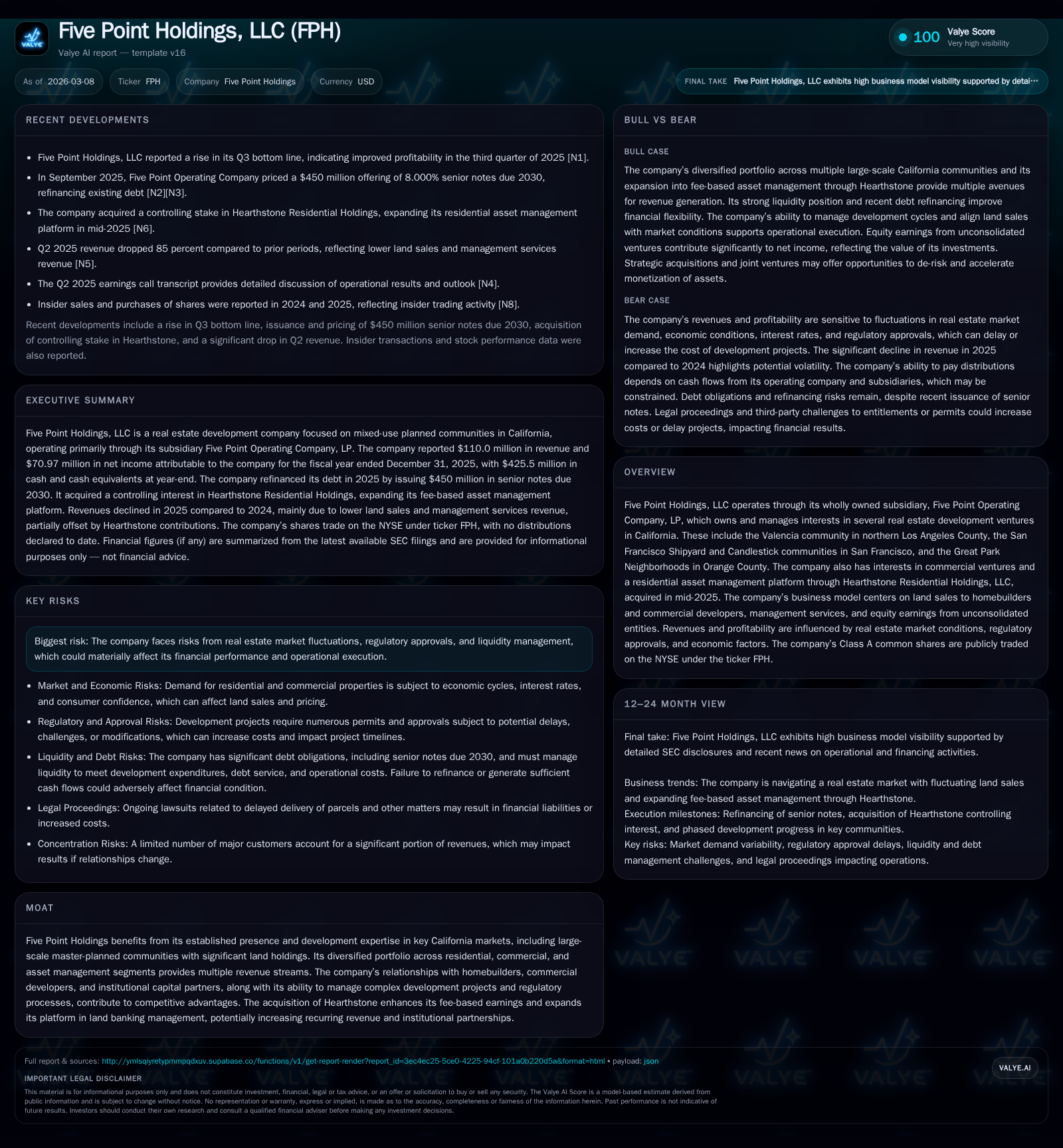
In 2025, Five Point Holdings’ revenues declined nearly 54% year-over-year to $110 million as the company strategically deferred residential land sales at Valencia to optimize pricing. Despite lower revenue, net income rose modestly to a record $71 million reflecting operational discipline and margin resilience. The acquisition of Hearthstone Residential Holdings expanded fee-based asset management capabilities, diversifying earnings. Refinancing efforts replaced higher-cost debt with $450 million of senior notes due 2030, improving liquidity and capital flexibility. Regulatory challenges and ongoing litigation pose risks to development timelines. Future focus includes phased neighborhood rollouts at Great Park Neighborhoods and maintaining liquidity for ongoing investments.
Established California Master-Planned Communities Driving Historical Growth
Five Point Holdings operates principally through its operating company, managing substantial interests in key Californian master-planned communities: Valencia near Los Angeles, the San Francisco Shipyard and Candlestick under the San Francisco Venture, and the Great Park Neighborhoods in Orange County [S1]. These assets enable value capture via phased residential lot sales to homebuilders alongside commercial land transactions.
Historically, revenues grew from $42.7 million in 2022 to a peak of $237.9 million in 2024 [F1], reflecting strong demand and absorption across these communities. Earnings also derive from managing complex horizontal infrastructure development and commercial leasing activities.
The July 31, 2025 acquisition of a controlling interest (75%) in Hearthstone Residential Holdings broadened Five Point's business model toward fee-based asset management focused on residential lot option programs involving institutional capital [S1]. This diversification complements traditional land sales with recurring management fees.
Geographic nuances influence operational cadence: Valencia focuses on industrial and residential land sales; San Francisco ventures face regulatory parcel delivery delays; Great Park implements phased neighborhood openings supported by homebuilder partnerships.
Revenue Contraction Reflecting Strategic Timing of Land Sales
In fiscal year 2025, consolidated revenues declined by approximately 53.8% year-over-year to $110 million from $237.9 million in 2024 [F1]. This was largely attributable to Five Point’s strategic decision to defer residential lot sales at Valencia to optimize pricing rather than maximize volume [S1]. However, commercial land sales continued, including a notable $42.5 million industrial land sale — the first significant such transaction at Valencia in over fifteen years [S1].
Additionally, variable price participation revenues linked to homebuilders decreased consistent with slower home price appreciation and absorption rates [S25], amplifying revenue volatility given their material contribution under ASC Topic 606 accounting guidance.
Hearthstone Acquisition Enhances Fee-Based Asset Management Platform
The mid-2025 acquisition of Hearthstone Residential Holdings added a fee-based asset management dimension focused on managing institutional capital within residential lot banking funds using lot option programs [S1]. Hearthstone typically holds nominal equity stakes (~1%) alongside third-party capital partners.
This model introduces annuity-like recurring fees that diversify Five Point’s earnings away from cyclical land sales while deepening institutional relationships.
Initial investment included the acquisition cost plus co-investments totaling approximately $61.8 million during mid-to-late 2025 [S25], underpinning this strategic expansion.
Great Park Neighborhoods: Robust Land Sales and Upcoming Deliveries
Within the Great Park Neighborhoods joint venture — where Five Point holds a 37.5% interest and serves as development manager — residential land sale revenues totaled approximately $782 million from about 920 homesites sold over roughly 75.6 acres during 2025 [S1]. These sales generated meaningful incentive management fees contributing to consolidated results.
Guest builders sold over 600 homes in the same period, indicating steady absorption while preparations continue for phased openings of new neighborhoods totaling approximately 513 homes across eight builder collections slated throughout 2026 [S1].
Such phased builder collections facilitate product diversification targeted at varied buyer segments while mitigating risk through multiple builder partnerships.
Capital Structure Improvements with Refinanced Debt Profile
September 2025 saw issuance of $450 million senior notes bearing an 8.0% coupon maturing October 2030; proceeds plus cash-on-hand were used to redeem approximately $471 million principal amount of higher coupon (10.5%) senior notes due in 2028 along with redemption of remaining notes totaling $52 million [S8][S9]. This refinancing lowered interest costs and extended maturity profile.
As of December 31, 2025, total indebtedness stood at $450 million with no outstanding draws against the revolving credit facility which has availability of $217.5 million for liquidity needs [S4][S8]. Debt covenants impose borrowing limits but provide operational flexibility for horizontal development investments subject to compliance [S4][S6].
Long-term fixed obligations include a water purchase agreement extending through at least initial term expiration in 2039, influencing liquidity planning alongside legacy related-party reimbursement obligations tied to EB-5 financing arrangements resumed in January 2026 after deferral [S5].
Total equity stood near $2.32 billion as of fiscal year-end reflecting solid capitalization amidst significant leverage inherent to real estate development [F1][S6].
Capital Allocation: No Distributions; Modest Return on Equity
Consistent with prior years since listing in May 2017, Five Point did not declare or pay dividends nor conduct share repurchases during fiscal year 2025; such decisions remain discretionary dependent on operating company distributions availability and contractual restrictions within debt agreements [S12][S14].
Return on equity approximated a modest level near 3.1%, calculated by dividing net income ($70.97 million) by shareholders’ equity ($2.32 billion) as of December year-end [F1]. This reflects typical characteristics of long-duration real estate developers engaged heavily in pre-development investments with cash flows skewed toward future periods.
Operating cash flow remained positive at about $105 million but declined nearly 9% versus prior year reflecting timing impacts from deferred lot sales combined with ongoing horizontal development expenditures essential for future growth [F1][S16]. Capital expenditures were minimal ($0.22 million) consistent with a business model focused on land entitlement and infrastructure investment capitalized into inventory rather than heavy fixed asset additions [F1].
Free cash flow supports reinvestment initiatives including completing community phases and scaling Hearthstone’s management platform.
Forward-Looking Challenges: Regulatory Delays and Market Dynamics
Operational risks center on regulatory approvals affecting parcel delivery timelines notably within San Francisco Shipyard parcels undergoing environmental retesting following litigation related to alleged contractor misconduct—a matter generating potential financial damages claims and reputational risks impacting project continuity [S1][S12].
Such delays extend time-to-market horizons critical for maximizing value amid California’s constrained housing supply environment characterized by elevated permitting costs.
Liquidity management will require ongoing attention given medium-term debt maturities coupled with working capital demands from horizontal development budgets aligned with expected absorption rates across geographic segments [S26]. Monitoring credit market conditions is vital given exposure to variable rate borrowing capacity within the revolver.
Historical Performance Summary Table
Historical performance (annual)
| FY | Rev ($mm) | Net ($mm) | CFO ($mm) | Capex ($) | Rev YoY | Net YoY |
|---|---|---|---|---|---|---|
| 2025 | 110 | 71 | 105 | 217000 | -53.8% | +3.9% |
| 2024 | 238 | 68 | 116 | 808000 | +12.4% | +23.3% |
| 2023 | 212 | 55 | 154 | 23000 | +395.9% | +459.6% |
| 2022 | 43 | -15 | -188 | 75000 |
Source: SEC companyfacts cache [F1].
Capital returns and efficiency (annual)
| FY | FCF ($mm) | ROE% |
|---|---|---|
| 2025 | 105 | 3.1 |
| 2024 | 115 | 3.2 |
| 2023 | 154 | 2.8 |
| 2022 | -188 | -0.8 |
Source: SEC companyfacts cache [F1].
Note: ROE is calculated as Net Income divided by Equity using data from [F1]. The table highlights rapid early growth followed by tactical contraction aligned with strategic timing decisions; net income progression underscores margin stability despite revenue pressure; cash flow remains robust supporting ongoing investment needs.
This analysis is based solely on information disclosed through March 7th–8th, 2026 SEC filings including Form10-K dated March6th without extrapolation beyond stated facts or guidance.
Disclaimer: This is research-only, informational analysis and not investment advice. It may include AI-generated interpretation and general industry context. Always verify important details using primary sources.

Comments