
Chegg Faces Challenges Amid AI Competition and Restructuring While Pivoting to Skilling Market
Chegg navigates ongoing revenue pressures and operational losses as it restructures and shifts focus toward AI-enhanced skilling solutions amid intensifying competition from tech giants.
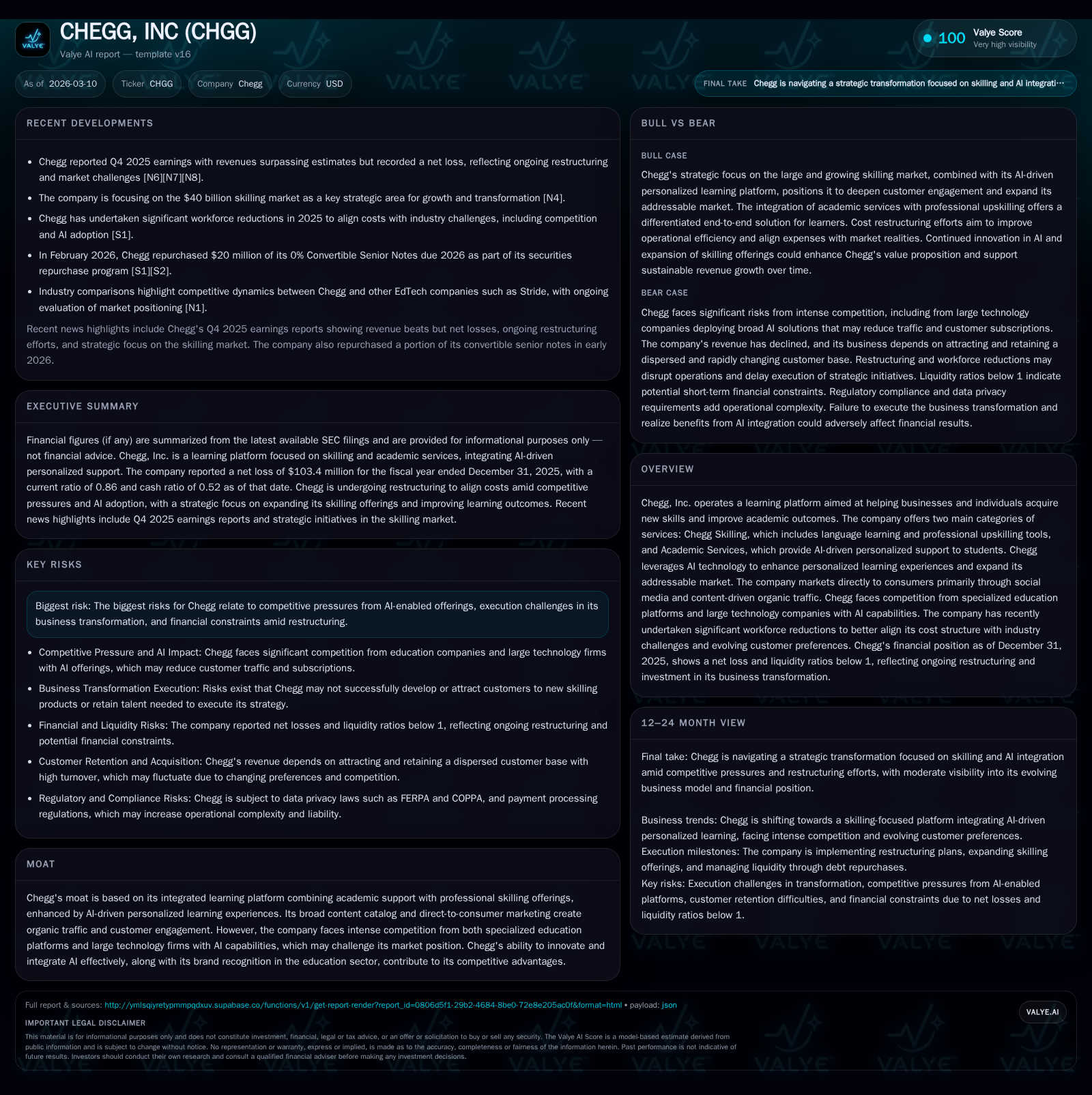
Chegg, Inc. reported continued revenue declines and operating losses in 2025 despite efforts to pivot toward a skilling-focused business model powered by AI. The company undertook significant workforce reductions and cost rationalization in response to competitive headwinds from generative AI tools offered by large technology companies. Chegg’s core Academic Services segment remains under pressure, while its growing Skilling segment targets a large market opportunity in workforce upskilling and language learning. Liquidity remains adequate with positive operating cash flow for 2025, though free cash flow was negative due to capital expenditures. The company paused share repurchases to preserve capital. Key areas for investors include execution of AI integration, growth in the skilling business, and navigating regulatory risks related to data privacy.
Historical Performance Overview
Chegg’s recent financial performance underscores the challenges faced during rapid technological disruption in education. Revenue dropped sharply from approximately $474 million in fiscal year 2024 to about $304 million through the first nine months of 2025 per SEC filings [S2][F1]. This decline largely reflects reduced demand for traditional Academic Services as competitors leverage generative AI tools.
Operating losses improved markedly, narrowing from -$737 million in 2024 to -$117 million in 2025, signaling effective cost management including workforce reductions [F1]. Net losses followed a similar trajectory improving from -$837 million to -$103 million year-over-year.
Cash flow dynamics show positive operating cash flow of $15 million for full-year 2025, although free cash flow remained negative due to capital expenditures of $28 million invested primarily in technology development and platform enhancements [F1].
Historical performance (annual)
| FY | Net ($mm) | CFO ($mm) | OpInc ($mm) | Capex ($mm) | Net YoY |
|---|---|---|---|---|---|
| 2025 | -103 | 15 | -117 | 28 | +87.6% |
| 2024 | -837 | 125 | -737 | 75 | -4704.3% |
| 2023 | 18 | 246 | -68 | 83 | -93.2% |
| 2022 | 267 | 256 | 9 | 103 |
Source: SEC companyfacts cache [F1].
Capital returns and efficiency (annual)
| FY | Buybacks ($mm) | FCF ($mm) | ROE% |
|---|---|---|---|
| 2025 | 0 | -13 | -86.5 |
| 2024 | 3 | 50 | -433.8 |
| 2023 | 335 | 163 | 1.9 |
| 2022 | 324 | 153 | 23.9 |
Source: SEC companyfacts cache [F1].
*Figures for FY2025 represent partial year annualized based on available quarterly data.
Business Model and Strategic Pivot
Chegg operates two main segments: Academic Services providing AI-enabled personalized homework help, writing assistance, and math problem solving; and Chegg Skilling focusing on professional upskilling programs including language learning tailored for workforce readiness [S4][S8].
The legacy Academic Services segment faces disruption from widespread availability of generative AI tools that offer immediate answers outside subscription models. In response, Chegg partnered with OpenAI starting mid-2023 to integrate GPT-4 capabilities into its platform aiming to enhance personalization and scalability of learning support [S19]. However, adoption has been slower than expected.
The Chegg Skilling segment targets a sizable ~$40 billion market opportunity encompassing technical skills such as coding, cybersecurity, data analytics alongside foundational business skills. These offerings leverage modular content delivery combined with real-time learner progress tracking powered by predictive AI nudges designed according to learning science principles to improve engagement and completion rates. This segment also focuses on enterprise customers seeking scalable talent development solutions [S8][N10].
Marketing strategies emphasize direct-to-consumer social media channels alongside organic traffic driven by Chegg’s extensive content library. Lifecycle marketing campaigns aim at onboarding new users, deepening engagement via cross-selling, and retention through promotional initiatives [S5].
Competitive Landscape
Chegg operates within a fragmented competitive environment. Its language learning platform competes with niche providers like Duolingo and GoFluent while workforce skilling faces rivals including Simplilearn, General Assembly, Codecademy among others offering both independent courses and institution-partnered credentials [S10].
More significantly, large technology companies embedding advanced AI into search engines and educational tools pose substantial challenges. For example, Google’s Artificial Intelligence Overview (AIO), launched broadly since mid-2024, presents AI-generated answers directly within search results reducing referral traffic to Chegg’s sites and impacting subscriber acquisition [S23][S24]. Other competitors include Microsoft leveraging OpenAI models plus Meta and Anthropic targeting education sectors.
Universities themselves are developing proprietary AI tutoring systems potentially cannibalizing third-party offerings. Additionally, content piracy remains an ongoing risk diluting monetization.
Financial Discipline Amid Restructuring
In response to sustained headwinds, Chegg implemented two major workforce reductions during 2025 cutting approximately 56% of its global employees (~640 positions) aiming to align costs with declining revenues while prioritizing investment toward strategic skilling initiatives [S16].
Liquidity remains sufficient with cash plus short-term investments exceeding $93 million as of late-2025 following debt repayments including repurchases of convertible senior notes due this year that partially alleviate balance sheet pressures [S3][F1]. However, accumulated deficits nearing $960 million reflect prolonged unprofitability.
Capital allocation priorities shifted away from share buybacks which ceased after modest repurchase programs totaling roughly $3 million in fiscal year 2024; no dividends have been declared historically reflecting focus on preserving capital during financial recovery [F1][S26].
Outlook: Execution Risks and Milestones
While explicit forward guidance remains limited beyond strategic disclosures and restructuring updates [N10], key factors influencing future performance include:
- Scaling Skilling Segment: Successful expansion of enterprise partnerships converting employer demand into sustainable revenues diversifying away from Academic Services.
- AI Integration: Effectiveness of ongoing GPT-4 enhancements driving user engagement versus competitive AI alternatives.
- Customer Metrics: Subscriber growth and retention remain critical given high churn inherent among student populations.
- Regulatory Compliance: Navigating data privacy laws such as FERPA and COPPA which may impose operational constraints or increased costs.
- Competitive Pressures: Ability to counteract free or low-cost alternatives offered by well-resourced tech competitors.
Investors should monitor quarterly reports for updates on active users by segment, marketing efficiency metrics, and cost control progress as indicators of potential inflection points.
Conclusion
Chegg stands at a crucial juncture amid an evolving edtech landscape rapidly reshaped by generative AI innovation. Financials reveal contraction after years of growth followed by severe losses; however, recent restructuring efforts indicate improved operational discipline.
The dual focus on workforce skilling alongside legacy academic support offers potential synergies but execution risks remain elevated amid intensifying competition from tech giants with substantial resources. Regulatory uncertainties add complexity particularly related to data privacy compliance.
Continuous monitoring of user engagement trends aligned with AI product rollout success alongside disciplined capital management will be essential for assessing Chegg’s path toward sustained recovery.
This analysis is based exclusively on publicly available information including recent SEC filings ([F1],[S1]-[S29]) and reputable news sources ([N1]-[N14]) as of March 10th, 2026.
Disclaimer: This is research-only, informational analysis and not investment advice. It may include AI-generated interpretation and general industry context. Always verify important details using primary sources.

Comments