
ACRES Commercial Realty Corp. Grows Net Income Despite Revenue Decline and Cash Flow Pressure in 2025
The company’s expertise in commercial mortgage loan structuring supports stable earnings amid market headwinds and cybersecurity risk oversight.
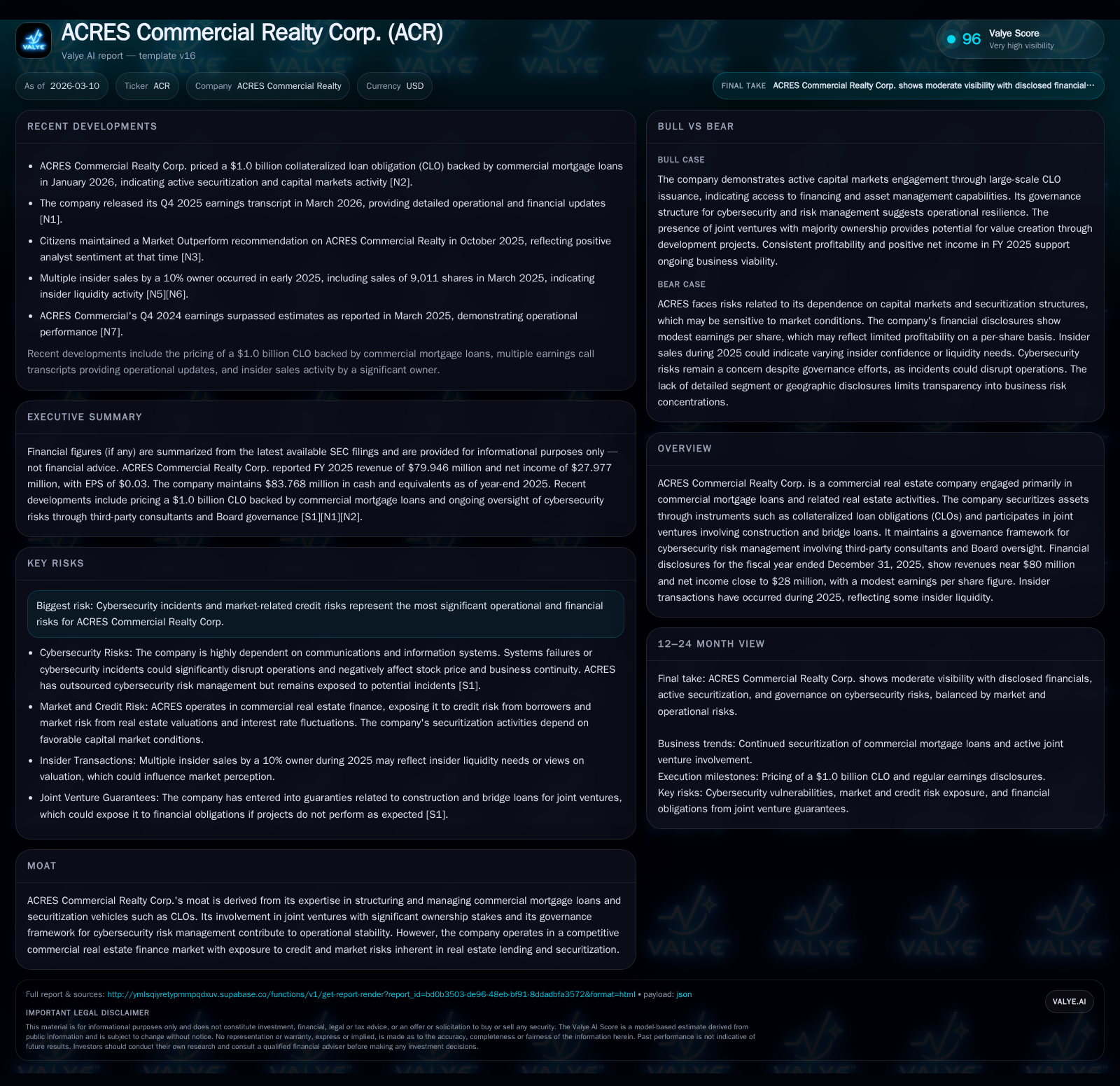
ACRES Commercial Realty Corp., specializing in commercial mortgage loans and securitizations, reported a 4.2% revenue decline to $79.9 million in 2025, tempered by a remarkable net income surge to $27.98 million. Despite this profitability boost, operating cash flow plunged nearly 79%, raising questions about near-term liquidity management. The firm’s strategic focus on joint ventures for construction and bridge loans, coupled with robust cybersecurity governance, underpins operational stability in a competitive environment fraught with credit risks. Capital allocation remains active with $22.3 million spent on share repurchases, signaling confidence despite cautious dividend payments.
Company Overview and Market Positioning
ACRES Commercial Realty Corp. operates predominantly within the commercial real estate finance sector focusing on originating and managing commercial mortgage loans alongside related property finance activities. Its business model involves financing via construction and bridge loans held often through joint ventures where it maintains significant ownership stakes—typically around 90%. Key to the firm's risk profile is its engagement in securitization of its loan portfolios primarily through collateralized loan obligations (CLOs), which demands sophisticated structuring capabilities to mitigate credit exposure while seeking yield enhancement.
Historical Financial Performance
Over the past four years ending in 2025, ACRES experienced fluctuations in revenues linked largely to the cyclical nature of its real estate lending operations and securitization markets (see table below):
Historical performance (annual)
| FY | Rev ($mm) | CFO ($mm) | Rev YoY |
|---|---|---|---|
| 2025 | 80 | 4 | -4.2% |
| 2024 | 83 | 19 | -8.4% |
| 2023 | 91 | 46 | +21.2% |
| 2022 | 75 | 33 |
Source: SEC companyfacts cache [F1].
Capital returns and efficiency (annual)
| FY | Buybacks ($mm) |
|---|---|
| 2025 | 22 |
| 2024 | 8 |
| 2023 | 7 |
| 2022 | 9 |
Source: SEC companyfacts cache [F1].
Revenues peaked in FY2023 at about $91 million before easing back due to market tightening or loan turnover dynamics impacting origination volume and yields.
In contrast with revenue softness, net income showed dramatic improvement reaching nearly $28 million in fiscal year 2025 compared to historical losses through much of the prior decade, illustrating effective expense control or favorable non-operating factors such as gains from loan sales or investment income [F1]. The company's approximate return on equity based on FY25 net income relative to its $421 million equity base is around 6.6% [F1].
Operating cash flow has contracted notably from highs exceeding $45 million down to just over $4 million by year-end 2025, highlighting diminished cash-generative capacity or changes in working capital requirements—potentially due to timing effects around securitizations or delayed cash receipts [F1]. Capital expenditures remain negligible historically reflecting a focus on financing rather than property ownership.
Growth Drivers and Constraints
Future growth avenues hinge on ACRES' capacity to expand its commercial mortgage loan originations while effectively managing credit quality within an intensely competitive marketplace for real estate finance capital [N1][S1]. The company's joint venture strategy allows shared risk exposure especially for higher-risk construction and bridge loans; however, such ventures also entail guaranty agreements which heighten contingent liability [S8][S9], exemplified by recent guarantees of completion and repayment obligations tied to specific multi-million-dollar projects.
Securitization via CLOs continues as a fundamental channel for both liquidity and risk transfer but is sensitive to broader capital markets conditions and investor appetite for structured credit products [N1]. Furthermore, credit risk trends amid shifting economic cycles impose downside pressure if borrower defaults rise or collateral values decline.
Cybersecurity represents an operational frontier where ACRES invests substantially into third-party managed controls overseen at board level to prevent incidents that could disrupt systems vital for transaction processing and reporting [S1][S10][S12]. Given reliance on information technology infrastructure for underwriting and portfolio management, breaches would pose serious reputational and financial damage risks.
Forecasts and Milestones
While explicit forward-looking guidance is not disclosed in filings, milestones worth monitoring include:
- Completion status of joint venture construction projects subject to guaranties
- Trends in new loan originations versus repayments/refinancings impacting revenue trajectory
- Changes in CLO issuance volumes reflecting capital market receptivity
- Developments around regulatory frameworks impacting commercial real estate finance securitizations
- Cybersecurity incident tracking disclosures or policy updates [N1][S3]
Capital Allocation & Returns Profile
ACRES displays active capital return activity with $22.3 million deployed for share repurchases in FY2025 against roughly $7–9 million annually over previous years, signaling heightened shareholder return emphasis despite lower operating cash flow availability [F1]. Dividend payments have been more modest relative to historical distributions particularly compared with prior peak payout years like FY2019 which saw upwards of $27 million dividends but appear undeclared at latest filings.
The company holds substantial cash and equivalents totaling approximately $83.8 million as of December 31, 2025, enhancing liquidity buffers amidst fluctuating cash flows [F1]. Leverage metrics are not explicitly detailed here but ongoing debt arrangements include preferred stock issuances carrying fixed-to-floating rates potentially influencing cost of capital dynamics [S8][S14].
Strategic Risks Considerations
Key operational threats stem from cybersecurity vulnerabilities given the criticality of information systems in controlling exposures across syndicated loans and CLO structures [S1]. Market cycles influencing interest rates, real estate valuations, and borrower creditworthiness further compound risks inherent in ACRES’ lending portfolio [S5][S10]. Moreover, environmental indemnities linked with loan guarantees place financial responsibilities contingent on external factors beyond direct control [S9][S14]. Competitive pressures within commercial mortgage finance necessitate continued innovation in financing terms and partnership structures.
Conclusion
ACRES Commercial Realty Corp.’s financial profile presents a mixed landscape: marked recent net income strength contrasts against receding revenue and sharply diminished operating cash flow indicating potential challenges ahead for sustaining earnings quality without operational adjustments or refinancing initiatives. The company’s domain expertise in structured commercial mortgage lending combined with disciplined cybersecurity governance forms its moat against competitive headwinds, albeit accompanied by elevated credit exposure requiring vigilant risk management.
As the firm advances in managing project guaranties and responds adaptively within capital markets for CLO securitizations, close attention should be paid to evolving liquidity positions, contract performance outcomes within joint ventures, and any signposts regarding cybersecurity incidents affecting business continuity.
This memorandum synthesizes data extracted exclusively from ACRES Commercial Realty Corp.'s publicly filed SEC reports as of March 10, 2026 ([F1],[S1]-[S25]) alongside reported earnings commentary ([N1]). It does not constitute investment advice or recommendations regarding the securities of ACRES or any other entity.
Disclaimer: This is research-only, informational analysis and not investment advice. It may include AI-generated interpretation and general industry context. Always verify important details using primary sources.

Comments