
Parke Bancorp: Sustaining Growth Through Localized Lending and Strategic Capital Management
Parke Bancorp has leveraged its regional banking model focusing on southern New Jersey and Philadelphia to deliver notable growth and capital discipline.
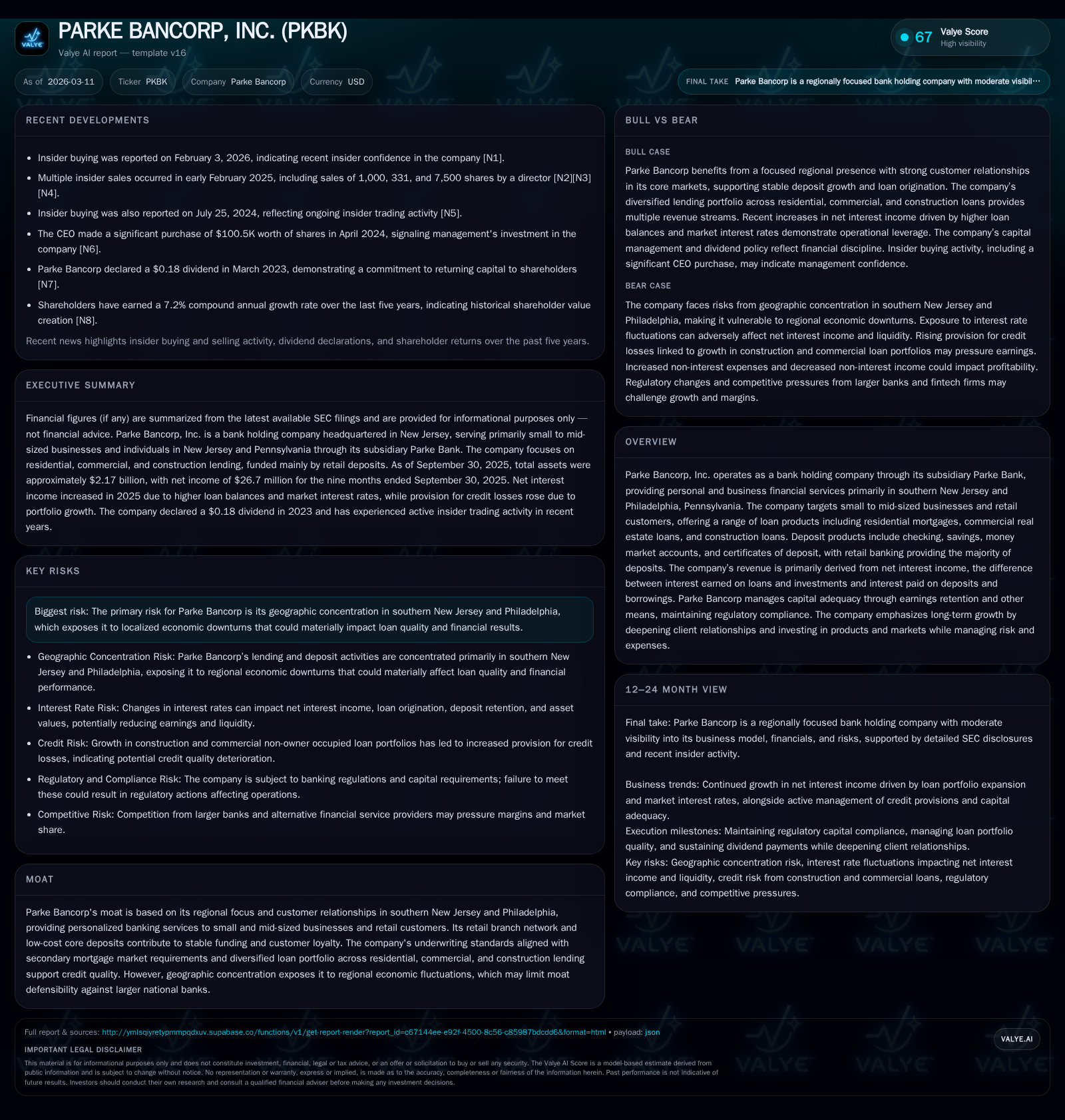
Parke Bancorp, Inc. operates predominantly in southern New Jersey and Philadelphia, employing a relationship-driven approach to serve small to mid-sized businesses and retail clients. Its historical financials show a strong rebound in net income with a 37.3% increase from 2024 to 2025, supported by disciplined capital retention and modest buybacks. The bank maintains a diversified loan portfolio with an emphasis on commercial real estate, residential mortgages, and construction loans, all underpinned by underwriting standards aligned with secondary mortgage market criteria. While localized economic dependency poses risk, the bank’s stable core deposits help mitigate funding volatility. Looking forward, growth hinges on expanding these core lending relationships organically alongside management's cautious navigation of interest rate risks.
Historical Financial Performance and Earnings Drivers
Parke Bancorp’s recent financial trajectory highlights a robust recovery culminating in a net income of approximately $37.8 million for FY2025—a sizable 37.3% increase over the prior year [$F1]. This rebound reflects higher net interest income stemming from incremental lending volumes across its core portfolios plus improved interest margins influenced by prevailing rate hikes [S2][S9]. Operating cash flow also advanced by 12.5% in this period ($39.6 million CFO), signaling enhanced cash-generative capacity despite minimal capital expenditure outlays (only $595 thousand in FY2025) that support operational leverage without diluting returns [$F1]. Collectively, these factors underpin an approximate return on equity (ROE) of 11.6% for FY2025, demonstrating effective profitability relative to shareholders’ equity.
Historical performance (annual)
| FY | Net ($mm) | CFO ($mm) | Capex ($) | Net YoY |
|---|---|---|---|---|
| 2025 | 38 | 40 | 595000 | +37.3% |
| 2024 | 28 | 35 | 119000 | -3.3% |
| 2023 | 28 | 23 | 150000 | -31.9% |
| 2022 | 42 | 43 | 150000 |
Source: SEC companyfacts cache [F1].
Capital returns and efficiency (annual)
| FY | Div ($mm) | Buybacks ($mm) | FCF ($mm) |
|---|---|---|---|
| 2025 | 8 | 6 | 39 |
| 2024 | 9 | 4 | 35 |
| 2023 | 9 | 23 | |
| 2022 | 8 | 43 |
Source: SEC companyfacts cache [F1].
Loan Portfolio Composition and Impact on Revenue Streams
The bank’s lending activities concentrate on three primary verticals: residential mortgage loans (both fixed- and adjustable-rate secured by one- to four-family homes plus multifamily properties), commercial real estate loans spanning owner-occupied and non-owner occupied offices, retail spaces, warehouses, and construction loans emphasizing real estate acquisition and property development [S6][S8][S21]. All are underwritten to meet secondary mortgage market standards, ensuring eligibility for pledging which aids liquidity flexibility.
Increases mainly occurred within construction loans (+41.5% increase year-over-year as of Q3 '25) and commercial non-owner occupied mortgages (~plus $1.2 million), whereas certain residential investment portfolios experienced contraction [S21][S29]. This diversification across loan types supports revenue stability but magnifies geographic exposure risks.
Deposit funding is anchored heavily in retail branches located across southern New Jersey towns like Galloway Township along with Philadelphia PA sites enhancing customer loyalty inherent in this localized franchise [S6][S10]. These core deposits offer a stable low-cost foundation compared with volatile brokered deposits sourced through third parties including Wells Fargo, Piper Sandler, and Stonecastle totaling roughly $87–90 million as of late-2025, while off-balance sheet IntraFi sourced products remain unused [S9][S14].
Capital Structure Evolution and Shareholder Return Measures
Equity expanded steadily reflecting profit retention intact with total stockholders’ equity rising from roughly $300 million at end-2024 to $324.5 million at December ’25 closing [$F1]. This was partially offset by consistent common dividend payments around $8.4 million annually and stepped-up share repurchases totaling approximately $6.5 million in FY2025—a near doubling year-over-year [$F1][S9][S22]. Liquidity management involved shrinking borrowings notably the repayment of Federal Home Loan Bank of New York (FHLBNY) advances falling from $145 million end-2024 to $70 million by Q3 ’25 [S4][S9].
The company continues classifying both itself and its bank subsidiary as “well capitalized” maintaining robust Tier 1 leverage ratios above regulatory minimums (~15%) providing a comfortable buffer against credit or macroeconomic shocks [S19][S20]. This conservative capital footing underlines strategic priority toward sustainable earnings growth over aggressive external financing.
Regional Economic Exposure: Risks and Mitigants
Parke Bancorp's moat derives significantly from its tight local-market customer intimacy concentrated in southern New Jersey and Philadelphia metropolitan areas . While this focus fosters depth in client relationships supporting deposit stickiness and underwriting insight for small/mid-sized business credit decisions, it conversely concentrates credit risk susceptible to regional economic downturns including real estate sector fluctuations or unemployment shifts [S2][S12].
Stable core deposit inflows counterbalance this risk mechanism somewhat; nonetheless geographic concentration remains an embedded limitation versus more widely diversified peers . The absence of material regulatory risk disclosures beyond standard compliance reinforces this viewpoint though vigilance on local market conditions will remain essential.
Outlook for Loan Growth and Deposit Stability
Management emphasizes organic client relationship expansion as the linchpin for future growth rather than rapid acquisitions or aggressive geographic diversification [S6][N1]. Recent footprint extensions into New York State and South Carolina diversify opportunity sets marginally but are modest relative to overall operations [S13]. Deposit sourcing balances traditional retail packages against strategic brokered arrangements; retailer loyalty yields lower cost core deposits supporting loan growth capacity even amid rising competitive pressures for funds.
Analysis suggests management’s balancing act involves nurturing these profitable deposit relationships while cautiously utilizing higher-priced brokered accounts only when advantageous [S14]. Regional economic performance will inherently cap scaling potential absent further geographies entered or product innovation.
Interest Rate Environment and Margin Considerations
Interest rate volatility remains pivotal given Parke Bancorp's asset/liability profile heavily weighted toward fixed maturities that reprice infrequently compared with floating counterparts such as money markets or adjustable-rate commercial loans [S2]. Rising rates during the last reporting periods have expanded net interest margins up toward ~3.8% from lower levels previously at ~3%–3.3%, reflecting improved spreads between loan yields and deposit costs [S18][S26].
Liquidity holdings are conservatively maintained mostly as balances with the Federal Reserve limiting duration risk though timing mismatches occur due to commercial loan repricing windows averaging five years creating asset sensitivity challenges amid rapid Fed policy changes [S2][S18].
Key Upcoming Milestones and Investor Considerations
Investors should closely monitor forthcoming quarterly earnings announcements given continuing macroeconomic complexities impacting credit loss provisions and net interest margin dynamics [N1][S3]. Also relevant will be any updates on regulatory capital reviews or shifts in strategic emphasis toward new markets or product lines that could recalibrate growth trajectories beyond current organic baselines.
Explicit forward guidance remains unpublished; thus qualitative signals—loan originations pace, deposit mix evolution, efficiency ratio developments—will be vital markers for assessing momentum.
This report synthesizes publicly available filings including SEC disclosures through March 11, 2026 ([F1], [S#]), alongside recent market news ([N1]) without incorporating speculative forecasts or valuation judgments. It aims solely to provide a detailed operational understanding of Parke Bancorp's recent performance patterns alongside contextual industry challenges pertinent for internal research purposes.
Disclaimer: This is research-only, informational analysis and not investment advice. It may include AI-generated interpretation and general industry context. Always verify important details using primary sources.

Comments