
Bitwise Bitcoin ETF’s Financial Oscillations: Assessing Volatility and Capital Strategies in 2025
BITB experienced dramatic financial swings in 2025 driven by bitcoin’s price volatility and regulatory pressures, prompting a distinct capital allocation approach.
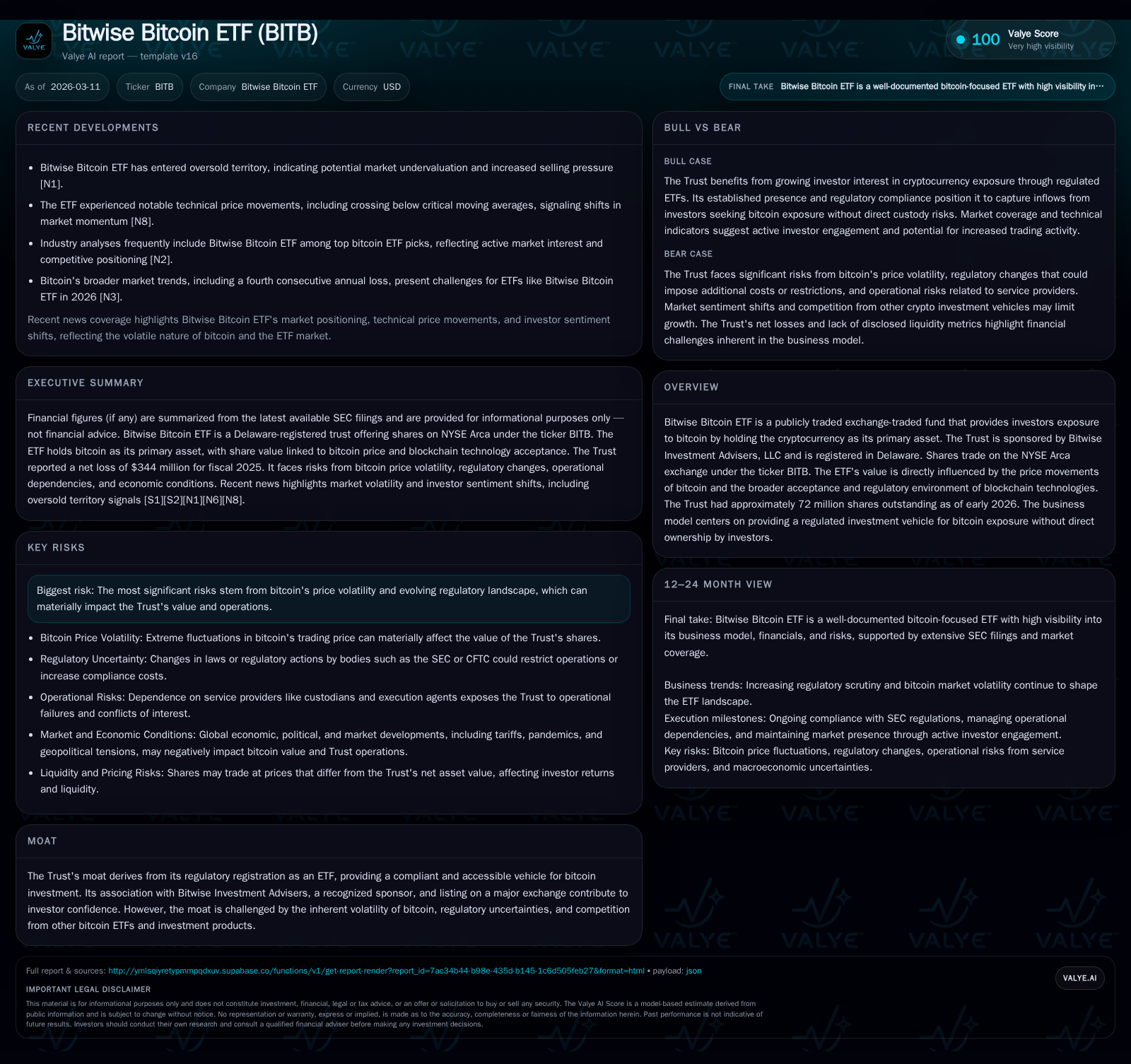
Bitwise Bitcoin ETF (BITB) faced a sharp reversal from a $1.59 billion net income gain in 2024 to a $344 million net loss in 2025, reflecting bitcoin market fluctuations and trust-specific operational factors. Despite the loss, operating cash flow swung positive for the first time, evidencing improved liquidity dynamics. The trust aggressively repurchased $2.46 billion of shares during 2025 despite earnings headwinds, signaling management’s active capital deployment stance amid regulatory uncertainties and NAV discount pressures. Key risks include volatile bitcoin valuations, evolving SEC oversight via initiatives like the Crypto Task Force, and dependence on service providers’ stability. Forward-looking catalysts hinge on regulatory clarity and bitcoin adoption trends.
From Sharp Profit Swings to Emerging Cash Flows: Bitwise Bitcoin ETF’s Recent Financial Journey
BITB’s financial statements for FY2025 illustrate striking volatility emblematic of its bitcoin underpinnings. Net income plunged steeply from a positive $1.59 billion in FY2024 to a loss of $344 million in FY2025, representing a -121.7% year-over-year change [F1]. This drastic swing directly corresponds with bitcoin’s inherent price volatility and related mark-to-market effects on the Trust’s underlying crypto holdings.
Concurrently, operating cash flow underwent a remarkable turnaround, shifting from a negative $2.17 billion in FY2024 to positive $39 million in FY2025—a shift of over +100% year-over-year [F1]. This inflection underscores an evolution in cash generation capacity that mitigates some concerns about ongoing liquidity despite earnings deficits.
A notable aspect is the substantial acceleration in share buybacks, rising by +42.2% year-over-year to $2.46 billion deployed in FY2025 versus $1.73 billion prior [F1]. This juxtaposition of aggressive capital return alongside losses suggests management’s strategic preference for deploying excess cash into shares during perceived undervaluation periods rather than accumulating retained earnings.
Historical performance (annual)
| FY | Net ($mm) | CFO ($bn) | Net YoY |
|---|---|---|---|
| 2025 | -344 | 0.0 | -121.7% |
| 2024 | 1587 | -2.2 | |
| 2023 | 0.0 |
Source: SEC companyfacts cache [F1].
Capital returns and efficiency (annual)
| FY | Buybacks ($bn) |
|---|---|
| 2025 | 2.5 |
| 2024 | 1.7 |
| 2023 |
Source: SEC companyfacts cache [F1].
Table: Bitwise Bitcoin ETF Annual Key Financial Data Summary (FY2024 vs FY2025) [F1]
Bitcoin Price Volatility and Regulatory Milestones Shaping Trust Valuation
BITB’s reliance on bitcoin as its sole asset exposes it directly to extreme digital currency market fluctuations documented repeatedly in SEC risk disclosures [S2–S8]. The rapidly evolving nature of blockchain technology adoption and unregulated ecosystems contributes to an uncertain medium-term value outlook for Shares.
Regulatory forces have become increasingly influential with the SEC’s Crypto Asset Task Force explicitly aiming to bolster oversight of digital asset market participants [S3–S6]. Such measures heighten compliance burdens potentially translating into extraordinary expenses or operational constraints for the Trust.
Furthermore, fluctuations in trading price relative to NAV—often due to investor sentiment shifts—pose valuation risks signaling structural inefficiencies and premium/discount cycles intrinsic to crypto ETFs [S2][N1].
Operational Dependencies: Custodian, Execution Agents, and Their Impact on Risk Profile
Critical operational risks arise from BITB's dependence on third-party custodians managing bitcoin custody and prime execution agents facilitating portfolio transactions [S2–S6]. These entities must uphold rigorous security protocols given the irreversible nature of blockchain transactions.
Counterparty risk is significant because custodian failures or service interruptions could severely disrupt Share pricing mechanisms and compromise asset integrity—a sector-specific vulnerability acute among crypto ETFs reliant on secure cold storage infrastructures.
Tariffs or geopolitical actions affecting infrastructure providers pose additional threats highlighted within SEC filings emphasizing intertwined global economic factors impacting trust operations [S3][S4].
Navigating Regulatory Trends: Implications of SEC and Crypto Task Force Actions on Business Model
Ongoing scrutiny raises the possibility that BITB or its Sponsor could be reclassified under money transmission or money services laws [S3–S6], triggering stringent state-level licensing requirements and heightened compliance costs.
Such regulatory redefinitions may curtail liquidity options for Shares or impose extraordinary nonrecurring expenses that erode profitability metrics and constrain capital flexibility—a notable concern for a vehicle whose performance hinges on minimizing overhead while maximizing bitcoin exposure efficacy.
These enforcement developments demand proactive governance adaptability around legal interpretations impacting trust status and operational scope going forward.
Capital Allocation Dynamics: Analyzing Buybacks, Dividends, and Liquidity Position
In the context of a negative net income year coupled with improving CFO figures [F1], BITB embarked on an unusually aggressive share repurchase path totaling $2.46 billion in FY2025 [F1][S14][S15].
This tactical capital deployment profile contrasts typical investment trusts which often conserve cash when experiencing losses; instead, BITB appears focused on shareholder value preservation through buybacks—potentially seeking undervaluation arbitrage while maintaining strategic liquidity buffers reported elsewhere [S16].
No dividends were declared according to filings; thus, returns largely stem from capital appreciation tied to NAV fluctuations managed via these buybacks.
Investor Confidence and Trading Behavior amid NAV Price Divergences
Nasdaq commentary dated February 12, 2026 reports BITB shares reaching oversold extremes [N1], reflecting widespread investor anxiety amidst regulatory uncertainty and volatile cryptocurrency markets.
Such behavioral patterns exacerbate disconnects between Shares’ market prices versus underlying NAVs—a phenomenon magnified by thin trading volumes relative to broader equity ETFs but not uncommon among niche crypto asset funds [S2].
This dynamic further challenges intrinsic valuation assessments since price discovery incorporates shifting sentiment beyond fundamental asset valuations.
Strategic Outlook: Tracking Key Catalysts and Risk Factors Into 2026
Looking ahead into 2026, essential markers include regulatory clarity progress—particularly any tangible outcomes from SEC Crypto Task Force initiatives—and developments within bitcoin adoption trends globally [N1][S2][S3][S14].
Additionally, operational continuity via stable custodian relationships will remain critical as heightened cyber-security threats loom across digital asset handlers.
Capital allocation choices will warrant monitoring closely; ongoing large-scale buybacks during periods of persistent market uncertainty may test trust resilience if sustained losses recur.
Ultimately, investors and stakeholders must observe these interlocking variables influencing BITB’s performance trajectory within an environment defined by evolutionary technology adoption tethered tightly to government policy shifts.
Disclaimer: This analysis is based solely on information publicly available through SEC filings and recent news reports as cited; it does not constitute investment advice or recommendations.
Disclaimer: This is research-only, informational analysis and not investment advice. It may include AI-generated interpretation and general industry context. Always verify important details using primary sources.

Comments