
Target Hospitality’s Contract-Centric Model Drives Revenue Stability Amid Customer Concentration Risks
The company’s vertically integrated rental and hospitality services ensure recurring revenue, but large customer dependencies and liquidity constraints present challenges.
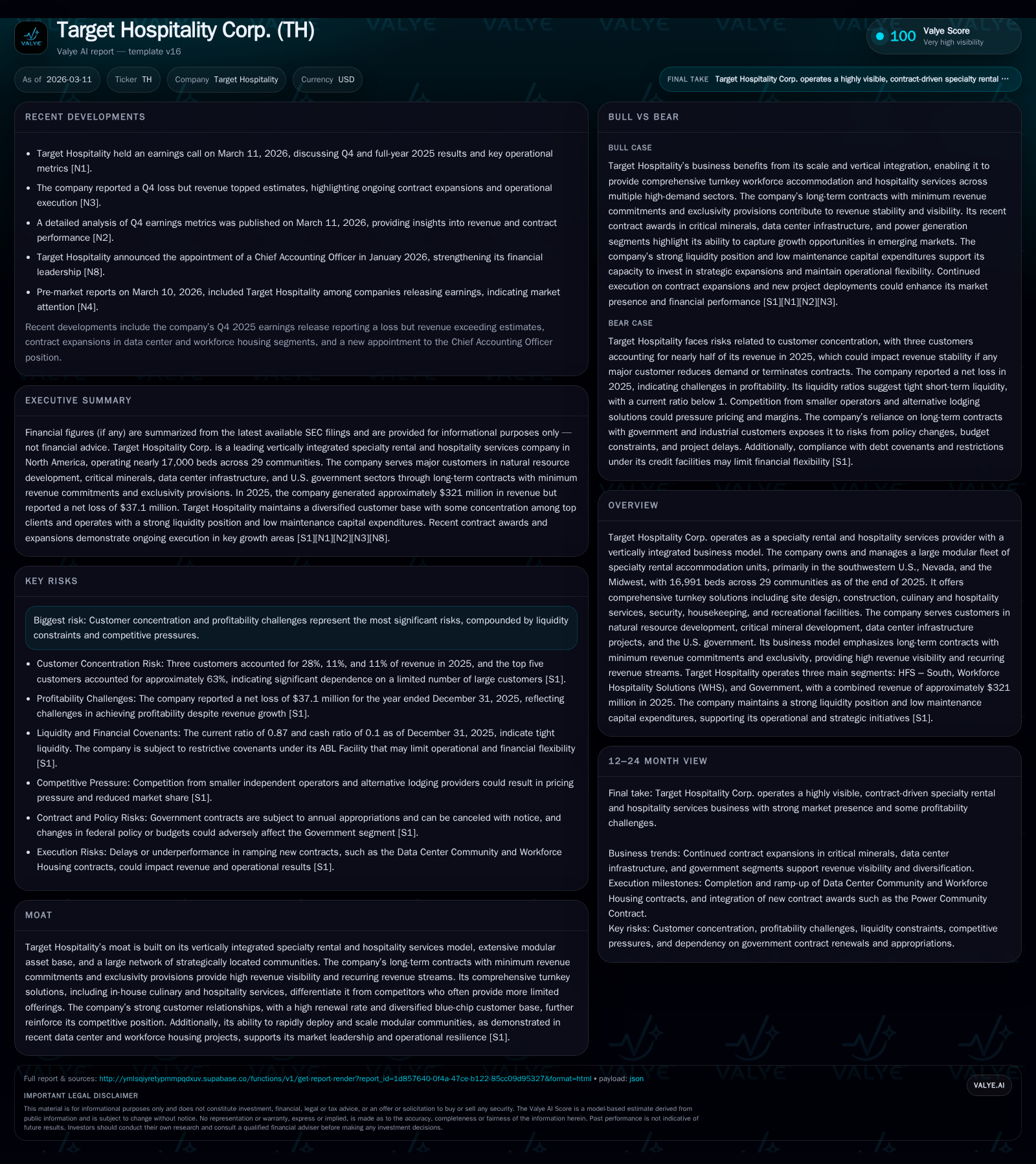
Target Hospitality Corp. operates a niche specialty rental and hospitality business, predominantly in the U.S. Southwest, serving natural resource, critical minerals, data centers, and U.S. government sectors through long-term contracts with high renewal rates. Its asset-light modular model with turnkey services generates stable cash flows yet significant revenue concentration among a few customers remains a key risk. The firm maintains strong growth prospects by expanding contract scope and pursuing new markets but faces liquidity pressures and competitive headwinds that warrant close monitoring.
Company Overview and Business Model
Target Hospitality Corp., founded in 1978 but operating its specialty rental and hospitality services model since 2006, holds a leading position within North America’s workforce housing solutions sector. It manages an extensive fleet of modular accommodation units—16,991 beds spread across 29 strategically located communities as of December 31, 2025—primarily servicing the natural resource development hubs of the southwestern United States alongside select facilities in Nevada and the Midwest [S1][S20].
The company’s business model integrates ownership and management of modular rental assets with comprehensive turnkey hospitality offerings ranging from site design to culinary services, housekeeping, security, concierge operations, and recreational amenities. By doing so directly via its own employees operating continuously throughout the year under its "Target 12" service commitment model, Target Hospitality offers superior control over quality and customer experience compared to competitors who outsource parts of their services [S10].
The customer base comprises blue-chip clients predominantly involved in natural resource extraction (especially around the Permian Basin), critical minerals development, large-scale data center infrastructure projects fueling cloud growth and AI workloads, as well as U.S. government contractors providing migrant services [S6][S8][S20]. The firm also holds a General Services Administration (GSA) schedule contract facilitating streamlined sales to federal agencies [S5][S20].
Historical Performance Drivers
For fiscal year ended December 31, 2025, Target Hospitality reported approximately $321 million in revenues [S1]. This revenue was distributed across its main business segments as follows: HFS – South (44%), WHS – Workforce Hospitality Solutions (30%), Government segment (22%), with remaining contributions from smaller operations [S7].
Revenue breakdown indicated that about 58.5% derived from specialty rental accommodations coupled with vertically integrated hospitality services; leasing-only arrangements made up roughly 14.3%, while construction fee income tied to community buildouts accounted for some 27.2%. This mix reflects the company’s strategy of embedding itself into long-term customer operations by bundling asset rentals with support services that enhance workforce productivity on client sites [S1].
Additionally, Target Hospitality benefits from longstanding relationships with approximately 320 customers including several investment-grade natural resource producers and infrastructure companies. These relationships underpin multi-year contract agreements characterized by minimum revenue commitments—about 16% of total revenues in 2025 included such guarantees—and geographic exclusivity clauses that provide high confidence in cash flow predictability [S21]. Historical client retention has exceeded 90% for five consecutive years demonstrating resilience through varying economic cycles [S6][S21]. The company leverages a scalable modular asset base whose relocatability allows redeployment across segments or regions responding dynamically to shifts in customer demand profiles [S6][S21].
| Fiscal Year | Revenue ($M) | HFS-South % | WHS % | Government % | Leasing & Construction Fee % | Client Retention % | Liquidity ($M) |
|---|---|---|---|---|---|---|---|
| 2025 | ~321 | 44 | 30 | 22 | ~42 | >90 | ~183 |
Note: Liquidity includes unused capacity on ABL credit line plus cash equivalents.
Future Growth Prospects
Target Hospitality is positioned to grow via expansion within existing industry verticals—natural resources and critical minerals—and by deepening penetration into emerging markets such as hyperscale data center construction projects which require significant labor housing solutions near remote infrastructure sites [S8][N1]. The company emphasizes enhancing contract scopes by offering complementary amenities to increase client reliance on its turnkey offerings.
Its modular fleet enables relatively rapid community deployment or expansion tailored to labor shifts driven by cyclical commodity demand or large capital projects—a key differentiator enhancing customer stickiness compared to less flexible competitors relying on fixed assets or tent-based accommodations [S6][S13]. Furthermore, its contracting approach prioritizes minimum guaranteed revenues together with geographical exclusivity provisions restricting customers from utilizing alternative accommodation providers within covered areas—thereby locking expected volumes effectively for up to an average weighted contract length around five years with renewals typically realized above a 90% rate historically [S21].
Growth could be moderated if there are project delays or cancellations among major hyperscale technology customers or if natural resource investments decline sharply due to volatile commodity prices or regulatory changes impacting fossil fuels and minerals extraction [S16][N3]. Competitive pricing pressure may intensify given the fragmented competitor landscape where smaller providers compete primarily on price without comparable service breadth or scale benefits offered by Target Hospitality’s vertically integrated model [S4][N2]. Additionally, expansions into new geographies pose execution risks related to regulatory environments, labor sourcing challenges amid tight hospitality staffing markets, and operational scalability concerns [S11][N1].
Operational Milestones & Expectations
While explicit financial guidance was not provided publicly for upcoming periods, management highlighted priorities including:
- Fully converting newly awarded contracts acquired after losing the prior PCC government contract into occupancy.
- Expanding footprint related to data center workforce housing deployments.
- Further diversifying industry end-markets beyond traditional oil & gas fields.
- Maintaining compliance with financial covenants under its asset-backed lending facility recently modified to allow flexibility around planned capital expenditures.
Investors should monitor occupancy ramp rates at reopened government facilities such as the Dilley Immigration Processing Center following reactivation in March 2025 after previous termination in August 2024. Performance metrics here alongside government subcontract renewals will indicate operational stability amid shifting political environments affecting immigration policies [S6][N3][N1]. Backlog growth linked to critical mineral development projects would also signal success penetrating higher-growth end-markets less exposed to oil sector volatility.
Capital Allocation & Financial Positioning
As of December 31, 2025, Target Hospitality reported zero outstanding indebtedness excluding finance leases but maintained access to a $175 million asset-based revolving credit facility which was undrawn at year-end providing liquidity totaling approximately $183 million inclusive of ~$8 million cash reserves [S9][S19]. This balance sheet posture supports financial flexibility though facility covenants impose restrictions on incremental indebtedness requiring disciplined capital allocation.
Capital expenditures maintain a low maintenance profile at around 3.4% of annual revenues reflecting long-lived modular assets designed for redeployment with estimated useful lives near fifteen years including residual value beyond depreciation schedules. Growth capex is selectively deployed based upon contracted revenue visibility ensuring investments meet internal return hurdles before committing capital—a conservative policy mitigating speculative spending risks common in hospitality real estate ventures [S21][S22].
No dividends were declared or paid during the reporting period nor were share repurchases noted despite an available authorization reflecting management’s current focus on liquidity preservation amid cyclical headwinds impacting profitability margins [S12].
Risk Factors Summary
Key risks include substantial customer concentration with top three clients representing nearly half total revenues despite diversification efforts post-PCC contract loss which formerly accounted for a large revenue share (~62% previously) creating potential earnings volatility upon client attrition or delayed ramp-up [S4][S7][S25]. Compliance under stringent U.S. government contracting laws exposes the company to termination-for-convenience provisions limiting recoverability beyond incurred costs if contracts are curtailed unexpectedly impacting earnings visibility negatively [S11][S16][N1].
Operational risks arise from labor cost inflation—critical due to full internal delivery of hospitality services—as well as raw material price increases affecting construction inputs needed for community expansions. Logistical execution demands relocating modular assets across dispersed remote sites add complexity alongside heightened competition mainly from smaller niche operators competing on price without equivalent breadth creating margin pressure potential [S26][N2]. Environmental regulatory developments relating to greenhouse gas emissions policies may reduce demand for traditional energy sector workforce housing further emphasizing diversification necessity into newer markets like data center infrastructure housing solutions [S11][S18].
Reputational risks remain material given public scrutiny especially concerning government immigration-related service segments where adverse events or litigation could impose substantial financial burdens or impair brand equity limiting future contract opportunities.
Conclusion
Target Hospitality commands a defensible niche featuring vertically integrated modular workforce housing paired with comprehensive hospitality meeting specialized client needs across multiple high-value sectors in North America. Its long-term contracted revenue base backed by minimum guarantees and geographic exclusivity confers significant stability uncommon among many accommodation providers serving project-based workforces.
However, investors should weigh this against pronounced customer concentration risk alongside emerging pressures from competitive forces and regulatory complexities inherent servicing government-related contracts. Capital allocation reflects measured growth investment philosophy underpinning robust asset utilization but continued operational discipline will be paramount amid evolving macroeconomic conditions influencing customers’ capital spending priorities.
Upcoming quarters will be pivotal validating conversion of newly won agreements particularly within government subcontracting streams along with expansion success into critical minerals and hyperscale cloud facility labor accommodations—segments envisioned as pillars driving future diversification away from legacy natural resource dependence.
This analysis is based solely on publicly available information including Target Hospitality's SEC filings dated March 11, 2026 (, Form 8-K), NASDAQ-sourced earnings transcripts/news articles from March 2026 ([N1],[N2],[N3]), and does not constitute investment advice or recommendations.
Disclaimer: This is research-only, informational analysis and not investment advice. It may include AI-generated interpretation and general industry context. Always verify important details using primary sources.

Comments