
Invesco Galaxy Solana ETF’s Launch, Staking Strategy, and Regulatory Landscape Impacting Growth
A newly launched ETF providing direct, passive exposure to Solana cryptocurrency integrates staking rewards amid evolving regulatory and market challenges.
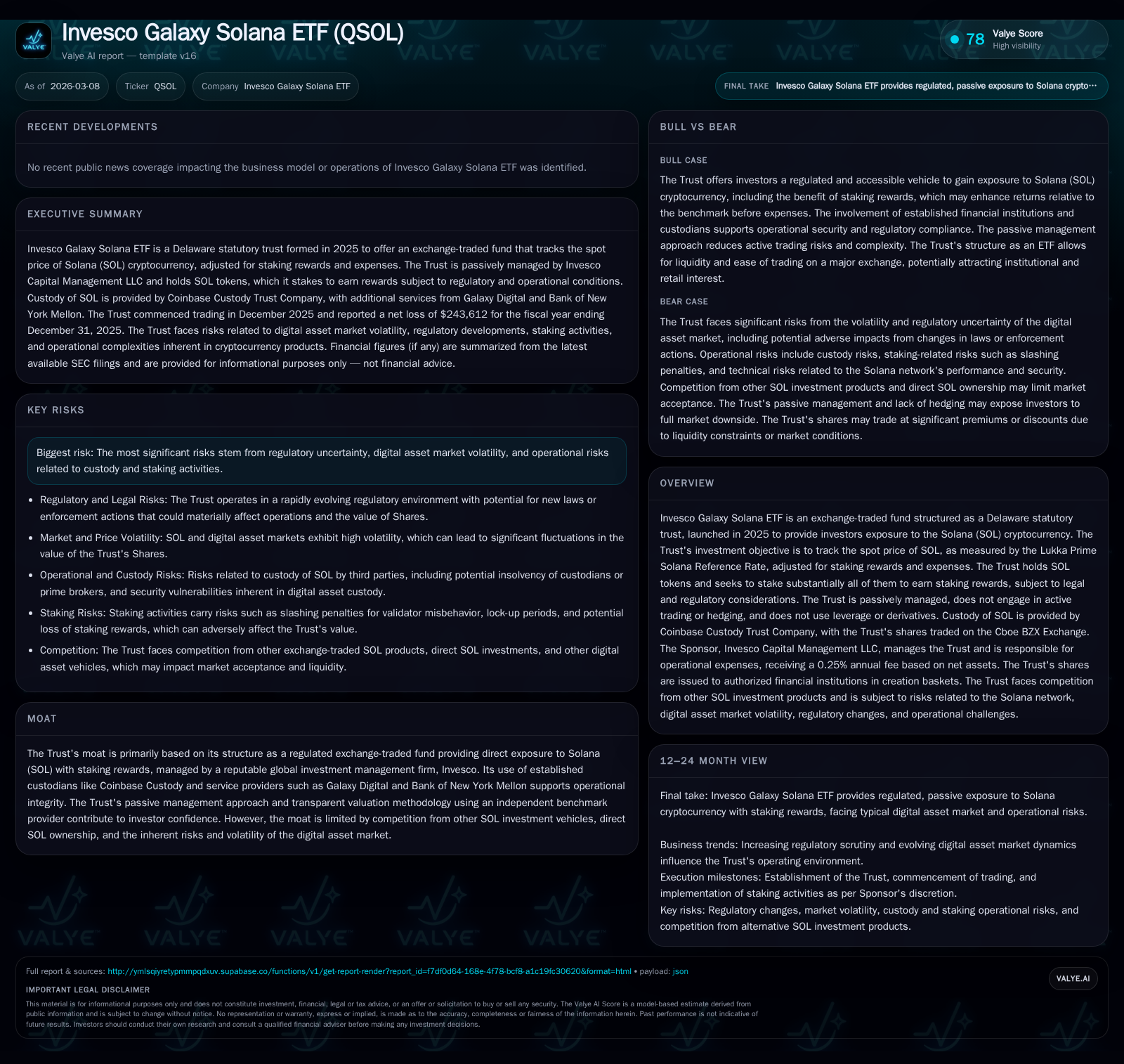
Invesco Galaxy Solana ETF (QSOL) debuted in late 2025 aiming to track the spot price of Solana (SOL), adjusted for staking rewards and expenses. It operates as a passive trust holding and staking SOL to enhance returns net of fees but faces significant risks from market volatility and regulatory uncertainty. Custody by Coinbase Custody Trust Company and operational support from reputable firms underpin its infrastructure. The fund recorded a net loss in its inaugural period, reflecting start-up costs and digital asset price dynamics.
Overview of Invesco Galaxy Solana ETF
Invesco Galaxy Solana ETF (ticker: QSOL) commenced operations in late 2025 as a Delaware statutory trust structured exchange-traded fund designed specifically to offer investors direct exposure to Solana (SOL), one of the prominent programmable blockchain cryptocurrencies. The Trust’s core investment goal is to track the spot price performance of SOL as measured by the Lukka Prime Solana Reference Rate — an independent benchmark that derives fair market value (FMV) for SOL from key regulated exchanges — while capturing the incremental staking rewards earned on SOL holdings net of expenses [S1].
The structure is notable for its passive management approach: the Sponsor, Invesco Capital Management LLC, primarily holds and stakes substantially all of the underlying SOL but does not engage in market timing, hedging strategies, leverage use, or derivatives transactions. This conservatism aligns with investor expectations for cryptocurrency ETFs seeking compliance within U.S. regulatory frameworks without exacerbating risk profiles through complex financial engineering [S1].
QSOL shares are traded on the Cboe BZX Exchange where they represent fractional undivided beneficial interest in the Trust’s underlying portfolio. The initial seed capital was established with $100,000 on October 16, 2025 via purchase of 4,000 shares by Invesco Ltd., shortly before public trading commenced on December 15 that year [S1].
Historical Financial Performance
Given its recent launch within December 2025, historical financial metrics are limited to inception period results. According to SEC companyfacts data [F1], QSOL recorded a net loss amounting to $243,612 for fiscal year ending December 31, 2025. This yielded an approximate return on equity (ROE) of negative 10.9%, attributable primarily to operational expenses including Sponsor fees and setup costs overriding any investment gains during this startup phase.
The Trust earns its returns principally through two components: changes in SOL’s market price plus staking rewards earned on held tokens. However, volatile cryptocurrency markets resulted in adverse mark-to-market impacts over this initial period overshadowing staking income benefits which typically accrue gradually [S1].
Historical performance (annual)
| FY |
|---|
| 2025 |
Source: SEC companyfacts cache [F1].
Table: QSOL Inception Year Net Income & ROE [F1]
Future Growth Prospects
Growth for QSOL hinges largely on broader adoption trends for Solana blockchain technology along with effective capitalization on staking yields. The Trust benefits from staking substantially all held tokens to generate additional yield that offsets expenses and may boost returns beyond simple price tracking [S1]. However, growth could be constrained by multiple factors:
- Solana Network Adoption: A slowdown or reversal in user adoption or network development could dampen SOL prices adversely impacting NAVs [S14].
- Market Volatility: Cryptocurrency prices remain highly volatile due to speculative behavior and momentum investing patterns common in digital assets [S14].
- Regulatory Environment: The shifting landscape around digital asset regulation poses uncertain future constraints on trading access, staking activity legitimacy, or fund operation eligibility [S6][S15][S20].
- Competition: Increasing number of competing SOL investment products—including direct coin ownership wallets and other ETPs—could fragment demand [S17][S21].
The Trust’s custody arrangements with Coinbase Custody Trust Company underpin secure token storage using cold wallet technology that mitigates risks associated with hacks or theft while engaging third-party staking providers extends operational complexity but is necessary for reward generation [S1][S27].
Forecasts and Milestones to Monitor
While explicit quantitative guidance has not been provided by the Sponsor or Trust filings at this early stage [N#], key milestones include:
- Expansion of Assets Under Management (AUM) driven by growing retail/fund investor interest in regulated crypto exposures.
- Scaling of staked assets relative to total SOL holdings balanced against liquidity needs for redemption.
- Regulatory clarity from U.S. Securities and Exchange Commission (SEC), Commodity Futures Trading Commission (CFTC), and Congressional legislation potentially reshaping custody rules or classification frameworks impacting operations.
- Benchmark methodology consistency by Lukka Prime amid digital asset market fragmentation.
- Performance tracking compared to competing SOL ETFs or trusts.
Investors should watch quarterly filings for updates on AUM growth trajectory alongside commentary about regulatory developments given their outsized impacts on both liquidity and pricing dynamics.
Returns and Capital Allocation Framework
QSOL incurs an annual Sponsor Fee set at 0.25% of net assets that covers management and operational costs but reduces gross returns derived from SOL price appreciation plus staking yields [S1]. The Fund does not distribute dividends; instead income generated via staking feeds directly into NAV enhancement after expense deductions.
As a passively managed vehicle holding only one underlying asset class without active trading or leverage usage, typical capital return mechanisms such as share buybacks or dividend payouts do not apply.
Operating cash flow metrics specific to QSOL are not detailed extensively due to limited history; similarly debt financing is absent aside from potential short-term credit facilities employed intermittently when needed for redemption obligations [S5][S16].
Industry Context and Competitive Positioning
Within the burgeoning crypto ETP landscape of early 2026, QSOL stands out due to its exclusive focus on Solana combined with integrated staking rewards—a feature that attempts to capture intrinsic utility benefits beyond mere coin holding. Nonetheless, it competes not only with alternative regulated ETPs covering larger cap coins like Bitcoin and Ether but also unregulated venues where direct coin ownership offers investors flexibility unavailable through trust structures.
Security infrastructure partnerships such as those with Coinbase Custody reinforce investor confidence given industry’s fraught history with exchange insolvencies and high-profile hacks [S8][S11]. Still operational risks remain inherent especially around custody provider limitations except in cases of gross negligence or fraud where indemnities cap recovery prospects [S22].
Heightened regulatory activity typified by SEC’s focus via "Crypto Task Force," potential amendments to custodian qualifications under Investment Advisers Act rules, plus ongoing legislative initiatives such as the GENIUS Act frame an evolving backdrop that must be navigated carefully going forward [S15][S18][S20].
Risk Profile Summary
QSOL confronts distinct risks including:
- Extreme Price Volatility: Rapid price swings have historically marked SOL due partly to speculative momentum cycles which could lead the Trust's shares toward substantial declines—even total loss scenarios as noted by intramarket assessments [S14].
- Regulatory Uncertainty: Pending federal regulations might affect not only Trust operations but also fundamental aspects like legality of owning or staking SOL tokens within U.S. jurisdiction [S6][S7][S26].
- Custodial & Cybersecurity Threats: Although employing cold storage mitigates threats somewhat, breaches suffered by counterparties in this space emphasize systemic vulnerability [S8][S27].
- Benchmark Variability: Lukka Prime’s methodology retains significant discretion over platform selection impacting FMV calculations causing potential valuation mismatches [S22].
- Market Liquidity & Redemption Risks: Lock-up periods related to staking may restrict movement of tokens required timely for share redemptions possibly forcing liquidity constraints under stressed conditions[S17].
- Concentration Risk: Sole focus on one digital asset inherently increases susceptibility versus diversified funds.
Conclusion
The Invesco Galaxy Solana ETF occupies an intriguing niche at the intersection of regulated finance and decentralized digital assets. Its design caters to investors seeking transparent regulated access combined with yield enhancement via staking while avoiding complexities associated with leverage or derivatives exposure. Nonetheless significant headwinds stem from nascent market volatility patterns plus ongoing regulatory evolution which together shape both near-term operating realities and long-term viability prospects.
Careful monitoring of regulatory developments affecting crypto ETFs broadly alongside rigorous evaluation of fund AUM progression will inform analysis going forward. The documented net losses from launch period underline typical initial operational burdens accompanying new vehicle establishment especially amid asset class maturation phases.
Investors considering sectors involving single cryptocurrency holdings should weigh these known risk parameters against their appetite for volatility given QSOL’s undiversified profile but unique structural features.
Disclaimer: This analysis is informational only based on available data as of March 2026; it does not constitute investment advice or recommendations.
Disclaimer: This is research-only, informational analysis and not investment advice. It may include AI-generated interpretation and general industry context. Always verify important details using primary sources.

Comments