
Home Bancorp Strengthens Regional Footprint with Robust Capital and Operational Resilience
Home Bancorp, Inc. leverages its strong capital base and focused regional strategy to drive stable profitability amid evolving interest rate dynamics and competitive pressures.
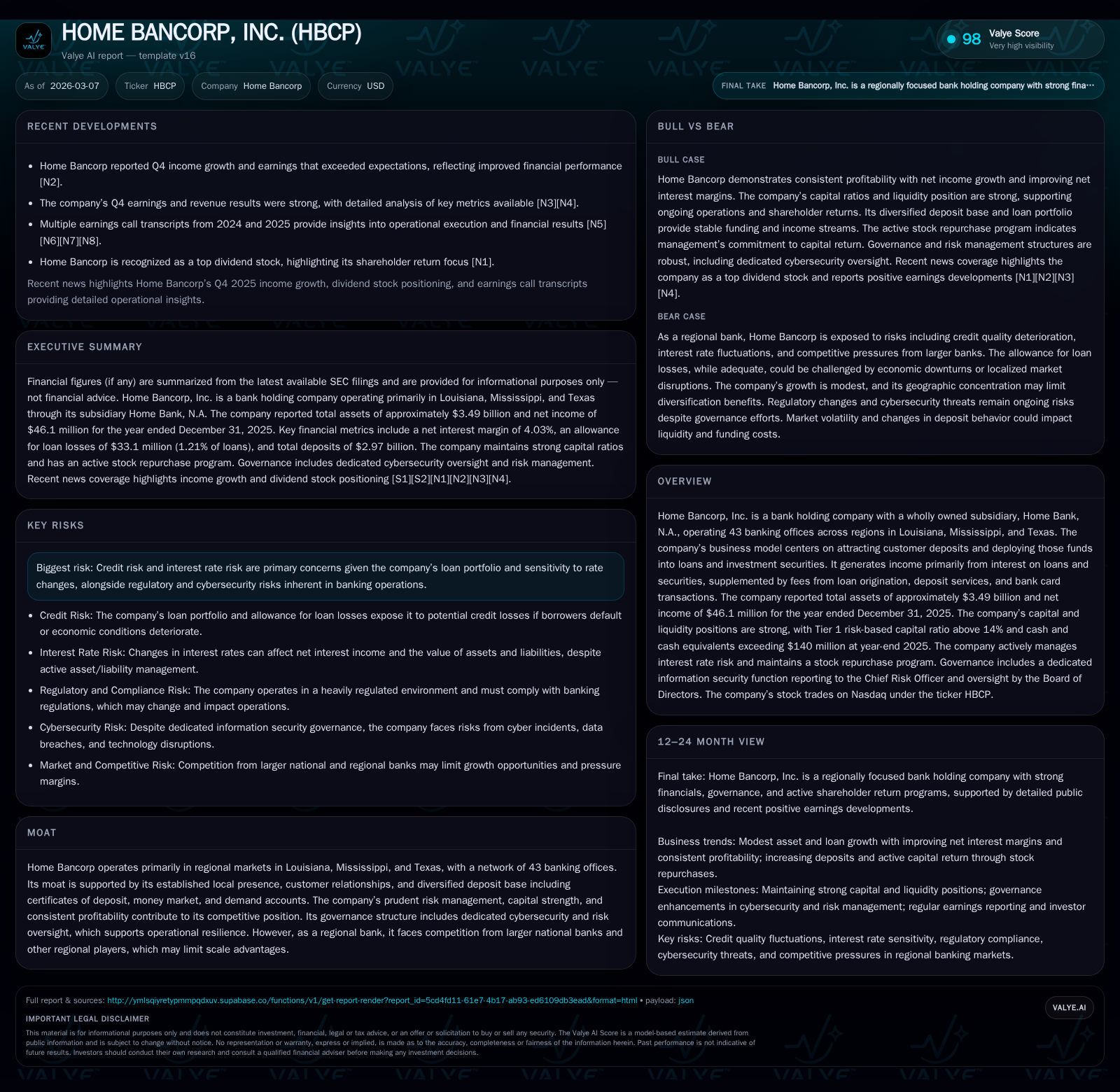
Home Bancorp, Inc. operates 43 offices across Louisiana, Mississippi, and Texas, emphasizing deposit gathering and loan deployment into a diversified portfolio. The company reported net income growth of approximately 18% in 2025 supported by solid asset quality and liquidity management, alongside active interest rate risk mitigation. Capital allocation prioritized shareholder returns through dividends and share repurchases, while regulatory capital ratios remain robust above required minimums. Moving forward, growth will hinge on local market penetration, interest rate developments, and maintaining competitive deposit pricing in regional banking markets.
Historical Performance and Growth Drivers
Historical performance (annual)
| FY | Net ($mm) | CFO ($mm) | Capex ($mm) | Net YoY |
|---|---|---|---|---|
| 2025 | 11 | 55 | 10 | +18.0% |
| 2024 | 10 | 49 | 4 | +3.1% |
| 2023 | 9 | 41 | 2 | -12.9% |
| 2022 | 11 | 51 | 3 |
Source: SEC companyfacts cache [F1].
Capital returns and efficiency (annual)
| FY | Buybacks ($mm) | FCF ($mm) | ROE% |
|---|---|---|---|
| 2025 | 14 | 44 | 2.6 |
| 2024 | 5 | 45 | 2.4 |
| 2023 | 5 | 39 | 2.6 |
| 2022 | 11 | 48 | 3.3 |
Source: SEC companyfacts cache [F1].
Home Bancorp, Inc., through its wholly owned subsidiary Home Bank, N.A., manages a network of 43 branches spanning key regional markets across Louisiana, Mississippi, and Texas. The company's business model principally involves the origination of loans funded by a diverse base of retail and institutional deposits alongside investment securities.
For fiscal year ending 2025, Home Bancorp reported net income of approximately $11.4 million, an 18% increase over the prior year’s $9.7 million [F1]. This improvement marks a continuation of positive earnings momentum driven by expansion in net interest income due to both volume growth in earning assets and successful management of interest rate exposures. Total assets as reported reached around $3.49 billion in late 2025 [S1], with loan portfolios remaining relatively stable at around $2.7 billion net of allowances [S2].
The company’s capacity to grow earnings has been underpinned by prudent credit risk management evidenced by stable allowance for loan losses which hovered near historic averages despite variable economic conditions [S22]. The balance sheet shows strong liquidity buffers with cash and equivalents exceeding $140 million at year-end 2025 [S1], positioning the company well to meet funding needs.
Business Model: Deposit-Centric Funding Coupled with Diversified Loan Book
The bulk of Home Bancorp’s funding derives from deposits that account for roughly $3.0 billion as of late 2025; these include a mix of noninterest-bearing demand deposits ($802 million) and interest-bearing products ($2.2 billion) [S2]. The company maintains an impressive breadth of retail customers—comprising individuals (52%), small businesses (38%), public funds (7%), and brokered deposits (3%)—demonstrating a broadly diversified deposit base resistant to concentrated withdrawal risks [S14]. Public funds exceeding FDIC-insured amounts are fully collateralized, mitigating uninsured deposit risks.
Loan production focuses on commercial real estate (CRE), commercial & industrial (C&I), multi-family residential properties, and consumer loans [S26]. Such diversification is typical for community-oriented regional banks aiming to capitalize on localized knowledge while avoiding overconcentration in any single sector. Additionally, Home Bancorp holds investment securities primarily classified as available-for-sale, balancing yield considerations with liquidity [S23].
Asset/Liability Management Strategies Amid Interest Rate Volatility
Interest rate risk represents a pivotal dimension for Home Bancorp’s earnings stability given the current macroeconomic environment characterized by elevated rates but heightened volatility. The company employs sophisticated net interest income simulation models to evaluate impacts across various scenarios.
Recent disclosures indicate that an immediate upward shift of +200 basis points in rates would increase projected net interest income by approximately 7.1%, while a decrease of -200 basis points could erode it by about 8.3% [S8]. To mitigate exposures particularly related to variable-rate liabilities, Home Bancorp employs interest rate swaps designated as cash flow hedges which stabilize future interest payments by exchanging floating for fixed obligations [S16].
Such derivatives usage reflects industry best practices within midsize regional banks seeking to dampen earnings volatility without undertaking speculative trading risks.
Capital Structure and Regulatory Positioning
Home Bancorp’s capital adequacy remains robust with Tier 1 risk-based capital ratio exceeding regulatory minimums at approximately 14.7% at year-end 2025 [S6]. The bank issued $55 million of subordinated notes bearing a fixed-to-floating rate coupon convertible from June 2027 onward; these qualify as Tier 2 capital strengthening the overall cushion against potential losses [S15].
Liquidity management benefits from substantial borrowing capacity through Federal Home Loan Bank advances with availability surpassing $1.25 billion as collateralized by pledged loans and securities [S20]. This access facilitates flexibility in funding operations amidst potential deposit outflows or opportunistic asset acquisitions.
Returns and Capital Allocation Policy
While explicit return on equity calculations are not directly published, rough derivation using reported net income against shareholders’ equity (~$435 million at end-2025) suggests moderate returns near 2.6% for the year [F1]. This comparatively modest figure aligns with the low-risk profile typical among community banks focusing on stability rather than aggressive growth.
Management actively returns capital via dividends complemented by share repurchases navigating between accretiveness and maintaining capital ratios safely above requirements. In fiscal 2025 alone, repurchases totaled approximately $14.4 million following dividend payments consistent with prior years’ payout levels [F1][S18]. The approved repurchase programs underscore shareholder-friendly policies balanced against prudent financial stewardship.
Expansion Initiatives and Competitive Positioning
Recent years have seen geographic expansion beyond Louisiana into Texas via acquisition of Friendswood Capital Corporation in Houston (completed in March 2022), enhancing scale but introducing competition against larger national banks prevalent in metropolitan markets [S27]. While this moves beyond traditional core markets providing growth upside potential, it also exposes Home Bancorp to intensified competitive dynamics that could compress margins or slow customer acquisition pace.
Nonetheless, the firm’s entrenched presence in Louisiana markets combined with localized customer relationships sustains its moat within regional market niches where responsiveness and tailored service remain critical differentiators.
Governance and Risk Oversight Framework
Home Bancorp invests significantly in governance infrastructure emphasizing operational resilience especially cybersecurity—a key vulnerability vector for modern financial institutions. Their information security department is led by a Director with certifications such as CISM and CISSP who oversees comprehensive cybersecurity risk assessment functions separated structurally from frontline defense teams reporting directly to the Chief Risk Officer ensuring independent oversight [S1].
Board-level committees regularly review technological risks including quarterly updates from management fostering proactive threat mitigation complemented by incident response protocols aligned with best practice regulatory expectations.
Other operational risks encompass typical banking challenges such as credit concentration risks inherent in CRE lending segments along with regulatory compliance risks consistent across mid-tier banks operating under OCC supervision.
Outlook Considerations and Industry Context (Analysis)
Future growth prospects for Home Bancorp hinge on leveraging its strong balance sheet fundamentals while executing disciplined credit underwriting amid varying economic cycles affecting primarily real estate values and business borrower health within its footprint.
Interest rates likely remain a key driver influencing net interest income trajectories; incremental rises could benefit margin expansion but must be balanced against potential borrower payment stresses reducing loan demand or elevating credit costs.
Deposit competition remains intense especially against national banks offering scale advantages; thus optimizing pricing strategies for certificates of deposit maturing cumulatively over $800 million within one year will be critical to retention metrics [S7][S9].
Key milestones to monitor include quarterly updates on loan portfolio performance metrics such as non-performing assets levels amidst inflationary pressures, trajectory of derivatives hedge effectiveness amid fluctuating SOFR rates, capital adequacy relative to evolving stress test landscapes, plus progress integrating Houston franchise fully within corporate systems ethos.
Overall, Home Bancorp situates itself prudently blending steady regional banking operations with tactical growth moves supported by disciplined financial management frameworks fostering sustainable shareholder value creation.
This analysis is based solely on information available from SEC filings dated March 6, 2026 ([S1]–[S29]), recent press releases ([N1]–[N8]), and company facts data ([F1]). It reflects an independent examination without offering investment advice or buy/sell recommendations.
Disclaimer: This is research-only, informational analysis and not investment advice. It may include AI-generated interpretation and general industry context. Always verify important details using primary sources.

Comments