
Jet.AI Inc.'s Strategic Pivot from Aviation to AI Data Center Infrastructure
Jet.AI shifts focus from AI-powered private jet services to high-performance AI data center infrastructure amid challenging financial and operational terrain.
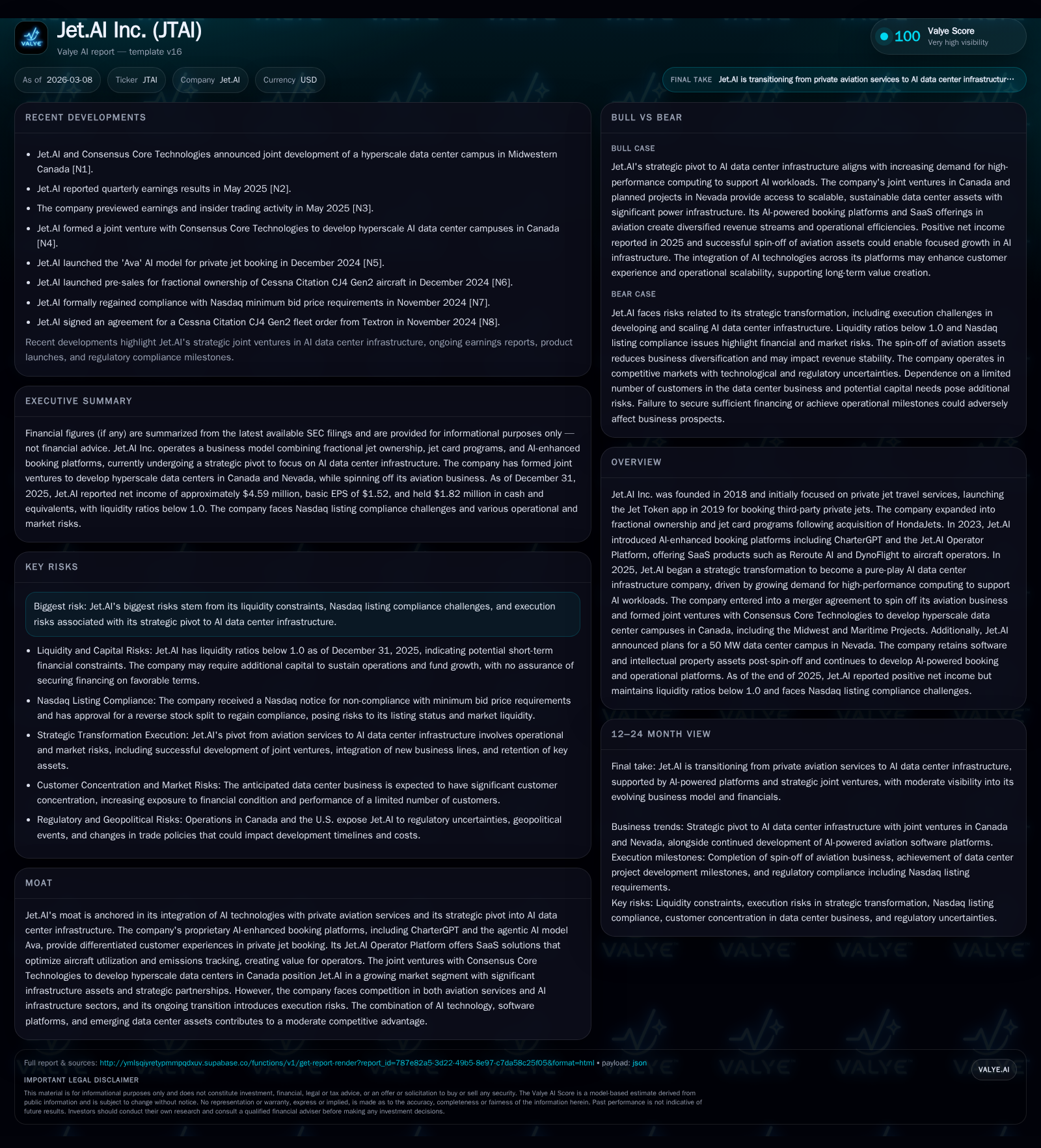
Founded in 2018 as a tech-enabled private jet travel platform, Jet.AI evolved through fractional ownership and AI-driven SaaS offerings before initiating a radical strategic pivot in 2025 towards AI hyperscale data centers. Despite improving net income in 2025, the company continues to face operating losses and cash flow deficits, amplified by liquidity constraints and regulatory challenges. Its divestiture of aviation assets via spin-off and joint ventures with Consensus Core Technologies mark critical milestones underpinning the attempt to reposition itself as an AI infrastructure provider.
Historical Growth: Scaling Private Aviation and Embedded AI SaaS
Jet.AI Inc. was founded in mid-2018 with a mission that intersected luxury private aviation and emerging artificial intelligence technologies. The initial product was the Jet Token app (launched September 2019), serving primarily as a digital booking platform connecting customers with third-party private jets [S25]. This platform leveraged an innovative approach combining fractional jet concepts with tokenized access models — an early example of embedding technology into traditional private charter services.
Following this foundation, Jet.AI accelerated expansion by acquiring HondaJets aircraft, enabling it to offer direct fractional ownership sales alongside jet card programs, thereby vertically integrating parts of its service offering [S25]. This move expanded control over inventory and diversified customer access beyond third-party operators.
In parallel with fleet growth, Jet.AI embraced artificial intelligence sophistication by launching CharterGPT in 2023 — an AI-augmented booking platform designed to automate personalized jet charter requests using natural language processing [S25]. Complementing this was the introduction of the Jet.AI Operator Platform providing SaaS tools like Reroute AI (optimizing aircraft repositioning flights to boost revenue) and DynoFlight (carbon emissions tracking coupled with carbon credit purchases via API) [S25], indicating a strategy that embedded AI not only front-facing but also into operator efficiency tools.
The company also formed niche partnerships such as 380 Software LLC with Cirrus Aviation Services enabling by-the-seat booking tailored for the Las Vegas Golden Knights hockey team markets [S25]. This demonstrated utilization of targeted vertical-specific applications within broader technological frameworks.
This phase saw Jet.AI develop both hardware assets (fleet expansion) and software platforms powered by proprietary agentic AI models like Ava that enhance user experience across text and voice channels [S26]. The integrated suite formed a moat based on differentiated customer touchpoints blending fractional ownership convenience with real-time intelligent assistance.
Table: Fiscal Year Performance Summary (2022-2025)
Historical performance (annual)
| FY | Net ($mm) | CFO ($mm) | OpInc ($mm) | Capex ($) | Net YoY |
|---|---|---|---|---|---|
| 2025 | 5 | -8 | -10 | 12922 | +136.0% |
| 2024 | -13 | -8 | -13 | 4339 | -0.9% |
| 2023 | -13 | -4 | -13 | 4339 | -275.8% |
| 2022 | 7 | 0 | 0 |
Source: SEC companyfacts cache [F1].
Capital returns and efficiency (annual)
| FY | FCF ($mm) | ROE% |
|---|---|---|
| 2025 | -8 | 20.9 |
| 2024 | -8 | -195.5 |
| 2023 | -4 | 320.5 |
| 2022 | -147.8 |
Source: SEC companyfacts cache [F1].
(Data sourced from [F1])
Transition Catalyst: Market Forces Driving the AI Infrastructure Shift
While Jet.AI showed technological innovation within aviation services leveraging AI-powered platforms and fractional ownership structures through early-2020s , fundamental industry dynamics set boundary conditions on scalability and profitability.
The competitive private jet sector continues to be fragmented with high capital intensity and competition from both legacy airline ventures and other well-capitalized fractional operators ranging from SentientJet to WheelsUp [S11]. Path dependencies driven by large fleets under long-term contracts puts pressure on margins for smaller entrants like Jet.AI.
Concurrently, growth drivers ignited by the explosion of generative AI and machine learning workloads sparked record demand for high-performance computing (HPC) infrastructure capable of supporting GPUs at hyperscale levels . Recognizing this confluence of limitations in its legacy aviation segment alongside market potential for delivering specialized AI infrastructure spurred Jet.AI’s strategic transformation announced in mid-2025 [S1].
This pivot included plans to divest the capital-heavy aircraft asset base via merger agreements while simultaneously investing in joint ventures focused on data center campuses with Consensus Core Technologies located strategically across Canada’s Midwest and Maritime provinces [S24].
The rationale also cites synergies between existing software expertise applied towards new SaaS offerings pivotal for data center clients’ operational needs amid emerging regulatory frameworks governing AI cloud services [S5][S6].
Current Financial Profile: Profitability Turnaround Amid Operating Losses
Analysis of most recent full-year financials reveals a nuanced picture. Operating income improved approximately 20% year-over-year but remained negative at roughly -$10 million in FY2025 [F1]. In contrast to prior years' deep losses exceeding $12 million per annum (FY2023/24), Jet.AI crossed into net income profitability territory with $4.6 million reported for FY2025 despite constrained operating cash flows still hovering near -$8.2 million [F1].
Capital expenditures increased almost threefold year-over-year to $12.9K — albeit a modest absolute sum relative to intense capex-intensive hyperscale deployments — indicative mainly of initial technology investments apart from physical campus buildouts expected through JVs [F1][S7][S14].
Liquidity metrics underscore significant pressure: current assets totaled approximately $2.17 million against liabilities exceeding $3.7 million yielding a current ratio near 0.58 which signals tight short-term funding capacity and dependency on external financing arrangements [F1][S8].
This pattern reveals tension between operational improvements signaling early benefits from strategic initiatives with continuing headwinds from heavy R&D costs associated with software platform upgrades alongside legacy aviation overheads yet to be fully shed.
AI Data Center Prospects: Opportunities and Execution Risks
Jet.AI’s entry into the hyperscale data center market comes amid skyrocketing GPU demand stressed by limited supply chains — a pivotal bottleneck underpinning client adoption rates for compute-optimized facilities tailored for generative AI workloads [S28]. The collaboration with Consensus Core involves phased campus deployments targeting combined power capacity nearing or exceeding gigawatt scale over several years including active Midwest projects growing towards 100 megawatts within twelve months [S17].
Despite growth potential fueled by customer appetite for localized high-density compute environments featuring dynamic SaaS layers such as Reroute AI aimed at resource optimization for operators outside traditional boundaries—clients remain concentrated among relatively few hyperscalers posing notable revenue concentration risks should demand shift or contracts lapse abruptly [S4].
Competition includes entrenched hyperscale giants Equinix, Digital Realty as well as cloud providers AWS Microsoft Azure Google Cloud who maintain massive proprietary infrastructures limiting new entrant market penetration rates [S11]. Additionally regulatory uncertainty regarding evolving multi-jurisdictional rules specific to hosting sensitive or regulated AI datasets heightens legal complexity confronting an emerging infrastructure player like Jet.AI [S6].
Operationally this transition requires mastering capital intensive construction timelines while developing novel go-to-market strategies distinct from previous B2C aviation booking experiences—heightening execution risk compounded by limited internal history managing such scale facilities [S5].
Strategic Actions: Aviation Spin-Off and Partnerships with Consensus Core
Jet.AI formalized its intention to exit fractional ownership and jet card businesses through a merger agreement signed February 13th, 2025 followed by amended terms incorporating share distribution mechanics structured around SpinCo—a wholly-owned subsidiary holding legacy aviation assets—to be merged ultimately under flyExclusive ownership post-distribution back to shareholders [S1][S3][S19][S24].
This separation enables Jet.AI management to focus resources on burgeoning pure-play data center operations while shedding non-core operating expenses tied up in aircraft management contracts.
Parallelly on June 26th, 2025 the company entered a Joint Venture Agreement with Consensus Core Technologies aligning technical expertise in high-performance GPU-centric data center ecosystems critical for anticipated client demands including multi-phase campus developments in Manitoba and Maritime Canada targeting upwards of ∼1.5 GW combined power capacity over timeframes spanning through late decade horizon [S24][S17].
Investment stakes have been steadily increased—initial contributions totaling approximately $2 million securing minority interests alongside planned further equity injections envisaged towards scaling project footprints illustrating committed capital deployment stretched across multiple years [S17][F1].
Capital Allocation Focus: ROE, Cash Flow Challenges, and Liquidity Constraints
While operational cash flow remains firmly negative reflecting ongoing development outlays (-$8.2M) net income turned positive ($4.6M) presents an apparent dichotomy characteristic of accounting timing differences mainly involving non-cash items or one-time reversals potentially related to restructuring or gain recognition post-divestiture activity [F1]. This contrast highlights persistent cash burn amidst headline earnings improvement.
Equity stands healthy at approximately $22 million leading to an estimated Return on Equity near 20.9% based solely on latest annual net income figures—yet this is tenuous given cash shortages restricting organic funding pathways absent successful future equity or debt raises [F1].[S8]
No dividends have been declared nor share repurchase programs implemented aligning with cash preservation needs acknowledged explicitly along with disclosures emphasizing future capital raising necessity framed as existential risk should external financing avenues falter under current market conditions or business model transitions prove protracted or costly [S13][S19].
Heavy investments into R&D aimed at refining agentic AI models such as Ava plus enhancements across CharterGPT bookings platforms alongside infrastructural software suites add layers of complexity inflating near-term expenses further compounding liquidity constraints inherent in shifting business model phases [S7][S14].
Competitive Pressure and Regulatory Hurdles in Dual Sectors
On one hand Jet.AI faces entrenched competitors in private charter aviation ranging from large fractional fleet operators like NetJets derivatives plus established luxury carriers wielding multi-decade relationships translating into superior network effects causing pricing pressures unfavorable for smaller scale participants like Jet.AI historically reliant on fleet scaling strategies but hampered by extended manufacturing waitlists limiting aircraft delivery cadence indirectly impacting service expansion timelines [S11].
Conversely entering hyperscale data centers exposes Jet.AI to competition against titanic entities such as Equinix Digital Realty or even cloud giants who vertically integrate infrastructure capabilities making new entrants dependent either on niche positions or highly specialized solutions backed by robust network connections plus proven uptime reliability [S11].
Regulatory scrutiny has intensified around services enabling or facilitating advanced AI deployments — federal agencies have begun imposing nascent compliance regimes targeting transparency fairness security aspects particularly concerning privacy laws across varying geographies including US state-level regulations like CCPA introducing costs that could disproportionately impact smaller firms lacking dedicated compliance resources versus larger incumbents equipped for global frameworks [S6][S10].
AI specific controls could impose restrictions hampering product rollouts or necessitating costly platform modifications impacting speed-to-market scenarios affecting competitive positioning especially if regulatory frameworks diverge widely between jurisdictions where data centers are located or operated complicating cross-border service offerings further layering risks on growth trajectories.
What Investors Should Monitor Next
Absent explicit forward guidance publicly disclosed yet key milestones surround timely closing of the flyExclusive spin-off transaction slated for early-mid 2026 which will materially reshape financial structure while clarifying pure-play strategic focus areas including cost structures freed from aircraft asset burdens [S19].
Progress completion rates against joint venture campus buildout schedules including staged capacity ramp-ups particularly upcoming Midwest Project goal toward scaling above two megawatts live toward planned hundred-megawatt target represent tangible execution barometers influencing future revenue inflections aspiring toward gigawatt class assets over longer terms.
Customer diversification remains critical given current anticipated revenue concentration exposing Jet.AI’s nascent infrastructure segment to downside if key clients reduce usage; updates on commercial traction gains across SaaS offerings Reroute AI DynoFlight relevant as these recurring revenue streams underpin scalable margins beyond brick-and-mortar data halls.
Regulatory developments pertaining specifically to jurisdictional interpretations surrounding allowed use cases for hosted AI applications pose potential catalyst risks warranting close observation particularly any imposed restrictions affecting cloud service interoperability or requiring additional certification processes.
Financially monitoring quarterly cash burn trends against financing activities will inform sustainability outlooks given current liquidity constraints—a scenario where supplemental capital raises may dilute shareholder value but are essential for continuity given capital expenditure intensity endemic in hardware deployment phases.
Disclaimer: This is research-only, informational analysis and not investment advice. It may include AI-generated interpretation and general industry context. Always verify important details using primary sources.

Comments