
BKV Corp’s Turnaround: From Loss to Profit with Strategic Power Expansion
BKV Corp transitioned from significant losses in 2024 to profitability in 2025, driven by acquiring and consolidating major power assets and developing carbon capture initiatives.
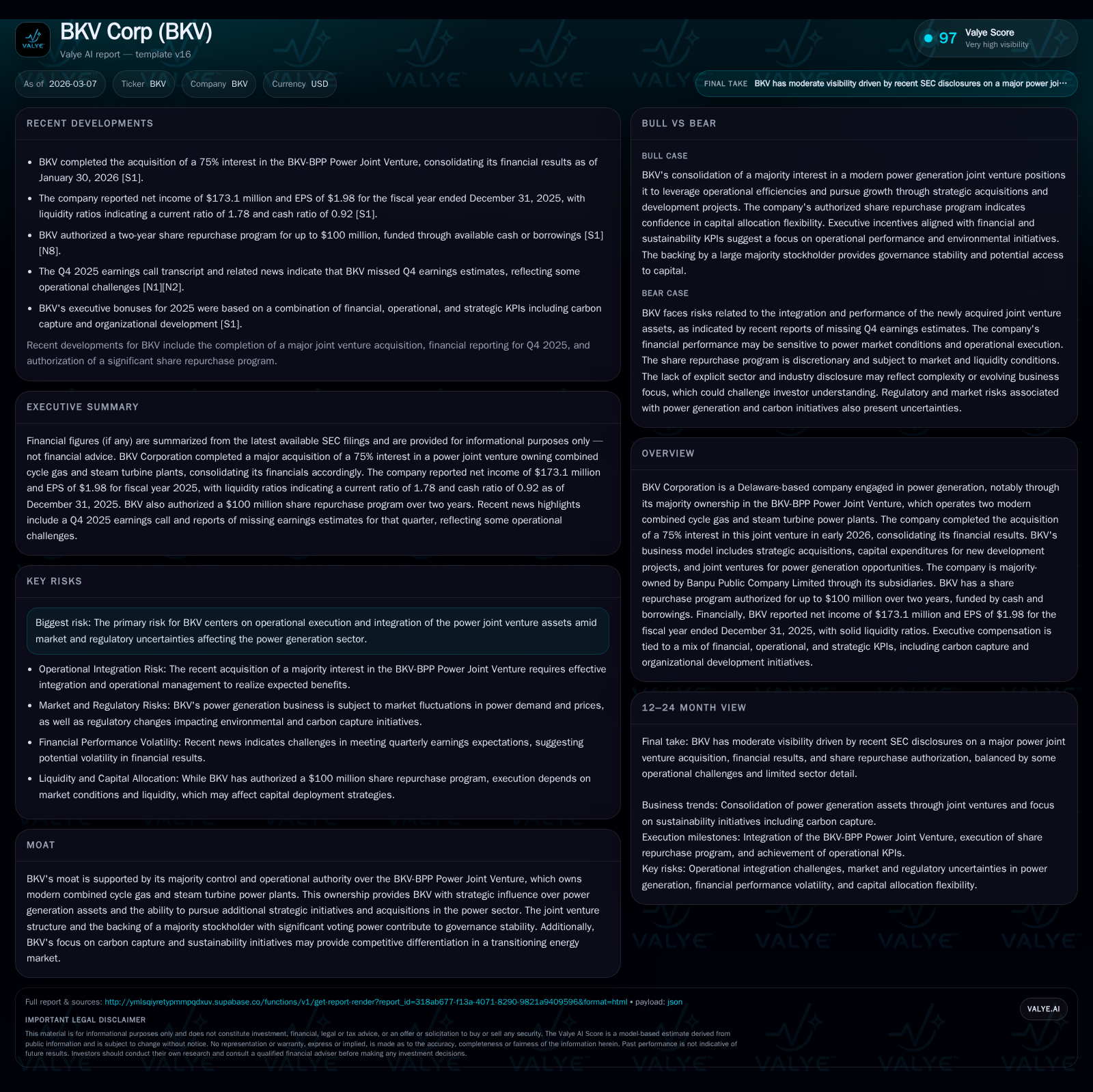
BKV Corp’s financial results swung sharply from a net loss of $142.9 million in 2024 to a net income of $173.1 million in 2025 following the acquisition of a majority stake in the BKV-BPP Power Joint Venture. The company’s closed-loop business model integrates natural gas production, midstream transportation, power generation, and carbon capture utilization and storage (CCUS), positioning it well for growth amid energy transition demands. Capital allocation balances share repurchases with manageable leverage, supported by strong liquidity and an 8.5% ROE. With its majority ownership by Banpu Public Company and ongoing CCUS projects slated to expand in early 2026, BKV faces operational integration risks but has a clear strategic growth path to watch.
From Losses to Profits: BKV’s Performance Pivot in 2025
BKV Corp marked a definitive turnaround from substantial losses posted in fiscal year 2024 to robust profitability in fiscal year 2025. Operating income climbed from a negative $154.8 million at year-end December 31, 2024, to a positive $217.6 million—a remarkable increase of approximately 240.6% [F1]. Correspondingly, net income shifted from a loss of $142.9 million in 2024 to net earnings of $173.1 million for the full year ended December 31, 2025 [F1], representing a gain exceeding 221%. This transformation reflects not merely market-driven cyclical improvement but structural changes brought about through strategic acquisitions.
Chief among these was the completion of BKV's acquisition of a controlling 75% interest in the BKV-BPP Power Joint Venture at the start of 2026, which retroactively influenced reported results for the last quarter through consolidation accounting [S10][S21]. The joint venture operates two advanced combined cycle gas and steam turbine power plants located within ERCOT's North Zone near Temple, Texas — facilities recognized for operational reliability and efficient conversion rates typical of combined cycle heat rates advantageous in resource dispatch contexts [S1].
Operating cash flow nearly doubled year-over-year from $118.5 million to $242.7 million in this period indicating not just higher profitability but enhanced liquidity from core operations supporting working capital needs and reinvestment activities [F1]. Equity expanded substantially from about $1.56 billion to over $2.04 billion reflecting both retained earnings accumulation and fresh equity issuances linked to growth financing events including an underwritten public offering completed late in 2025 [F1][S13].
Historical performance (annual)
| FY | Net ($mm) | CFO ($mm) | OpInc ($mm) | Net YoY |
|---|---|---|---|---|
| 2025 | 173 | 243 | 218 | +221.2% |
| 2024 | -143 | 119 | -155 |
Source: SEC companyfacts cache [F1].
Capital returns and efficiency (annual)
| FY | Buybacks ($) | ROE% |
|---|---|---|
| 2025 | 600000 | 8.5 |
| 2024 | 0 | -9.2 |
Source: SEC companyfacts cache [F1].
Source: Latest SEC company facts exhibit [F1]
Operational Footprint: Power Generation and the Closed-Loop Business Model
At its core, BKV employs an integrated approach that meshes upstream natural gas production with midstream transportation systems feeding directly into its power generation assets underpinned by state-of-the-art combined cycle technology arrangements [S1]. Combined cycle gas turbines operate by capturing heat from fuel combustion via ceramic-lined combustion chambers that drive gas turbines linked to generators; exhaust heat then produces steam powering secondary turbines—maximizing thermal efficiency typically exceeding traditional simple cycle units.
The partnership via the BKV-BPP Power Joint Venture vests operational control predominantly with BKV following its acquisition raising ownership from an initial stake held by Banpu Power US Corporation subsidiary (25%) to majority control (75%), enabling strategic decision-making autonomy including capital investments and acquisitions without requiring counterparty consent except for reserved board matters detailed contractually [S10][S20].
Complementing direct power generation are upstream natural gas assets delivering feedstock via proprietary midstream gathering pipelines that reduce differential pricing volatility by delivering sourced volumes efficiently into the joint venture’s plants or third-party markets thus achieving cost synergy across production-to-power value chain segments.
This closed-loop model optimizes operational reliability through tight integration enabling maintenance scheduling coordination across asset classes while fostering commercial optimization whereby natural gas supplied upstream matches consumption downstream ensuring stable margin profiles even during periods of supply-demand market swings—a key competitive advantage amid changing energy economics.
Carbon Capture Growth: Early Adoption and Strategic Pathways
Recognizing the evolving regulatory ecosystem emphasizing decarbonization, BKV has incorporated Carbon Capture Utilization & Storage (CCUS) within its business lines—a forward-looking pillar aligned with early action pathways endorsed across U.S regulatory frameworks aiming for net-zero Scope emissions timelines targeted early to late 2030s depending on emission scopes addressed [S1].
Initial sequestration commenced November 2023 at its first CCUS facility embedded within its operational purview [S1]. The company anticipates two additional CCUS projects commencing sequestration activities during Q1-Q2 2026 per planning disclosures [N1][S3], signaling scale-up intent.
Strategically, these projects enable BKV not only to reduce carbon intensity associated with their natural gas production footprint but also qualify for emerging revenue streams associated with greenhouse gas credits or tax incentives that increasingly reward early movers demonstrating tangible sequestration metrics — terminology relevant as “sequestration activities” emphasize permanent subsurface storage securing CO2 from entering atmospheric circulation.
The coupling of CCUS adoption with ongoing expansion in power generation using natural gas positions BKV uniquely within peers advancing transitional energy strategies balancing reliability requirements with sustainability commitments.
Analyzing Capital Allocation: Share Repurchases, Debt Management, and Liquidity
In December 2025, BKV authorized up to $100 million for share repurchases over two years aimed at enhancing shareholder value through disciplined buybacks subject to existing liquidity constraints and market conditions [S4]. Actual repurchase volume through fiscal year-end remained minimal—only about $0.6 million—reflecting measured capital deployment given elevated investment needs primarily driven by integration of acquired power assets and continued CCUS capex commitments requiring substantial outlay leading to negative free cash flow when subtracting capital expenditures from operating cash flow [$24m CFO minus ~$82m Capex equals approximately -$57m FCF] [F1].
Liquidity metrics are healthy; current ratio stood at approximately 1.78 bolstered by total current assets near $388 million against current liabilities ~$218 million plus cash balances approaching ~$199m as of December 31, 2025 evidencing ample short-term coverage capacity [F1].
Leverage management follows strategic funding executed via equity offerings totaling roughly $265 million net proceeds deployed partly toward debt reduction including repayment of related party loans plus funding acquisition cash portions related to the BKV-BPP Power JV purchase transaction valued around $115 million paid half by cash and half via issuance of common stock subject to lock-up provisions [S10][S13].
Return on equity approximated at 8.5% captures improved earnings generated against increased shareholder equity base post-transaction highlighting effective capital utilization even amidst growth phase expenditures highlighting balanced financial stewardship [F1].
Governance and Ownership: Impact of Majority Stakeholder Banpu Public Company
Banpu Public Company Limited maintains majority ownership over BKV Corp primarily through subsidiaries such as Banpu North America Corporation owning roughly two-thirds (~66%) voting stock assuring solid governance stability favorable during complex transitions involving sizeable acquisitions like that executed on January 30, 2026 regarding the power joint venture stake consolidation [S6].
This concentration enables streamlined decision-making agility vital for navigating dynamic upstream-midstream-power operational environments while aligning strategic priorities commensurate with Banpu’s broader corporate vision addressing international energy markets' decarbonization imperatives.
However, concentrated ownership forms implicit agency oversight demands requiring attention particularly related to minority interests though contractual mechanisms such as joint venture governance rights provide checks around major structural changes including board reserved matters where minority partner consent remains mandated under thresholds maintaining fairness balance within partnership structures [S20].
Risks and Market Headwinds in Natural Gas and Power Sectors
BKV explicitly outlines multiple risk vectors concentrated around operational execution risks inherent in integrating newly acquired assets post-JV stake acquisition compounded by significant exposure to volatile commodity markets especially Henry Hub natural gas spot prices which historically ranged widely—from lows near $1-$2 per MMBtu to spikes exceeding double digits creating revenue unpredictability beyond management influence—effects compounded by macroeconomic factors like geopolitical conflicts impacting regional supply chains affecting pricing regimes globally as witnessed recently between Russia-Ukraine tensions plus Middle East unrest driving sanctions landscapes influencing export-import trade flows [S1].
Regulatory uncertainty over emissions regulations imposes potential compliance costs altering project economics particularly for conventional natural gas-fired power generation while introducing capital-cost burdens alongside potential shifts toward alternative renewable sources."Market dislocations", price swings referencing indices like Henry Hub embody sector-native challenges impacting contract structuring.
Environmental litigation exposures or claims surrounding operational compliance although assessed not materially adverse presently remain contingent variables adding complexity layers within ordinary course operations [S1].
What To Watch: Growth Milestones and Future Earnings Drivers
Without explicit forward guidance disclosed publicly yet management commentary signals pivotal value creation linked to ramping sequestration volumes from new CCUS projects slated Q1-Q2 ’26 launch enhancing sustainability profile supporting potential margin uplift via incentivized carbon credit frameworks or offset trading platforms available domestically.[N1][S3]
Further scrutiny warranted on any accretive ventures expanding power portfolio or supplemental JV investments underscored during recent analyst engagements evidencing strategic appetite.[N1]
Execution tempo on share repurchase program remains an important barometer demonstrating financial flexibility given competing capex demands; incremental buyback activity would reflect market confidence juxtaposed against internal liquidity assessments.[S7]
Key performance indicators meriting observation include plant utilization rates reflecting dispatch economics amid ERCOT dynamics; sequestration measurement outputs tied tightly into regulatory reporting frameworks assessing compliance progress; operating expense trends relative to commodity price fluctuations influencing cost management effectiveness.
Continued monitoring recommended on commodity price volatility triggers affecting EBITDAX sensitivity intertwined with capital expenditure pacing controlling long-term earnings sustainability especially under evolving climate policy regimes.
This analysis synthesizes publicly available SEC filings including latest Form 10-K dated March 6, 2026 ([F1],[S#]) alongside recent news transcripts ([N#]) without speculative forecasting or investment recommendation intentions.
Disclaimer: This is research-only, informational analysis and not investment advice. It may include AI-generated interpretation and general industry context. Always verify important details using primary sources.

Comments