
Aebi Schmidt: Scaling North American Operations, Managing Seasonal Cycles, and Pioneering Electric Solutions
Aebi Schmidt leverages a legacy brand portfolio and recent North American acquisition to address essential municipal and commercial vehicle markets, but faces short-term margin and revenue headwinds as it pushes toward ambitious growth and electrification targets.
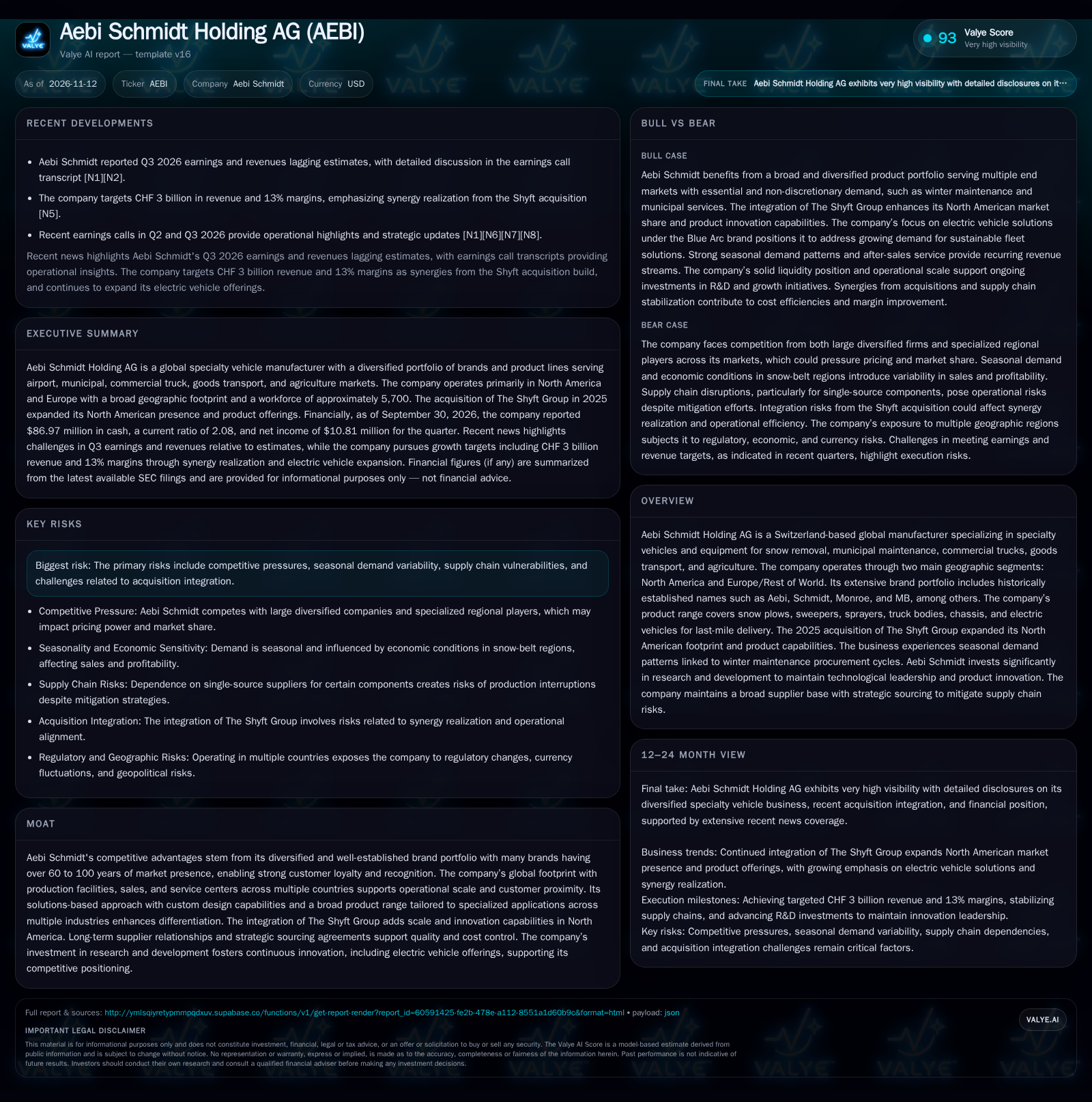
Aebi Schmidt, a Swiss-based specialty vehicle manufacturer, is integrating The Shyft Group to expand its North American footprint while contending with Q3 2026 earnings shortfalls and cyclical demand. Its diversified offerings—from snow equipment to electric last-mile vehicles—position it for stable municipal and infrastructure demand, but the realization of synergies, margin improvement, and successful EV scaling remain central to its investment case. Execution on integration and innovation, alongside supply chain resilience, will likely determine whether Aebi Schmidt can deliver on its CHF 3 billion revenue and 13% margin ambitions. [S1] [S2] [N1] [N2] [N5]
Aebi Schmidt Holding AG stands at a strategic crossroads: it is integrating a major North American acquisition, pursuing ambitious revenue and margin goals, and investing heavily in electrification, all while contending with the cyclical nature of its core municipal and infrastructure markets. The company’s broad product portfolio and global footprint provide resilience and customer stickiness, but recent earnings shortfalls and ongoing integration risks highlight the operational complexity ahead. The next phase for Aebi Schmidt will be defined by its ability to unlock synergies in North America, manage supply chain and seasonality headwinds, and successfully scale its electric vehicle initiatives.
Recent Results and Strategic Moves Reshape the Near-Term Outlook
Aebi Schmidt’s Q3 2026 financials revealed net income of $10.81 million, basic and diluted EPS of $0.14, cash of $86.97 million, and a current ratio of 2.08. However, both earnings and revenues missed analyst estimates, with company commentary emphasizing operational details and ongoing integration efforts. The July 2025 acquisition of The Shyft Group is actively being integrated into the North America segment, expanding the company’s reach in commercial trucks, last-mile delivery (including electric vehicles), and municipal equipment. These moves are intended to accelerate progress toward the company’s stated targets of CHF 3 billion in revenue and 13% margins. [S1] [S2] [N1] [N2] [N5]
How Aebi Schmidt’s Diversified Model Drives Revenue and Margin Potential
Aebi Schmidt generates revenue through the sale of specialized vehicles, upfitting, and equipment for municipal maintenance, airports, goods transport, and agriculture. Its business is structurally seasonal, with the second half of the year typically stronger due to winter equipment procurement and associated after-sales activity. The company’s product mix spans high-capex equipment (e.g., snow plows, sweepers, airport chassis), recurring after-market parts and service, and, increasingly, electric vehicle platforms for last-mile logistics. While hardware sales are capital-intensive and often cyclical, after-sales service provides revenue stability and margin support.
The recent Shyft Group integration could enhance operating leverage if procurement, manufacturing, and distribution synergies materialize. The company’s $27 million R&D spend in 2025, up from prior years, suggests a commitment to innovation, particularly in electrification and vehicle customization. However, large-scale electrification initiatives typically require substantial upfront investment and may pressure margins until volumes scale or cost curves improve. The company’s broad supplier network and strategic sourcing agreements are intended to mitigate input cost volatility, but supply chain friction remains a potential drag on margin realization.
The seasonal nature of Aebi Schmidt’s business also necessitates careful working capital management, as inventory build-ups typically precede peak demand periods. Efficient inventory turnover and flexible manufacturing capacity are critical to avoid margin erosion from excess stock or expedited logistics. Moreover, the balance between capital expenditures on durable equipment and investments in after-sales service infrastructure influences cash flow stability. If disclosed, metrics such as days sales outstanding (DSO) and inventory days would provide insight into how well the company manages these seasonal cash flow swings and whether integration with The Shyft Group improves these operational levers.
Brand Legacy, Geographic Reach, and Product Breadth: Moats and Market Pressures
Aebi Schmidt’s competitive advantages stem from its legacy brand portfolio—many brands with 60+ years of market presence—and its global operational footprint, including over a dozen production facilities and 70+ locations. Deep relationships with municipal and infrastructure customers, who value reliability and service, can create meaningful switching frictions, especially for specialized or upfitted vehicles. Its solutions-oriented approach allows tailored offerings for airports, cities, and contractors, further embedding the company within procurement cycles.
However, the competitive landscape is bifurcated: large diversified industrials (potentially with deeper R&D and capital pools) and nimble regional specialists both vie for share. Price competition, particularly in cyclical or commoditized segments, remains a risk. Electrification may reset the competitive order, with new entrants and established players seeking to capture the emerging last-mile and municipal EV markets. The successful integration of The Shyft Group could strengthen North American positioning, but realization of cross-selling or platform synergies is not yet proven.
The company’s geographic diversification can mitigate localized economic or weather-related downturns, but also introduces complexity in managing regulatory compliance, especially around emissions and safety standards that vary by region. This regulatory heterogeneity may both slow and increase the cost of electrification efforts, as product adaptations are required for different markets. Competitors with more standardized global platforms might achieve scale advantages, while Aebi Schmidt’s tailored approach could preserve customer loyalty. The interplay between customization and standardization will be a key determinant of competitive positioning, particularly as electrification and digitalization reshape customer expectations.
If Synergies and Electrification Scale, Margin and Revenue Ambitions Become Achievable
In a favorable scenario, Aebi Schmidt successfully integrates The Shyft Group, unlocking procurement and distribution efficiencies, and cross-selling opportunities across its expansive North American customer base. The company’s Blue Arc electric vehicle platform gains traction in last-mile delivery and municipal fleets, leveraging growing regulatory and customer demand for sustainable solutions. After-market service revenue benefits from the expanded installed base, buffering cyclicality and improving operating leverage.
Evidence that would confirm this scenario includes: sequential margin improvement in North America, accelerating revenue contribution from electric vehicle sales, and management commentary or data on realized cost and revenue synergies. Additional signs would be sustained R&D investment translating into differentiated, high-demand products, and customer wins in key EV segments.
Seasonal Strength Offsets Integration Friction, With Gradual Progress on EV and Margin Goals
A more probable path sees Aebi Schmidt maintaining its core municipal and infrastructure customer base, benefiting from seasonal procurement cycles and stable after-sales revenue. The integration of The Shyft Group delivers incremental, but not transformative, cost and distribution benefits in North America. Electric vehicle offerings under Blue Arc gain moderate traction but face adoption headwinds and margin dilution in the early years.
This scenario would be confirmed by steady, if unspectacular, revenue growth in both geographic segments, stable gross margins, and ongoing R&D expenditures. Signs of friction—such as continued earnings misses, delays in synergy realization, or slow EV adoption—would falsify the likelihood of rapid progress toward the company’s financial targets.
Integration Stumbles, Supply Chain and Seasonality Expose Earnings Volatility
In a negative scenario, the integration of The Shyft Group proves more complex than anticipated, leading to operational inefficiencies, higher costs, and distraction from core businesses. Supply chain disruptions—especially for critical components—interrupt production or drive up input costs, eroding margins. Persistent seasonality, compounded by mild winters or municipal budget constraints, reduces equipment order volumes and after-sales activity.
Confirmation would come from recurring earnings and revenue misses, rising operating expenses or inventory levels, and negative management commentary around integration or supply chain issues. Weak or declining margins in North America, as well as stagnation or contraction in the EV business, would further support the downside case.
Milestones That Will Clarify Aebi Schmidt’s Path Toward Scale, Margin, and Innovation
Quarterly progress on synergy realization from The Shyft Group integration, including procurement savings and cross-brand sales—if disclosed—would help test the integration thesis.
Unit sales and revenue contribution from Blue Arc electric vehicles, particularly in North America, as a measure of EV adoption and product-market fit.
Gross and operating margin trends in both North American and European segments, especially in periods of seasonal demand strength.
R&D investment levels and pipeline disclosures, particularly the pace of new product launches in electrification and digital solutions.
Supply chain stability, as evidenced by inventory turns, lead times, or commentary on component sourcing.
After-sales revenue and service contract growth, which would signal the stickiness and long-term value of the installed base.
Municipal and airport contract wins or renewals, providing visibility on forward demand and competitive positioning.
Disclaimer: This is research-only, informational analysis and not investment advice. It may include AI-generated interpretation and general industry context. Always verify important details using primary sources.

Comments