
Riverview Bancorp: Interest Rate Sensitivity Defines Near-Term Earnings Trajectory
With robust asset quality and a conservatively managed balance sheet, Riverview Bancorp’s core profitability remains tied to net interest margin dynamics. As recent earnings outpace prior quarters, the bank’s exposure to rate movements and disciplined risk management shape both opportunity and vulnerability in the current cycle.
Watch for trends in loan growth, deposit costs, and credit loss provisioning to gauge durability of outperformance.
Riverview Bancorp’s latest results underscore both its operational discipline and the acute sensitivity of its earnings to interest rate cycles. While Q2 2027 net income outpaced previous periods, the underlying driver—net interest income—remains exposed to ongoing rate volatility and competitive deposit pressures. Investors should focus on deposit cost trends, loan growth, and the speed of net interest margin normalization to assess the sustainability of current performance.
Recent Earnings Strength and Asset Quality Underpin Current Position
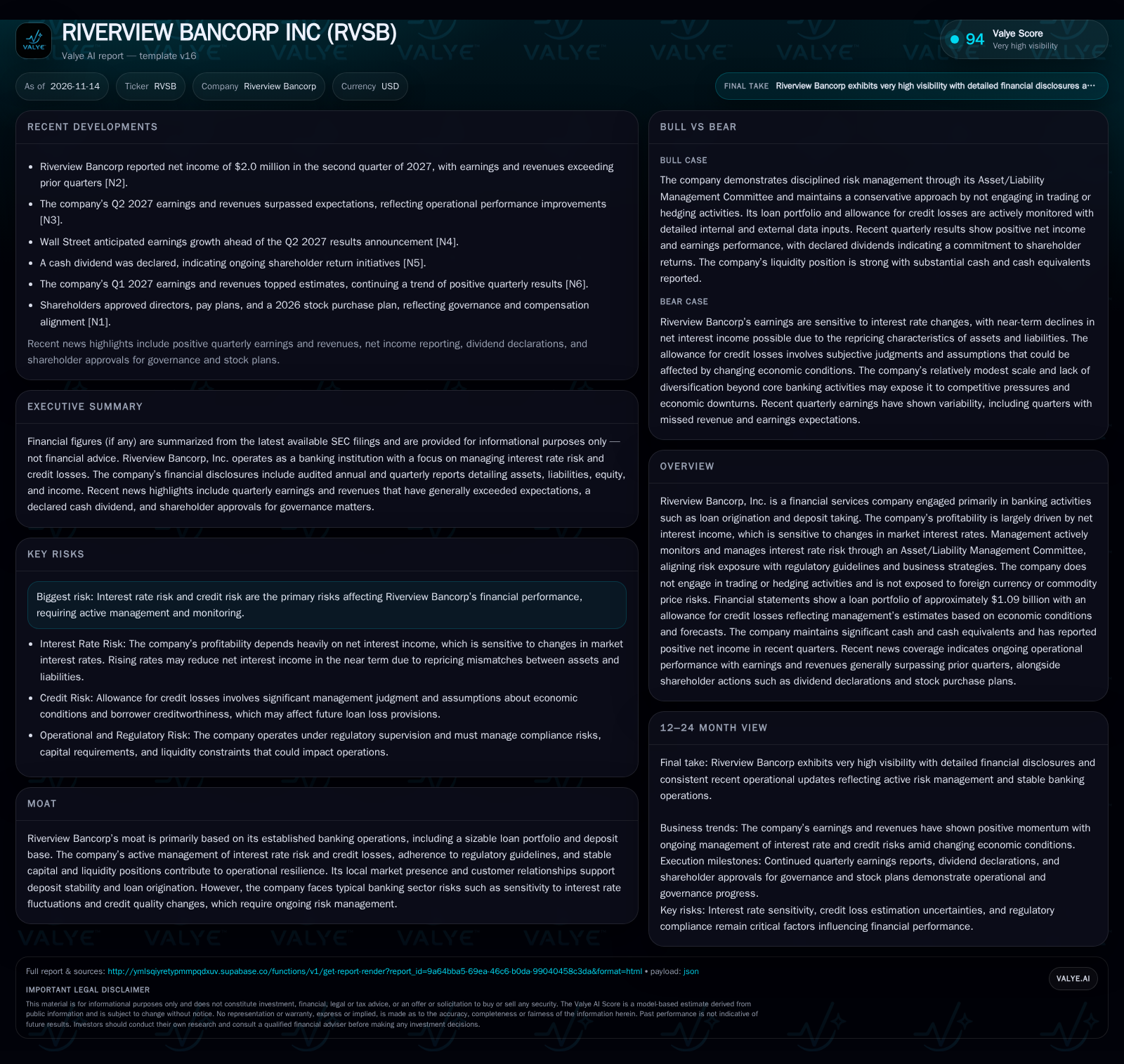
Riverview Bancorp reported net income of $2.0 million in the second quarter of 2027, marking an improvement over previous quarters and beating analyst estimates [N2] [N3]. This uptick is notable given the sector-wide margin compression from rising funding costs. As of March 31, 2026, the company managed $1.464 billion in total assets, with deposits of $1.254 billion and a loan portfolio of $1.09 billion [S1]. Its allowance for credit losses was $15.2 million, reflecting a cautious approach to provisioning amid ongoing economic uncertainty [S1]. The company reported cash and liquidity metrics for the period; these figures do not by themselves establish operating runway, investment capacity, financial flexibility, or financing capacity. [S2] [N5] These facts frame Riverview’s current stability, but also highlight its direct exposure to rate cycles and the need for vigilant credit risk management.
How Riverview Bancorp’s Core Profit Engine Responds to Rate Cycles
Riverview’s core profitability is fundamentally driven by its net interest margin (NIM)—the spread between interest earned on loans and investments and interest paid on deposits and other funding sources. In the current environment, higher market rates have increased deposit costs more quickly than yields on some loan assets, compressing NIM in the near term. The bank’s interest rate risk simulation model indicates that net interest income declines over the first 12 months of a rising rate scenario before recovering over a 24-month horizon, assuming rates stabilize [S1].
The company does not engage in trading, hedging, or non-core banking activities, so fee income and non-interest revenue streams are likely limited. This amplifies the impact of rate movements on profitability. Operating leverage is moderate; while a substantial portion of costs are fixed (branches, compliance, technology), deposit gathering and loan origination costs can flex with volume. Capital needs are managed conservatively, with total shareholders’ equity of $145.6 million supporting a loan-to-deposit ratio that suggests prudent risk-taking [S1].
Credit loss provisioning is another key variable. The $15.2 million allowance on a $1.09 billion loan book reflects management’s forward-looking assessments, but credit costs could rise if economic conditions deteriorate. Sustaining earnings momentum will require not only margin defense but also stable asset quality and controlled operating expenses.
Local Market Focus and Risk Discipline Shape Competitive Standing
Riverview Bancorp’s competitive position is anchored in its established local market presence, customer relationships, and conservative risk management culture. Its sizable deposit base and loan portfolio provide scale within its regional footprint, helping support recurring business and community engagement. However, like most community and regional banks, Riverview faces ongoing competition from larger national banks, digital-first challengers, and non-bank lenders for both deposits and high-quality loan customers.
The lack of non-interest income streams and limited diversification beyond traditional banking make Riverview more exposed to sector-wide margin pressures and less able to offset interest income declines with fee-based business. Technology adoption and digital service capabilities are increasingly important, as customers demand convenience and seamless banking experiences—areas where larger or more agile peers may have an edge.
Switching costs for depositors are generally low, especially in a rising rate environment where customers may shop for higher yields. However, long-standing customer relationships and local brand recognition can help mitigate churn, provided service levels and product offerings remain competitive. Ultimately, Riverview’s ability to defend its position will hinge on maintaining credit discipline, offering attractive rates, and investing in customer-facing capabilities.
Faster Margin Recovery if Rate Pressures Ease and Loan Growth Accelerates
The most favorable scenario for Riverview Bancorp hinges on stabilization or a decline in market interest rates, allowing deposit costs to plateau while loan yields remain elevated. This would enable a quicker recovery in net interest income and expand NIM, especially if the bank can grow its loan book with disciplined underwriting. Evidence of this scenario would include sequential improvement in net interest margin, acceleration in loan origination volumes, and continued benign credit loss experience (low or declining net charge-offs and delinquencies).
Additional upside could come from expense discipline or a modest expansion in non-interest income, perhaps through new fee-based products or services. If economic conditions improve and credit quality remains robust, management could deploy excess capital for shareholder returns or growth investments. Confirmation would come from quarterly reports showing rising pre-provision net revenue, stable or improving efficiency ratio, and no material increase in non-performing assets.
Managing Through Margin Pressure While Preserving Asset Quality
The most plausible path forward is one in which Riverview continues to experience near-term margin compression as deposit costs catch up to asset yields, but avoids significant asset quality deterioration. Net interest income may remain under pressure for several quarters, consistent with management’s interest rate simulations, before gradually recovering if rates stabilize and competitive deposit pricing moderates [S1].
Loan growth is likely to be modest, reflecting cautious underwriting standards and potentially softer demand in a higher-rate environment. Credit costs should remain manageable if the macro backdrop does not worsen materially, with the current allowance for credit losses providing a cushion. This scenario would be confirmed by steady net income, stable or slightly improving NIM, and continued low levels of non-performing loans and charge-offs.
Prolonged Margin Squeeze or Credit Shock Could Undermine Resilience
A less favorable scenario would see sustained upward pressure on deposit costs without a corresponding rise in asset yields, leading to a prolonged squeeze on net interest income. This could be exacerbated if competitive pressures force Riverview to pay up for deposits or lose funding to higher-yield alternatives, especially from rate-sensitive customers. In this environment, the bank’s earnings would come under pressure, potentially leading to cuts in discretionary spending or even the dividend if profitability deteriorates.
The risk of a credit shock is also present: a downturn in the local or broader economy could drive up delinquencies and losses, forcing larger provisions and eroding capital. The current allowance for credit losses, while prudent, might prove inadequate in a severe stress scenario, impacting both earnings and regulatory capital ratios. Downside confirmation would include a declining or negative trend in net interest income, rising non-performing assets, elevated charge-offs, and potential regulatory scrutiny if capital or liquidity metrics falter.
Benchmarks for Testing Riverview Bancorp’s Margin Defense and Credit Quality
Quarterly net interest margin trends—especially the pace of recovery or further compression relative to peer banks.
Deposit cost growth versus loan yield expansion, which will illuminate the direction of net interest income.
Loan portfolio growth rates and mix (commercial, consumer, real estate), if disclosed, to assess risk appetite and opportunity.
Allowance for credit losses as a percentage of loans, and trends in net charge-offs and non-performing assets.
Efficiency ratio movements to track expense discipline and operating leverage.
Regulatory capital ratios and liquidity coverage, particularly if asset quality deteriorates or earnings weaken.
Any new initiatives to diversify revenue streams or expand technology-enabled services, if disclosed.
Disclaimer: This is research-only, informational analysis and not investment advice. It may include AI-generated interpretation and general industry context. Always verify important details using primary sources.

Comments