
BIO-key International’s Profitability Struggles in a Highly Fragmented Biometrics Market
BIO-key International’s 2026 financials underscore persistent losses, a narrow reported cash balance, and revenue shortfalls, even as the company maintains operations across diverse geographies. The real test ahead: Can BIO-key leverage its technology and footprint to carve out defensible economics before capital constraints bite?
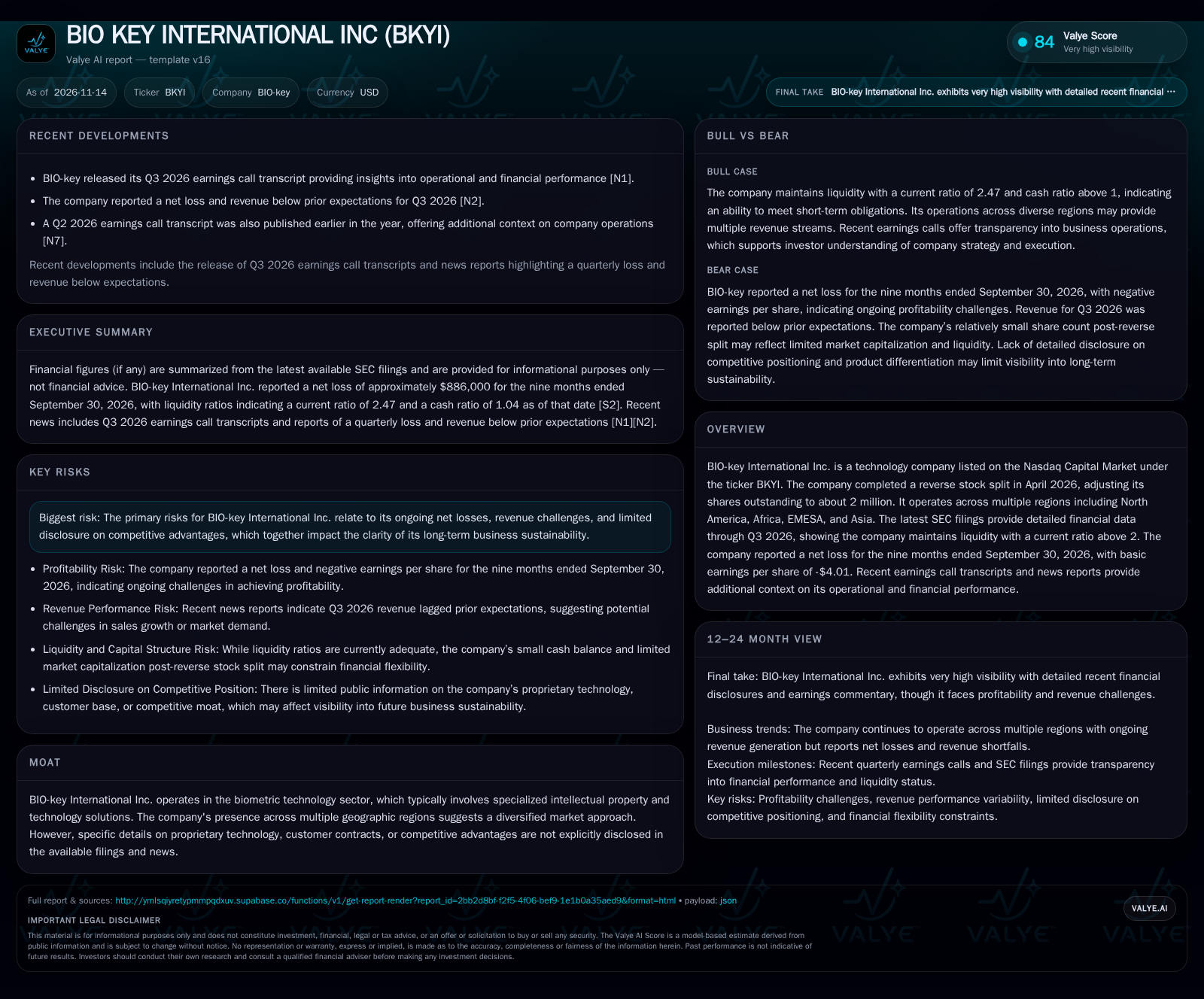
BIO-key International reported a net loss of $886,000 for the nine months ended September 30, 2026, with Q3 revenue below expectations and a cash balance of $2.22 million. Despite a current ratio of 2.47, the company remains unprofitable and faces uncertain demand visibility, but operates across North America, Africa, EMESA, and Asia. The core question: Will its multi-region presence and potential IP portfolio enable a turnaround before potential financial flexibility tightens further? [S2] [N2]
BIO-key International, a small-cap biometrics technology provider, remains mired in net losses and reported revenue below expectations for Q3 2026, despite showing liquidity coverage on paper. Its operations span multiple continents, but the company’s financials highlight a familiar pattern for niche tech players: a struggle to convert intellectual property and geographic reach into sustainable profits.
Persistent Losses and Liquidity Status in Recent Financial Reports
As of September 30, 2026, BIO-key International reported a net loss of approximately $886,000 for the nine months year-to-date, translating to basic earnings per share of -$4.01 [S2]. The company’s Q3 revenue lagged prior expectations, underscoring ongoing demand or execution challenges [N2]. The company reported cash and liquidity metrics for the period; these figures do not by themselves establish operating runway, investment capacity, financial flexibility, or financing capacity. [S2] The company completed a 1-for-10 reverse stock split in April 2026, reducing shares outstanding to about 2.04 million, which may impact trading liquidity and reflects its small capitalization [S2]. BIO-key operates across North America, Africa, EMESA, and Asia, but the recent financials do not clarify the contribution or momentum from these regions.
Profit Pools and Cost Dynamics Defining BIO-key’s Economic Prospects
In biometrics, value capture typically depends on a mix of hardware sales (e.g., fingerprint readers), software licensing, and ongoing support or integration services. Pricing power is often constrained by intense competition, customer procurement cycles, and rapid technological shifts. For BIO-key, the lack of reported profitability suggests that either gross margins are compressed, fixed costs (such as R&D and SG&A) remain high relative to scale, or both.
The company’s capital needs are modest by large-cap standards but significant relative to its cash balance and losses. With $2.22 million in cash and ongoing net losses, BIO-key may need to consider external financing or cost containment if revenue does not inflect [S2]. Operating leverage is a potential lever—biometric software and cloud authentication solutions can offer high incremental margins if sales volumes rise, but the current loss profile implies that the fixed cost base is not yet covered by revenue.
Without disclosure on contract duration, customer retention, or recurring revenue mix, it is unclear whether BIO-key’s sales are project-based, subscription, or hardware-led. If the model skews toward one-off hardware deployments, revenue and cash flow could remain lumpy and unpredictable; a shift to software-as-a-service or managed identity offerings could improve visibility and margins, but evidence for such a transition is not established in the current filings.
The interplay between fixed and variable costs within BIO-key’s cost structure critically influences its path to profitability. If fixed costs such as R&D and SG&A remain elevated without a proportionate increase in sales volume, operating leverage cannot be realized, perpetuating losses. Conversely, if BIO-key can scale sales—particularly through higher-margin software or recurring revenue streams—the incremental contribution margin on additional sales could rapidly improve overall profitability. This dynamic underscores the importance of not only growing revenue but also shifting the revenue mix toward offerings with sustainable margins and predictable cash flow.
Fragmented Market Conditions Challenge BIO-key’s Differentiation Efforts
BIO-key competes in a fragmented global biometrics landscape, facing alternatives ranging from established multinational security vendors to niche hardware specialists and emerging software/cloud authentication providers. Larger competitors often benefit from scale, deeper R&D budgets, established customer relationships, and bundled security offerings.
The company’s multi-region presence could provide diversification, but also strains resources across varied regulatory, sales, and support environments. The absence of detail on proprietary technology, unique integration capabilities, or anchor customer contracts in recent filings leaves open the question of what—if anything—confers durable pricing power or customer stickiness.
Technology substitution risk is high in biometrics: as authentication shifts toward mobile, multi-factor, or AI-driven modalities, hardware-centric models may face margin pressure or obsolescence unless accompanied by compelling software or platform value. Without clear evidence of network effects, high switching costs, or ecosystem lock-in, BIO-key’s competitive position appears vulnerable to both incumbent and disruptive entrants.
Potential for Operating Leverage from Regional Gains or SaaS Shift
A favorable scenario for BIO-key would involve material customer wins in one or more regions—ideally with multi-year, recurring software or managed service contracts—enabling the company to leverage its fixed R&D and support base. If BIO-key can demonstrate that its intellectual property or integration capabilities solve pain points for high-security sectors (such as government, healthcare, or enterprise access control), pricing power and retention could improve.
Confirmation would come from future disclosures showing: (1) a shift in revenue mix toward recurring SaaS or service contracts; (2) growing average contract value or customer lifetime value; (3) expansion in gross margins; and (4) evidence of anchor customers or long-term relationships. If these metrics are reported and accompanied by narrowing losses or a return to profitability, it would suggest that BIO-key is successfully climbing the adoption curve and capturing a defensible profit pool.
Projection of Modest Revenue Growth Amid Profitability Pressures
The most plausible near-term outcome is that BIO-key maintains its multi-region operations but struggles to materially outgrow its fixed cost base. Revenue may remain lumpy or modest, with limited visibility into contract duration or renewal rates.
Evidence supporting this scenario would include continued net losses, limited disclosure on customer concentration or contract wins, and little change in the revenue mix or gross margin. If external financing becomes necessary to bridge ongoing losses, dilution or higher capital costs could further constrain shareholder returns.
Retrenchment or Restructuring Risks from Capital and Competitive Challenges
A negative scenario would unfold if revenue continues to lag expectations, losses persist or widen, and the company approaches the limits of its cash resources without access to additional capital. In this case, BIO-key could be forced to scale back operations, exit less profitable regions, or pursue dilutive financings on unfavorable terms.
Confirmation would come from sharp reductions in headcount or R&D, asset sales, or negative going-concern language in future filings. Increased customer churn, loss of key accounts, or technology obsolescence would further accelerate downside risk. Ultimately, inability to establish a clear competitive advantage or defend market share could result in strategic alternatives—including sale or wind-down—if capital markets are unreceptive.
Upcoming Developments Shaping BIO-key’s Biometrics Market Path
Quarterly gross margin trends—expansion would signal improving economics or a shift to higher-value offerings; compression would imply ongoing pricing or mix pressure.
Disclosures of recurring revenue, contract duration, or customer retention rates—if disclosed—would help determine the stability and predictability of the business model.
Region-specific revenue growth or customer wins—clear evidence of traction in any geography would test the value of BIO-key’s international footprint.
Details on product or platform differentiation—such as patent activity, integration capabilities, or unique security features—would support or refute claims of a sustainable moat.
Management commentary on sales pipeline, backlog, or strategic partnerships—if disclosed—would provide clarity on forward demand and execution risk.
Any announced financings, asset sales, or restructuring actions would signal financial stress or a pivot in strategy.
Disclaimer: This is research-only, informational analysis and not investment advice. It may include AI-generated interpretation and general industry context. Always verify important details using primary sources.

Comments