
Paramount Gold Nevada: Regulatory Milestones Set Stage for Commercial Advancement
With federal approvals now secured for its flagship Grassy Mountain project, Paramount Gold Nevada faces the pivotal transition from developer to producer. The next phase will test the company’s ability to convert regulatory momentum into operational and financial progress amid sector volatility and capital demands.
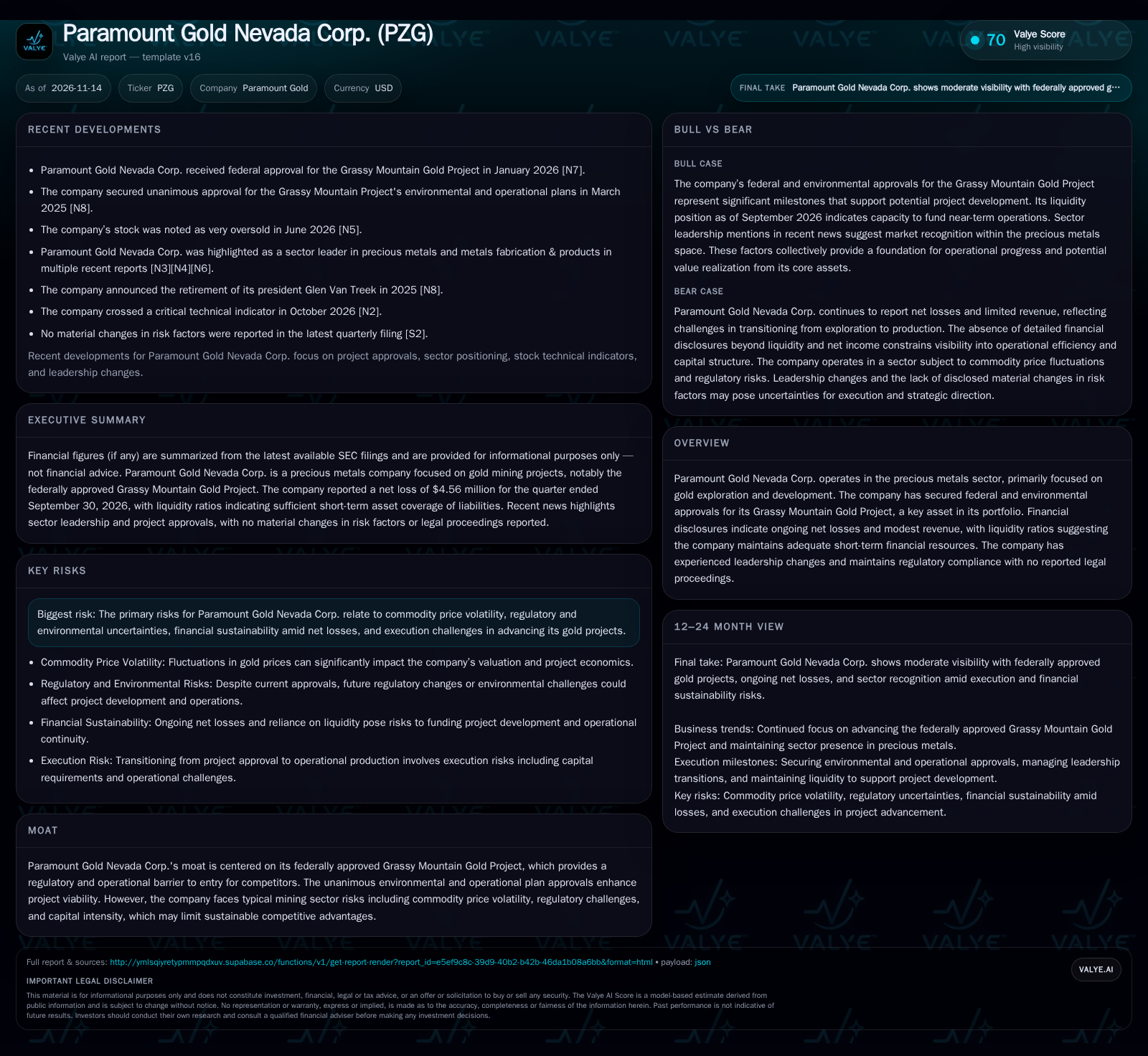
Paramount Gold Nevada has achieved a critical breakthrough with unanimous federal and environmental approvals for the Grassy Mountain Gold Project. While this regulatory success positions the company favorably within the precious metals sector, ongoing net losses and limited current revenue highlight the challenge of funding, building, and executing a transition into production. Sustained progress will require clear evidence of project advancement, financing solutions, and resilience to sector headwinds. [S2] [N7] [N8]
Paramount Gold Nevada Corp. has crossed a major threshold with unanimous federal and environmental approvals for its Grassy Mountain Gold Project, positioning it as a credible contender among North American junior gold developers. Yet the company remains in a capital-intensive, pre-revenue phase, posting continued net losses and relying on a finite reported cash balance to advance its flagship asset. The central question now is whether Paramount can marshal the resources and operational expertise to move from permit to production, and ultimately deliver on the promise that regulatory success has unlocked. The next 12-24 months will be decisive for translating this hard-won optionality into tangible economic value.
Strategic Direction Shaped by Recent Regulatory Approvals
Paramount Gold Nevada's unanimous federal approval for the Grassy Mountain Gold Project in early 2026, following environmental and operational plan sign-offs in 2025, marks a pivotal shift in the company’s outlook. These milestones sharply reduce the permitting and regulatory overhang that often derails junior mining projects, potentially making Paramount’s asset more valuable and investable to partners or acquirers. However, Paramount remains pre-revenue and reported a net loss of $4.56 million for the September 2026 quarter, highlighting the ongoing financial drain as it advances toward production. Recent leadership transition and sector visibility further shape the current context, but the company’s ability to bridge the gap between approval and cash-generating operations remains untested. [S2] [N7] [N8]
Economic Realities Behind Turning Permits into Profit
The core economic engine for Paramount Gold Nevada is the successful development and eventual production of gold from the Grassy Mountain project. In the mining industry, value creation is highly sensitive to three factors: realized gold prices, project capital intensity, and the efficiency of moving from approval to cash flow. With regulatory hurdles cleared, the focus shifts to financing construction and managing the high fixed costs inherent in building and operating a mine. Pre-production mining companies like Paramount typically face negative cash flows as they fund exploration, permitting, and feasibility studies, with only a distant prospect of revenue. If production is achieved, operating leverage can be substantial—fixed costs are spread over each additional ounce of gold—but this also amplifies risk if gold prices fall or costs overrun. Paramount’s current financials reflect high burn and limited revenue, suggesting that near-term economics will be dominated by capital-raising needs and project investment, rather than operating margins. The ultimate profitability will depend on the project’s all-in sustaining costs per ounce versus future gold prices, and on Paramount’s ability to control dilution and debt as it finances the build-out.
A critical consideration in assessing Paramount's path to profitability lies in the sensitivity of the project’s economics to capital structure choices. The mix between equity, debt, and alternative financing instruments will influence not only dilution but also the weighted average cost of capital, which in turn affects project net present value. For instance, higher leverage can amplify returns when gold prices are favorable but increases financial risk during downturns. Additionally, the timing of capital deployment relative to project milestones impacts the company’s burn rate and investor sentiment. Effective capital management strategies, including staged financing aligned with construction progress and milestone achievements, can mitigate funding risk and enhance valuation.
Operational execution post-approval is another determinant of economic outcomes. The ability to adhere to projected timelines and budgets during mine construction and commissioning directly affects cash flow trajectories. Delays or cost overruns can erode margins and extend the pre-production period, increasing cumulative losses. Furthermore, operational efficiency during production—such as ore recovery rates, processing throughput, and maintenance costs—will influence all-in sustaining costs per ounce. Paramount’s capacity to implement robust project management and leverage industry best practices will be pivotal in converting regulatory success into sustainable profitability.
Permitted Status Offers Competitive Edge Without Guaranteeing Dominance
Securing federal and environmental permits gives Paramount Gold a meaningful edge over peers still mired in the permitting process—an acute bottleneck in North American gold development. This regulatory clarity can attract strategic partners, financiers, or suitors seeking de-risked assets. However, the sector remains crowded, with numerous juniors vying for capital and attention, and established producers able to acquire or develop new projects at scale. Paramount’s competitive position depends on its ability to move swiftly from permit to production, and on whether Grassy Mountain’s grade, size, and cost structure can withstand competition from both brownfield expansions and other greenfield projects. Long-term, the company’s moat is not structural; it is contingent on execution, cost discipline, and the ability to secure capital on acceptable terms. Substitutes for investor dollars—such as ETFs, royalty companies, or larger, lower-risk miners—remain readily available, and gold itself faces indirect competition from other stores of value. The regulatory win is a differentiator, but not an enduring barrier.
The competitive landscape also demands consideration of how Paramount’s project characteristics align with evolving investor preferences and market dynamics. Investors increasingly favor projects with lower environmental, social, and governance (ESG) risks, which can affect access to capital and partnership opportunities. Paramount’s ability to demonstrate strong ESG credentials, including responsible resource stewardship and community engagement, could enhance its competitive positioning beyond regulatory compliance. Additionally, the potential for technological innovation in mining and processing at Grassy Mountain may offer cost advantages or operational improvements, setting the project apart in a crowded field. However, these factors require consistent execution and transparency to translate into tangible competitive benefits.
Market cyclicality and macroeconomic factors further complicate Paramount’s competitive stance. Gold prices are influenced by global economic conditions, currency fluctuations, and investor risk appetite, all of which can shift rapidly. Paramount’s project economics must therefore be resilient across a range of price scenarios to sustain investor interest and operational viability. Moreover, competition for capital is not static; shifts in broader commodity markets or capital market conditions can alter the relative attractiveness of junior gold developers. Paramount’s strategic flexibility—such as the ability to scale project development phases or pursue joint ventures—will be critical in navigating these external pressures and maintaining a competitive edge.
Key Factors for a Smooth Shift from Permit to Production
The most favorable scenario for Paramount Gold is a rapid and well-financed transition from permitting to construction and then to commercial gold production at Grassy Mountain. This would likely require securing significant external capital—either through equity, debt, a joint venture, or a sale/partnership with a larger mining company. If Paramount can demonstrate project advancement milestones such as final engineering, procurement of long-lead items, and the start of site preparation, investor confidence could rise and cost of capital could fall. Confirmation of this scenario would come from disclosed project financing agreements, positive construction updates, and clear guidance on production timelines and expected costs. A sustained rally in gold prices would further enhance project economics and strategic value. Conversely, delays in financing, cost inflation, or execution missteps would challenge the upside case.
Funding and Execution Challenges Define Current Outlook
The most plausible near-term scenario is one of incremental progress, with Paramount Gold pursuing staged project advancement while seeking additional funding. The company may focus on detailed engineering, limited site work, and continued permitting at the state or local level if needed. Cash burn is likely to persist, and further equity or convertible debt raises may be required, potentially diluting existing shareholders. Confirmation of this scenario would come from regular progress updates, continued regulatory compliance, and modest increases in capital spending. Falsification would occur if the company announces a halt or slowdown in project activity due to funding constraints, or if unanticipated regulatory or technical hurdles emerge. Gold price volatility and capital market sentiment will play a significant role in determining the pace and scale of progress.
Risks of Delays and Financial Pressure Despite Regulatory Success
In an adverse scenario, Paramount fails to secure the necessary capital to advance Grassy Mountain into construction, leaving the project stranded despite regulatory success. Extended delays could erode the value of the permits, increase holding costs, and force the company to seek asset sales or highly dilutive financings at distressed valuations. Adverse moves in gold prices, sector risk appetite, or shifting regulatory requirements could accelerate this scenario. The key risk is that without timely execution, the window of opportunity created by permitting success may close before value can be realized.
Crucial Milestones Guiding Paramount’s Path to Value Creation
Evidence of project-level financing—debt, equity, or joint venture terms—sufficient to fund the next phase of Grassy Mountain development, if disclosed.
Regular updates on construction readiness: engineering progress, procurement of key equipment, and site preparation milestones.
Any changes in gold price trends or sector-wide risk appetite that could impact the economics or funding options for new producers.
Disclosure of new off-take agreements, partnerships with larger miners, or strategic investment that could accelerate project advancement.
Status of any remaining regulatory or community engagement requirements at the state or local level.
Turnover or stability in management and board composition, particularly after the recent retirement of the company’s president.
Disclaimer: This is research-only, informational analysis and not investment advice. It may include AI-generated interpretation and general industry context. Always verify important details using primary sources.

Comments