
Urban One’s Cross-Platform Dilemma: Managing Losses, Leverage, and the Future of Urban Media
Urban One remains the leading multi-media platform targeting African-American and urban audiences, but persistent losses, high leverage, and shifting media consumption habits raise questions about the sustainability and evolution of its business model.
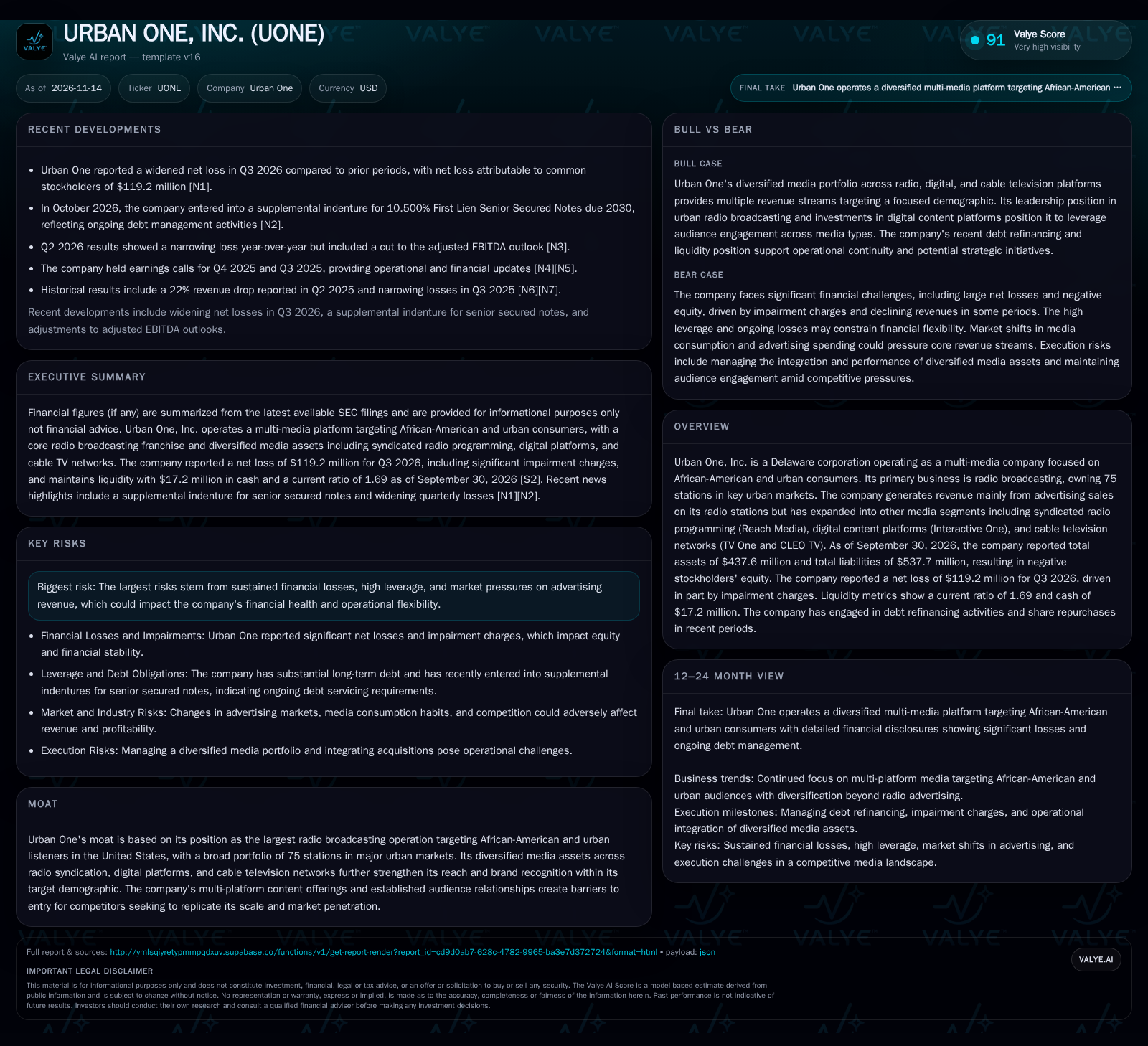
Urban One reported a $119.2 million net loss in Q3 2026, driven by major impairment charges on its media assets. Despite industry-leading reach in urban radio and a diversified portfolio spanning digital and cable, revenue declined to $88.0 million, and the company’s negative equity and ongoing debt management underscore financial stress. The question is whether Urban One’s multi-platform strategy can stabilize cash flows amid secular headwinds in traditional media and evolving advertising trends. [S2] [N1] [N2]
Urban One, Inc. stands at a crossroads as America’s largest urban radio broadcaster and a diversified content provider for African-American and urban audiences. Despite its premier market position and multi-platform reach spanning radio, digital, and cable, the company faces mounting losses, shrinking revenues, and a balance sheet weighed down by impairments and debt. The central question for Urban One is whether its strategy of cross-platform diversification can arrest the slide in legacy revenues and deliver financial stability, or whether structural shifts in media consumption will outpace its ability to adapt.
Impairment-Driven Losses and Debt Refinancing Define the Current Landscape
Urban One reported a net loss of $119.2 million for Q3 2026, largely the result of a $128.9 million impairment charge related to goodwill, intangible assets, and long-lived assets. This marks a sharp reversal from prior quarters where losses were narrowing, highlighting the severity of asset write-downs and the stress on the company’s earning power. Net revenue declined to $88.0 million in Q3 2026 from $92.7 million a year earlier, indicating continued top-line pressure. The company’s balance sheet showed negative equity of about $100.2 million at quarter-end, with total liabilities of $537.7 million against $437.6 million in assets. Urban One also entered into a supplemental indenture for 10.500% First Lien Senior Secured Notes due 2030 in October 2026, reflecting ongoing debt management needs and the cost of capital in a high-leverage environment. [S2] [N1] [N2]
How Urban One’s Revenue Mix and Cost Structure Shape Financial Outcomes
Urban One’s business model is anchored in advertising revenue, historically derived from its 75 radio stations in major African-American markets. Radio advertising is typically high-margin when fixed costs are covered, but secular declines in radio listenership and fragmentation of ad budgets have pressured both volume and pricing. The company has attempted to diversify through Reach Media (syndicated radio), Interactive One (digital platforms), and TV One and CLEO TV (cable networks), aiming to capture a larger share of the urban media value chain.
While digital and cable theoretically offer growth and margin expansion opportunities—digital via scalable content and cable via carriage fees and targeted advertising—these segments often require significant up-front investment in content, technology, and distribution. The Q3 2026 impairment suggests that previous investments may not be yielding expected returns, or that future cash flows from these assets are being revised downward. Urban One’s cost base remains high, with Q3 2026 operating expenses of $214.6 million. High debt service costs, as implied by the recent 10.5% secured notes, further squeeze operating leverage and reduce flexibility for reinvestment or strategic pivots. [S2] [N2]
Dominance in Urban Radio Meets Rising Digital and Media Substitution Threats
Urban One’s primary competitive advantage remains its scale and brand recognition in urban radio broadcasting, providing unique access to African-American and urban audiences—a demographic often underserved by national media. This leadership enables valuable local and national advertising relationships and a degree of pricing power within its niche.
Yet, the broader media landscape is rapidly evolving. Digital audio platforms, podcasting, social media, and streaming services are capturing audience share, especially among younger listeners. Cable networks targeting the same demographic face cord-cutting and the migration of ad dollars to digital-first platforms. While Urban One’s multi-platform approach offers a hedge, the competitive environment is increasingly defined by digital-native players with lower fixed costs and data-driven advertising solutions. The challenge is translating reach and brand equity into sustainable digital monetization before legacy revenues erode further.
Unlocking Value Through Digital Scale and Multi-Platform Monetization
A favorable scenario for Urban One would see the company successfully leveraging its unique audience insights and brand loyalty to drive digital engagement, attract new advertisers, and grow non-radio revenue streams. The company could use its digital platforms to cross-promote content, aggregate first-party data, and command premium ad rates for targeted campaigns. Additionally, rationalizing its cost structure—possibly through further asset sales, partnerships, or technology investments—could improve margins and free up capital for growth initiatives.
Evidence that would confirm this scenario includes sustained growth in digital and cable revenues, a stabilization or rebound in overall top-line performance, and a return to positive adjusted EBITDA. Improved asset utilization and reduced impairments would signal that diversification investments are beginning to pay off. Successful refinancing at lower rates or material debt reduction would further validate a turnaround.
Adapting to Slow Revenue Erosion While Managing Debt and Impairment Risk
The most plausible trajectory is a continuation of gradual revenue declines in legacy radio, modest growth or stabilization in digital and cable, and ongoing cost management efforts to limit losses. Urban One may be able to offset some top-line pressure with selective cost cuts, but high fixed costs and debt service obligations limit the scope for rapid margin improvement. Periodic impairments could continue if asset performance fails to meet expectations, perpetuating negative equity and reducing future flexibility.
Confirmation would come from sequential revenue trends showing stabilization in digital/cable, persistent but not accelerating losses, and successful debt service or refinancing without covenant breaches. Falsification would be a marked acceleration in revenue or audience decline, inability to meet debt obligations, or further large impairments.
Accelerated Decline in Core Revenues and Liquidity Stress
In a bearish scenario, Urban One experiences a rapid acceleration in radio and cable revenue declines, outpacing the company’s ability to grow digital or cut costs. Advertising budgets could shift more aggressively to digital-native competitors, and legacy platforms may lose pricing power. Continued asset underperformance would force further impairments, deepening negative equity and raising questions about going-concern status.
Liquidity could become constrained if operating cash flows turn negative and refinancing options tighten, especially given the high coupon on new debt. Evidence for this scenario would be sharp declines in revenue, persistent operating losses, further large impairments, rising interest expense, and warnings or breaches related to debt covenants.
What Will Determine Urban One’s Ability to Pivot and Survive?
Quarterly revenue growth or stabilization in digital and cable segments—if disclosed—would help test whether diversification is working.
Advertising revenue mix by channel (radio, digital, cable) would provide insight into the pace of legacy decline versus new growth.
Adjusted EBITDA trends and margin trajectory are crucial for assessing cost control and underlying profitability.
Progress in debt reduction or refinancing, including pricing and covenant terms, will indicate potential financial flexibility.
Asset impairment charges and their frequency/size will reveal whether asset values are stabilizing or still at risk.
Audience engagement and ratings data for both radio and digital platforms—if disclosed—would clarify competitive positioning.
Capex trends and content investment levels will show whether management is prioritizing growth or retrenchment.
Any strategic asset sales, partnerships, or acquisitions could alter the company’s risk/reward profile in either direction.
Disclaimer: This is research-only, informational analysis and not investment advice. It may include AI-generated interpretation and general industry context. Always verify important details using primary sources.

Comments