
Churchill Capital Corp XII: reported balance sheet position, But Strategic Uncertainty Looms
Churchill Capital Corp XII reports reported liquidity position and positive net income as of Q3 2026, yet its future hinges on the execution and clarity of a successful business combination. With minimal public disclosure on core operations, the SPAC’s value proposition and long-term trajectory remain unresolved.
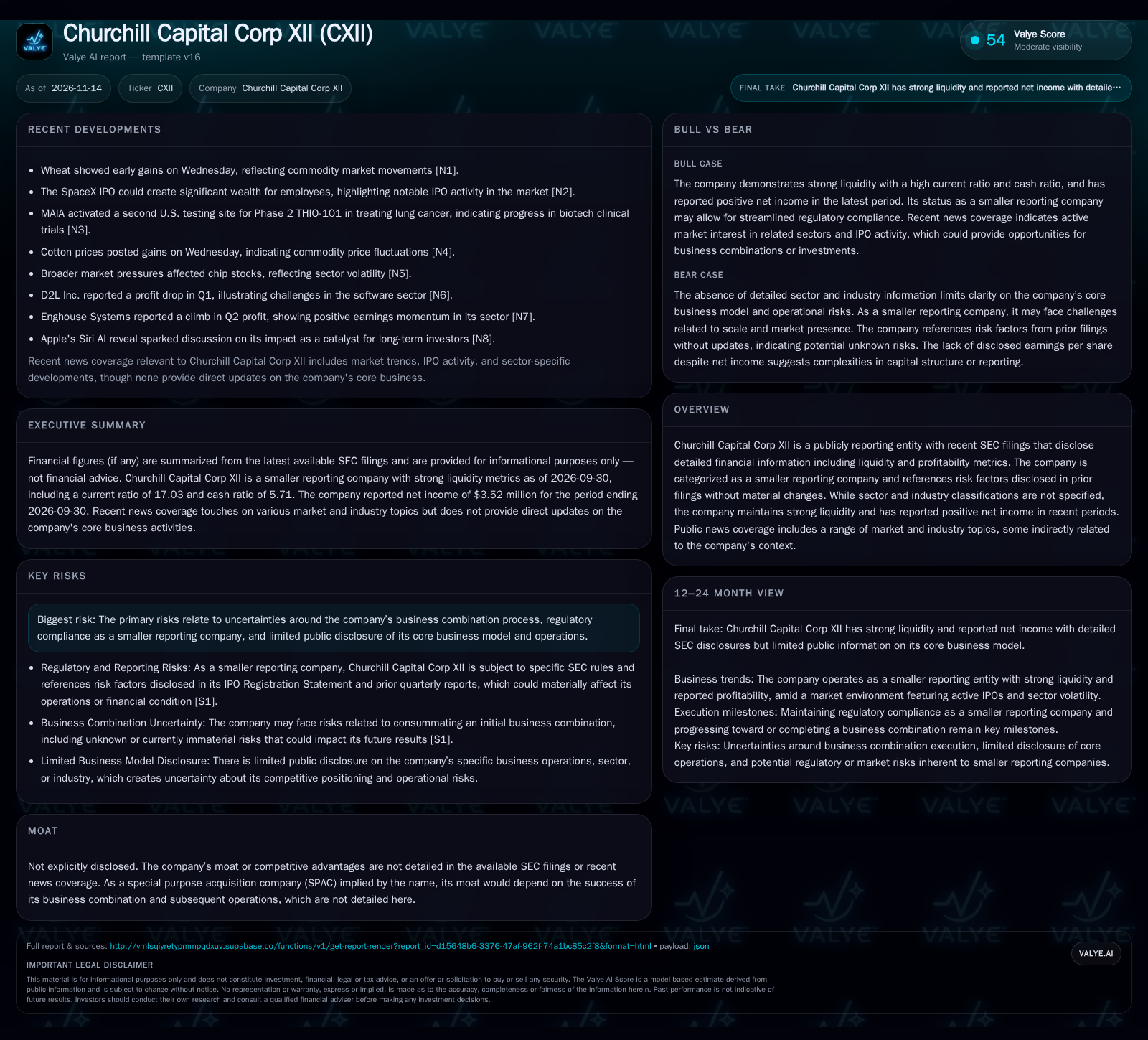
Churchill Capital Corp XII holds a current ratio of 17.03 and $3.5M net income as of Q3 2026, signaling a strong financial position [S1]. However, without a disclosed business combination or operational focus, investors face significant uncertainty about its future direction and competitive potential.
Churchill Capital Corp XII enters late 2026 with a notably reported liquidity position and positive net income, yet its core business activities and strategic direction remain opaque. As a special purpose acquisition company (SPAC), the most material driver of future value lies in its ability to identify, negotiate, and close a compelling business combination. Until more is disclosed about its target industry or operational model, investors and analysts are left weighing robust financial metrics against the backdrop of significant strategic ambiguity.
Liquidity Surplus and Earnings, But No Operational Clarity
As of September 30, 2026, Churchill Capital Corp XII reported $578,224 in cash and cash equivalents and total current assets of $1,723,484, with current liabilities of only $101,200. This results in a current ratio of 17.03 and a cash ratio of 5.71, both well above typical operating company norms and indicative of reported liquidity position [S1]. The company also recorded net income of $3,522,104 for the period [S1]. However, there is no disclosure of active business operations, sector focus, or a completed business combination. The absence of earnings per share despite net income suggests non-traditional capital structure or accounting, further reinforcing the company’s status as a SPAC awaiting its primary transaction [S1].
The reported liquidity surplus and positive net income, while encouraging, must be contextualized within the SPAC structure, where operational activities are typically dormant until a business combination is consummated. This means that the financial metrics largely reflect the management of trust assets and related financial instruments rather than business performance. The company reported cash and liquidity metrics for the period; these figures do not by themselves establish operating runway, investment capacity, financial flexibility, or financing capacity. Additionally, the absence of operational clarity complicates traditional valuation models, as investors cannot assess revenue growth, cost structure, or capital expenditure requirements, leaving intrinsic value estimation speculative at best.
Economic Model Hinges on Business Combination Execution
SPACs like Churchill Capital Corp XII typically generate limited operating revenue prior to a business combination. Their economics are driven by the interest earned on trust assets, minimal expenses, and—most importantly—the upside potential from merging with a private business. The reported net income likely reflects non-operating gains, such as interest income or changes in warrant liability valuations, rather than traditional revenue-generating activities [S1].
Once a target is acquired, the economics would shift dramatically—future profitability, cash flow, and value creation would depend on the acquired company’s revenue model, margin structure, and capital needs. Until a target is identified and terms are disclosed, the mix of fixed versus variable costs, required capital outlay, and potential for operating leverage remain entirely hypothetical. The main near-term capital requirement is maintaining compliance, managing operating expenses, and preserving the trust for a future transaction.
The economic model of a SPAC prior to combination is inherently constrained by its fiduciary mandate to preserve trust assets, limiting aggressive investment or operational initiatives. This creates a financial profile characterized by low risk but also minimal organic value creation. The transition point—the business combination—introduces multiple conditional variables: the acquired company's industry cyclicality, capital intensity, and competitive dynamics will dictate future cash flow volatility and capital allocation needs. Furthermore, the timing and structure of the transaction, including earn-outs, warrants, or founder shares, can materially influence post-merger economics and shareholder dilution. Thus, the ultimate economic outcome is a function of both the intrinsic qualities of the target and the negotiated deal terms, underscoring the importance of strategic alignment and financial discipline.
SPAC Market Dynamics and the Race for High-Quality Targets
Churchill Capital Corp XII’s competitive position is shaped by the broader SPAC landscape, in which hundreds of blank-check companies are vying for a limited pool of attractive private targets. The company’s ability to differentiate itself—through sponsor reputation, deal-making expertise, or access to capital—could be decisive in securing a high-quality merger partner.
However, with no sector focus or strategic intent disclosed, it is unclear whether Churchill Capital Corp XII has a thematic edge or unique sourcing channel. In recent years, increased regulatory scrutiny, a glut of SPACs, and target companies’ growing bargaining power have intensified competition and occasionally led to suboptimal deal structures or failed combinations. For Churchill, the absence of a clear investment thesis or sector specialization may be a disadvantage versus SPACs with more defined mandates.
In a crowded SPAC market, differentiation often hinges on the quality and exclusivity of deal flow, which is in turn influenced by sponsor networks, sector expertise, and reputation. Without a clearly articulated sector focus, Churchill Capital Corp XII may face challenges in sourcing proprietary opportunities or attracting high-caliber targets that prefer partners with domain knowledge and strategic insight. Moreover, the competitive intensity among SPACs can lead to bidding wars or pressure to accept suboptimal deal terms, especially in sectors experiencing frothy valuations. Regulatory developments and investor sentiment shifts also add layers of uncertainty, potentially affecting the cost of capital and willingness of targets to engage. Therefore, the company’s strategic positioning will be tested not only by deal execution but also by its ability to navigate evolving market and regulatory dynamics.
A Transformative Acquisition Could Unlock Shareholder Value
The most favorable scenario for Churchill Capital Corp XII is the successful identification and acquisition of a private company with robust growth prospects, strong unit economics, and a scalable business model. If the target operates in a high-growth sector—such as technology, healthcare, or next-generation industrials—with a clear path to cash flow generation, the SPAC’s remaining cash, public listing, and sponsor network could serve as powerful growth accelerants.
Confirmation of this scenario would require disclosure of a signed merger agreement with a reputable, high-quality target, detailed financial projections, and favorable deal terms. Evidence such as a definitive proxy statement, positive market reaction, and third-party validation of the target’s prospects would further strengthen the case.
Extended Search Period and Heightened Deal Scrutiny Define the Likely Course
Absent a near-term business combination, Churchill Capital Corp XII is likely to continue incurring minimal operating expenses while searching for an appropriate target. In this scenario, Churchill may eventually announce a deal with a mid-tier or late-stage private company—potentially outside of ‘hot’ sectors—where valuation and growth prospects are more moderate.
Evidence supporting this outcome would include continued maintenance of high liquidity, periodic extensions of the SPAC’s combination window, and eventual deal announcements with less market enthusiasm or mixed shareholder response. Falsification would come in the form of rapid target identification or a high-profile merger.
Failure to Combine or Poor-Quality Deal Erodes Shareholder Value
The principal risk is that Churchill Capital Corp XII fails to consummate a business combination within the allowed timeframe, resulting in the dissolution of the SPAC and return of remaining funds to shareholders—often at a modest premium to trust value but with little upside. Alternatively, the company could rush into a poor-quality deal, overpaying for a weak target or accepting unfavorable terms, which could lead to post-merger value destruction, increased redemptions, and potential delisting.
Confirmation of this scenario would include repeated extensions, redemptions outpacing new capital infusions, negative market reaction to a proposed combination, or regulatory challenges. Falsification would require timely completion of a credible, well-received merger.
What Will Define Churchill Capital Corp XII’s Next Strategic Pivot
Announcement of a definitive business combination agreement, including target company details and deal structure, would be the clearest catalyst.
Changes in trust asset balance and redemption rates, if disclosed, would indicate shareholder confidence and deal quality.
Regulatory filings or proxy statements outlining merger terms, financial projections, and sponsor incentives would help test the value-creation thesis.
Disclosure of a sector or thematic focus for target identification would clarify competitive positioning.
Information about sponsor team experience, reputation, or prior SPAC track record would contextualize deal-making capability.
Updates on extension of the SPAC’s combination window, if any, would signal progress or lack thereof.
Shareholder meeting outcomes and redemption levels at the time of a proposed combination would provide real-time feedback on perceived deal quality.
Disclaimer: This is research-only, informational analysis and not investment advice. It may include AI-generated interpretation and general industry context. Always verify important details using primary sources.

Comments