
Irenic Acquisition Corp.: SPAC Structure, Trust Asset Dynamics, and the Countdown to a Business Combination
With over $256 million in trust and a recent IPO, Irenic Acquisition Corp. faces a familiar SPAC tension: reported balance sheet position optics versus the urgent need to secure a value-creating merger before time and redemption pressure erode its capital base.
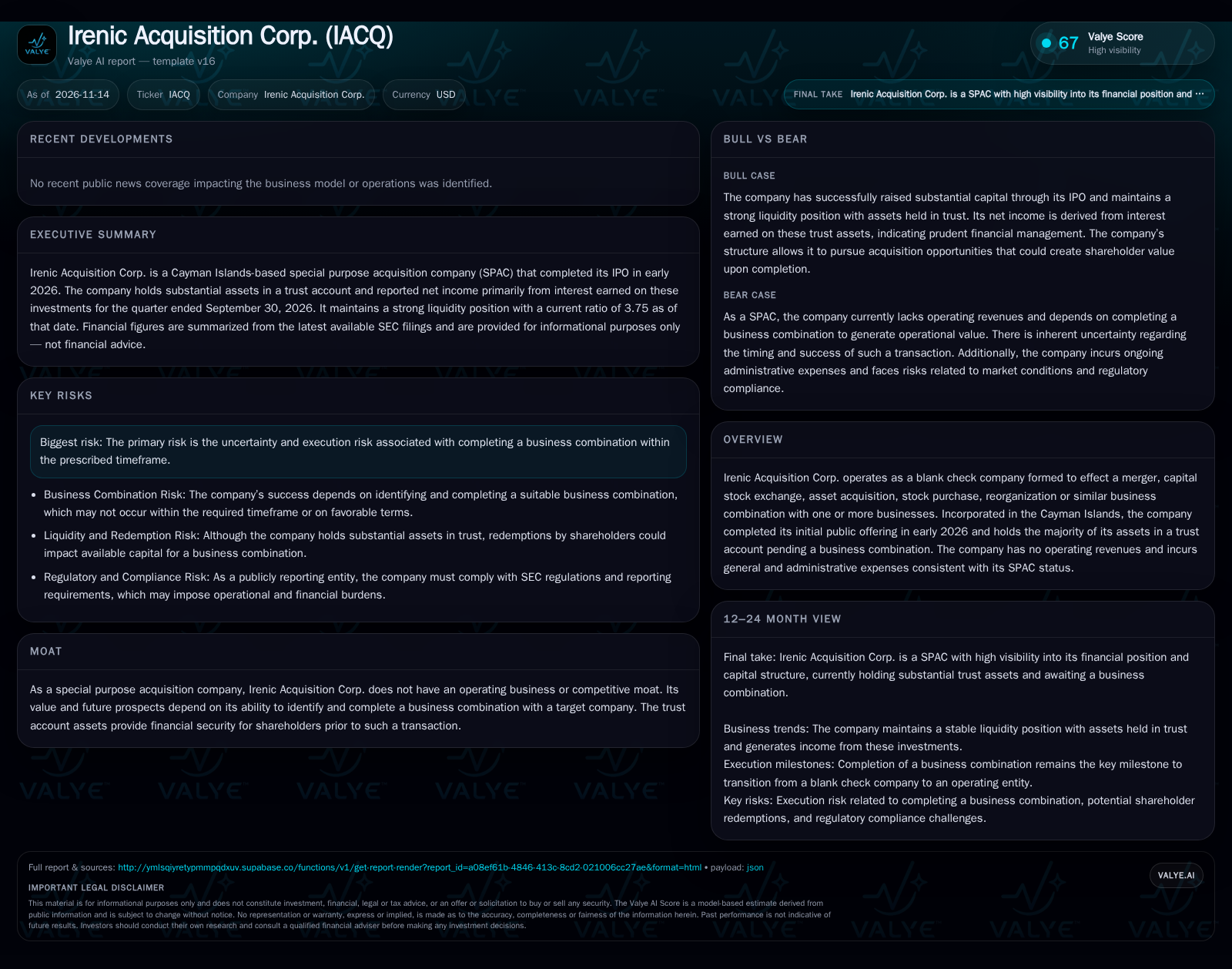
Irenic Acquisition Corp. is a newly listed SPAC with $256 million in trust as of September 2026. Its income is currently limited to interest on these assets, while ongoing administrative costs persist. The company’s future value hinges entirely on identifying and completing a business combination within its mandated timeframe, all while managing potential shareholder redemptions and regulatory hurdles. Until a deal is announced, the economic upside and downside are defined less by current operations and more by the quality, timing, and terms of any future acquisition. [S1]
Irenic Acquisition Corp. exemplifies the modern SPAC lifecycle: newly public, flush with trust capital, and yet fundamentally a shell awaiting transformation through merger. With over $256 million in trust as of September 2026, its near-term financials are dominated by interest income, while general and administrative expenses accumulate. The real test for Irenic—and the lever for shareholder value—lies ahead: securing a compelling business combination before redemptions, market conditions, or regulatory changes erode its deal-making potential. Until then, the company’s financial optics are largely a function of prudent cash management and the ticking clock of SPAC deadlines. [S1]
IPO Proceeds, Trust Assets, and the Redemption Overhang: The Current State
Irenic Acquisition Corp. completed its IPO and partial overallotment by April 29, 2026, raising a total of $252.5 million in gross proceeds. As of September 30, 2026, the company had $256.4 million in trust—slightly above gross proceeds due to interest accrual. This trust account is the core economic engine for Irenic pre-merger, as the company has no operating revenues and reported Q3 net income of $2.1 million exclusively from interest on trust investments. The company’s current assets stood at $1.13 million, with current liabilities of $0.3 million, translating to a current ratio of 3.75. However, these figures reflect the low-operating-cost, cash-heavy nature of a pre-deal SPAC, not the health of an ongoing business. The most material near-term reality is the potential for shareholder redemptions at $10.15 per share, which could sharply reduce the capital available for any acquisition. [S1]
How Value Is Created (or Lost) in the SPAC Lifecycle
Until a business combination is completed, Irenic’s economics are defined by a simple formula: interest income from trust investments minus ongoing administrative and due diligence costs. The trust account is typically invested in short-term U.S. government securities, which, in the current high-rate environment, can generate meaningful but transient yield. However, these returns are immaterial relative to the company's ultimate goal: deploying trust assets in a merger that creates value for post-combination shareholders.
Upon completion of a business combination, the economics shift dramatically. The SPAC may issue new equity, take on debt, or use a combination of cash and shares to acquire a target. This introduces dilution risk for public shareholders—especially if redemptions are high and sponsor shares convert at favorable ratios. Meanwhile, the acquired business’s own economics (revenue scale, margins, capital intensity, and growth prospects) become paramount. If the target is capital-hungry or structurally unprofitable, the merged entity may need additional funding or face liquidity constraints post-merger. Conversely, a high-quality, cash-generative target can create immediate value and justify the SPAC premium.
SPAC Competition: Timing, Target Quality, and the Crowded Acquisition Market
Irenic operates in a crowded SPAC environment, where hundreds of blank check companies vie for a shrinking pool of attractive private targets. Its competitive position is defined not by operating moats but by sponsor reputation, deal-sourcing networks, and the ability to negotiate favorable terms under time pressure. The risk of overpaying, chasing lower-quality assets, or facing adverse selection grows as the SPAC deadline approaches.
At the same time, Irenic must contend with the possibility of significant shareholder redemptions, which can erode its trust capital and bargaining power. Competing SPACs with differentiated sponsor teams, industry expertise, or pre-committed PIPE (private investment in public equity) financing may have an edge in securing premium targets. Traditional IPOs, direct listings, and private equity exits also compete for the same universe of late-stage private companies, increasing the challenge.
Catalysts for Successful De-SPAC: What Would Unlock Shareholder Value
The most favorable outcome for Irenic is the identification and acquisition of a high-growth, profitable target with strong management, clear market opportunity, and a compelling story for public investors. If redemptions are modest and the target business brings operational synergies or a differentiated product, the merged entity could command a valuation premium and deliver upside to both public shareholders and sponsors.
Confirmation would come from a deal announcement featuring: (1) a well-known or fast-growing target with above-market growth prospects, (2) a manageable redemption rate that preserves most of the trust capital, (3) strong PIPE or additional financing support, and (4) positive post-deal trading performance relative to peers. If these conditions materialize, Irenic could transition from a capital shell to a growth platform, justifying the initial SPAC premium.
Navigating the Standard SPAC Challenge: Execution under Pressure
The most likely scenario is that Irenic, like many SPACs, faces a race against the clock to identify and close a deal before its merger deadline. As time passes, the risk of redemptions grows, which could reduce the trust pool and force the sponsor to seek additional backstops or PIPE investments to complete a transaction. The eventual target may be solid but not exceptional—perhaps a mid-tier private company seeking liquidity but unable to command a premium valuation in the IPO market.
Evidence confirming this base case would include: (1) a deal announcement with substantial but not overwhelming redemptions, (2) a target company with moderate growth and profitability but limited public visibility, and (3) a muted or volatile market reaction post-merger. If the SPAC cycle plays out in this fashion, the upside for public shareholders may be modest, and any premium over trust value could be eroded by dilution, transaction costs, or target underperformance.
When Redemptions and Deal Risk Erode the SPAC Value Proposition
The adverse scenario for Irenic would involve (1) a failure to secure a suitable target within the mandated timeframe, (2) excessive shareholder redemptions triggered by market skepticism or poor deal quality, or (3) regulatory or legal hurdles that delay or derail the transaction process. In such cases, the SPAC may be forced to liquidate and return trust capital to shareholders, with sponsors losing their at-risk capital and public shareholders receiving only nominal interest over their initial investment.
Falsifying evidence would include: (a) multiple deal negotiations failing to close, (b) high-profile redemption waves, (c) persistent trading below trust value, or (d) regulatory filings indicating extension requests or liquidation preparations. In this outcome, the opportunity cost for sponsors and public investors is significant, and the SPAC premium is never realized.
Milestones That Will Determine Irenic’s SPAC Outcome
Announcement of a definitive business combination agreement, including target identity, valuation, and transaction structure.
Shareholder redemption levels at the time of deal approval—a high redemption rate could severely limit post-merger capital.
PIPE (private investment in public equity) commitments or other external financing secured to support the transaction, if disclosed.
Sponsor backstop arrangements or willingness to forfeit or adjust promote shares in response to high redemptions, if disclosed.
SEC or regulatory feedback—delays, comments, or legal challenges to the proposed merger or registration statement.
Post-merger trading performance relative to the SPAC’s trust value and peer de-SPACs.
Extension or liquidation vote activity as the deadline approaches, indicating market confidence (or lack thereof) in a forthcoming deal.
Disclaimer: This is research-only, informational analysis and not investment advice. It may include AI-generated interpretation and general industry context. Always verify important details using primary sources.

Comments