
American Drive Acquisition Co: Navigating the SPAC Lifecycle Amid Liquidity Constraints and a Ticking Clock
With more than $236 million in trust and a looming deadline to consummate a business combination, American Drive Acquisition Co faces a familiar SPAC crossroads: execution risk, sponsor alignment, and the challenge of converting a blank-check vehicle into a value-generating operating company.
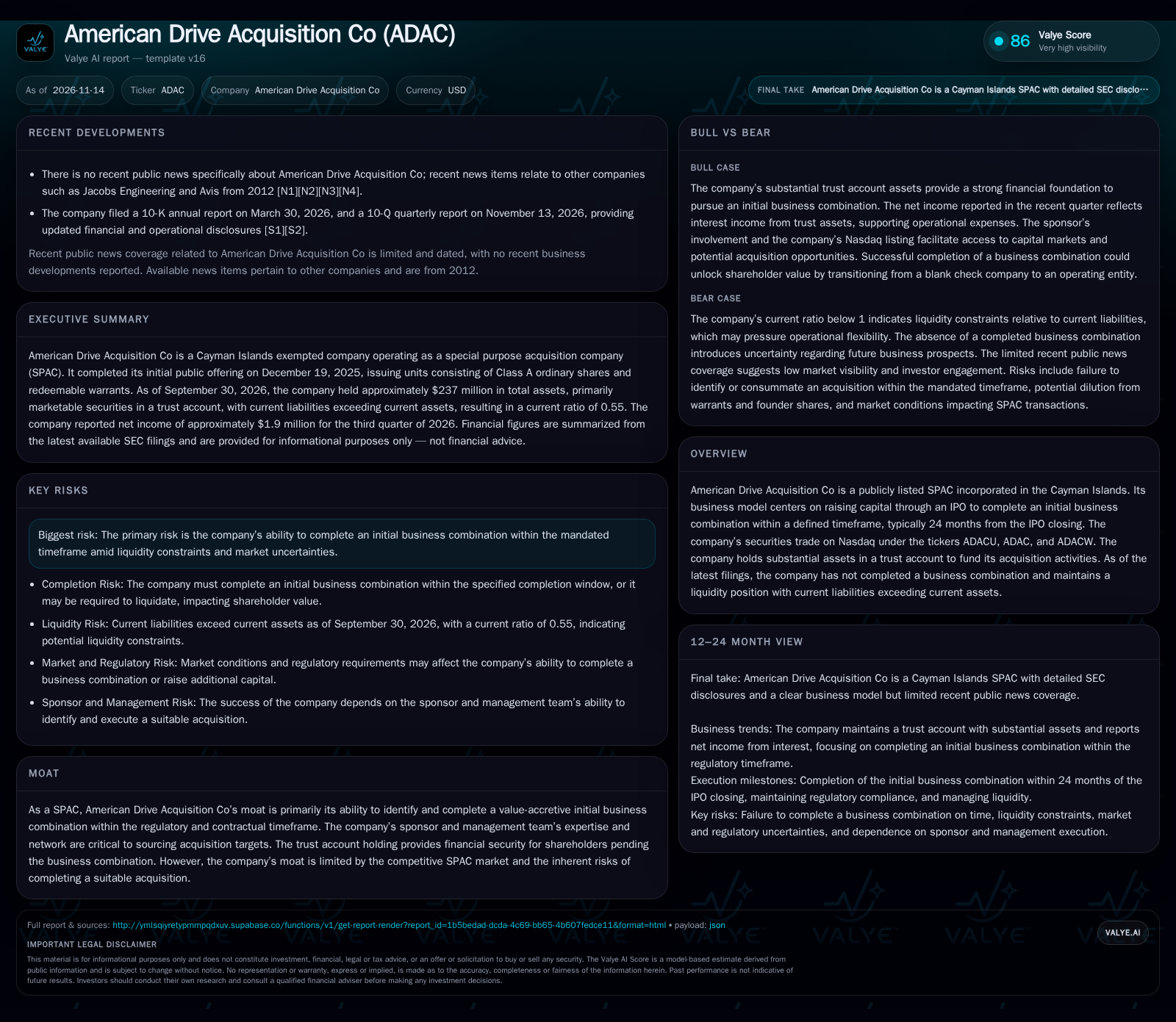
The company reported net income of $1.9 million for the recent quarter, derived from interest on trust assets. With no business combination completed as of the latest filing and a firm two-year window from its December 2025 IPO to merge with a target, ADAC's future hinges on management's ability to identify and close a deal before mandatory liquidation or seek shareholder extension.
American Drive Acquisition Co epitomizes the modern SPAC lifecycle: flush with capital post-IPO, generating interest income from a substantial trust account, and operating under the pressure of a fixed merger deadline. As of September 30, 2026, ADAC has yet to announce or close a business combination, and its liquidity snapshot reveals current liabilities outpacing current assets. With the clock ticking toward a December 2027 liquidation trigger, the company's fate will largely depend on sponsor alignment, target sourcing, and the ability to navigate a crowded, competitive SPAC market. The next year will test whether ADAC can transition from a blank-check entity to an operating company that justifies its trust capital.
Trust Assets, Liquidity Profile, and the Countdown to De-SPAC
As of September 30, 2026, American Drive Acquisition Co reports $236.5 million in marketable securities held in trust, representing the principal capital raised in its December 2025 IPO [S2]. The company has 23 million Class A shares subject to possible redemption and 5.75 million Class B founder shares outstanding. Despite these assets, ADAC’s current liabilities ($1.47 million) exceed current assets ($0.81 million), resulting in a current ratio of 0.55 [S2]. Net income for the quarter was $1.91 million, driven by interest on trust holdings rather than operating activity. No business combination has been consummated, and the company faces a mandatory liquidation deadline of December 19, 2027, if it does not complete a merger or obtain shareholder approval for an extension [S2]. These facts set the stage for a classic SPAC execution risk: ample trust capital, limited operating runway, and a finite window to deliver a transformative transaction.
How the SPAC Model Creates and Consumes Value
SPACs like American Drive Acquisition Co are structured to raise significant capital through an IPO, place the proceeds in a trust account, and seek a private company to merge with—bringing it public and providing growth capital. Until a deal is completed, the SPAC earns interest on the trust account, which can be used to offset administrative expenses but does not generate operating revenue. The trust funds are typically invested in low-risk, short-term securities, limiting yield but preserving capital for the eventual acquisition. Upon closing a business combination, the merged entity accesses the trust capital (net of any redemptions and transaction costs), while the SPAC transitions to an operating company.
Economically, the SPAC’s value creation hinges on sourcing a target that justifies the trust value and overcomes dilution from public and founder shares as well as warrants. The structure creates fixed administrative costs—legal, compliance, listing fees—and variable costs associated with deal diligence and negotiation. If a deal is not closed within the required timeframe, the SPAC must liquidate, returning trust capital to public shareholders and leaving sponsor equity and warrants worthless. Thus, the capital at risk for sponsors and the dilution embedded in the capital structure create strong incentives for timely and value-accretive dealmaking.
ADAC’s current ratio below 1 highlights a typical SPAC friction: while trust assets are restricted for acquisition or return to shareholders, operating cash is limited, and working capital pressures can mount as the search window progresses. This can make external financing or sponsor loans necessary if deal pursuit or extension costs escalate before a transaction is closed.
Competing for Targets in a Crowded SPAC Arena
American Drive Acquisition Co operates in an environment where the SPAC market is highly competitive, with many vehicles chasing a finite pool of attractive private companies. The company’s competitive positioning is shaped by the size of its trust, sponsor reputation, and the breadth of its network. However, there is no evidence in the current report of a sector focus, proprietary sourcing advantages, or unique structural features—placing ADAC among the many generalist SPACs seeking a deal.
The main competitive advantage for any SPAC is the sponsor’s ability to identify, negotiate, and close a compelling transaction ahead of rivals. In recent years, the SPAC market has seen increased scrutiny, higher redemption rates, and a shift in target-company bargaining power. Competing SPACs may offer similar capital and terms, making differentiation challenging unless sponsors bring sector expertise, operational value-add, or a unique pipeline of targets.
Substitutes for the SPAC route—such as traditional IPOs or direct listings—remain viable for high-quality private companies, especially when public market conditions are favorable. ADAC must therefore convince a target of the relative speed, certainty, and sponsor support that a SPAC can provide, while managing dilution and redemption risk.
A Compelling Target and Smooth De-SPAC Unlocks Shareholder Value
The most favorable outcome for American Drive Acquisition Co would involve the identification and successful closing of a business combination with a high-growth, high-quality private company that values the speed and capital certainty of the SPAC process. If ADAC announces a well-received target—ideally with sector tailwinds, a credible management team, and robust financials—it could catalyze positive market reaction, limit redemptions, and transition the SPAC into a viable operating company.
Key evidence confirming this scenario would include public announcement of a definitive merger agreement, favorable investor feedback (as measured by low redemption rates and positive share price reaction), and regulatory clearance. Additional confirmation would come from the target’s financial disclosures demonstrating growth potential that justifies the trust valuation and anticipated dilution. Falsification would occur if the company fails to announce a deal, faces high redemptions, or the proposed target is poorly received by the market or regulators.
Execution Frictions and the Realities of the SPAC Mandate
The most plausible outcome for American Drive Acquisition Co is a protracted search for an acquisition target, with ongoing administrative costs and the risk of a deal that is either delayed or only marginally value-accretive. As the December 2027 deadline approaches, the likelihood of increased sponsor pressure to close a deal—potentially with less attractive terms or higher dilution—rises. Redemption rates among public shareholders could be elevated, especially if market conditions are volatile or the target lacks clear public-market appeal.
Evidence supporting this scenario would include repeated extensions, sponsor loans to cover working capital, or announcements of deals with targets in less attractive sectors or with limited financial transparency. Conversely, falsification would occur if the company rapidly announces and closes a high-quality deal with minimal redemptions and strong market endorsement.
Failure to Close a Deal Triggers Liquidation and Sponsor Losses
The adverse scenario for ADAC is an inability to identify or consummate a business combination before the deadline, resulting in mandatory liquidation. In this outcome, public shareholders receive their pro-rata share of the trust, but sponsor equity and warrants become worthless. This outcome is not uncommon in periods of SPAC market congestion or adverse capital-market conditions, where targets are scarce or unwilling to accept SPAC terms.
Confirming evidence would include a lack of deal announcements as the deadline nears, negative working capital trends requiring sponsor support, or formal liquidation filings. Falsification would be indicated by progress toward a merger, regulatory filings for a combination, or shareholder votes to extend the search window with demonstrated sponsor alignment.
Testing the SPAC Thesis: Milestones and Frictions to Track for ADAC
Announcement of a definitive business combination agreement, including target identity, sector, and transaction terms.
Shareholder redemption rate at the time of merger vote, if disclosed, to assess market confidence in the proposed deal.
Extensions of the merger deadline or sponsor-funded working capital loans, which may signal deal execution challenges.
Changes in trust account balance due to redemptions, interest income, or transaction costs, if disclosed.
Market and regulatory response to any proposed business combination, including SEC review outcomes and Nasdaq listing continuity.
Sponsor actions such as additional capital contributions, warrant exercises, or public statements regarding deal progress.
Updates to management composition or disclosed sector focus, which could provide insight into evolving acquisition strategy.
Disclaimer: This is research-only, informational analysis and not investment advice. It may include AI-generated interpretation and general industry context. Always verify important details using primary sources.

Comments