
Inhibrx Biosciences: Advancing Registrational Milestones While Addressing Oncology Biologics Commercialization
Inhibrx advances its oncology pipeline with ozekibart achieving a pivotal chondrosarcoma trial win and regulatory filings, but faces the classic hurdles of clinical-stage biotechs: regulatory review risks, manufacturing scrutiny, and the daunting leap from promising trials to commercial execution.
Inhibrx Biosciences has achieved a statistically significant progression-free survival benefit for ozekibart in chondrosarcoma, culminating in FDA and EMA regulatory filings.
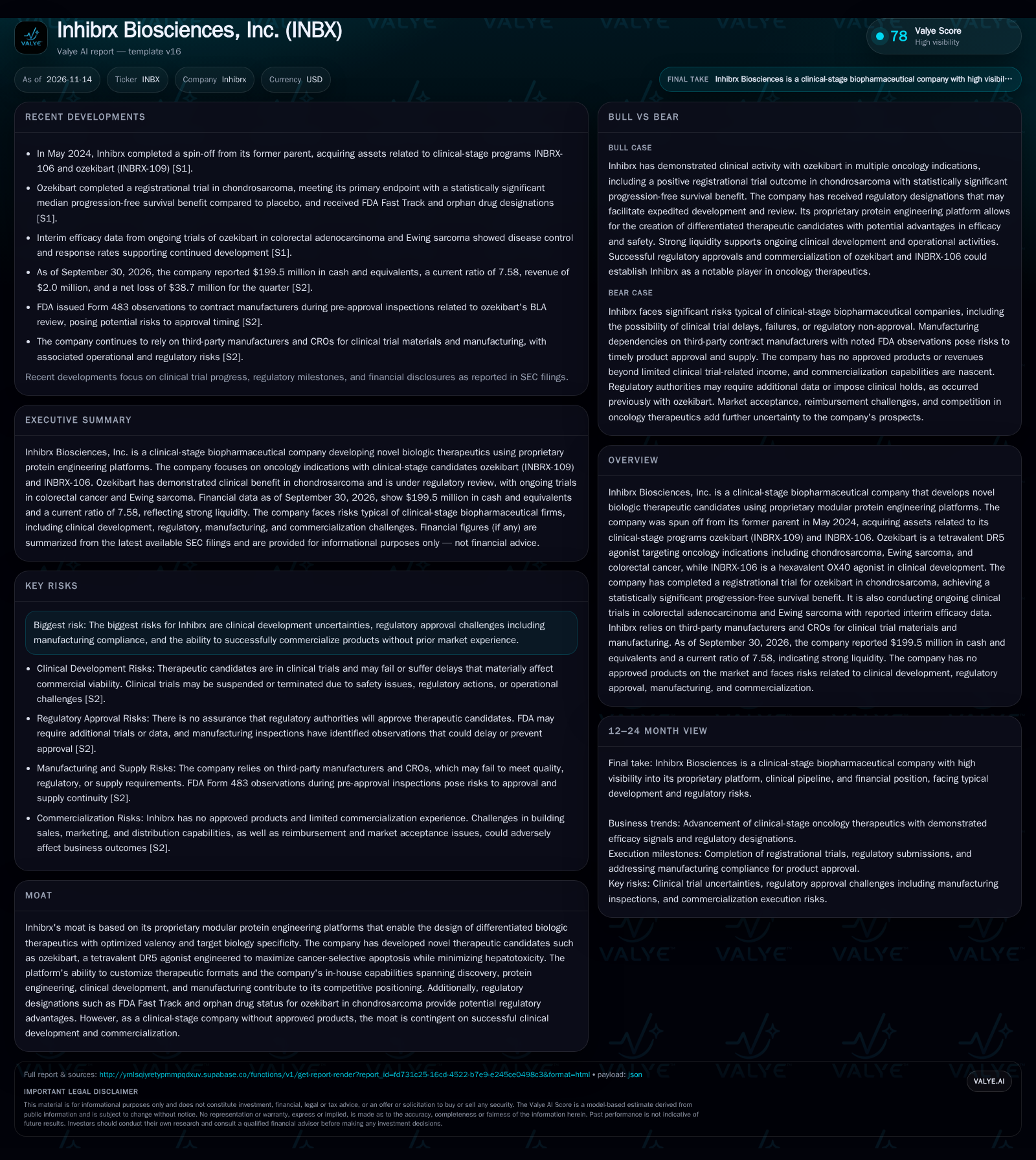
Inhibrx Biosciences, a clinical-stage oncology company, has reached a pivotal moment following a successful registrational trial for ozekibart in chondrosarcoma, where it achieved a significant progression-free survival advantage. With the FDA and EMA now reviewing its lead candidate and additional efficacy signals emerging in Ewing sarcoma and colorectal cancer, Inhibrx possesses the scientific and financial resources to advance its pipeline. However, the company’s future value hinges on its ability to convert clinical promise into regulatory approvals and commercial adoption—amidst manufacturing, regulatory, and operational execution risks typical of emerging biotechs [S1] [S2].
Recent Clinical and Regulatory Achievements Propel Inhibrx Forward
The most significant recent development for Inhibrx is the completion and positive readout of the registrational ChonDRAgon trial for ozekibart (INBRX-109) in metastatic or unresectable conventional chondrosarcoma. The trial achieved its primary endpoint, with ozekibart demonstrating a 52% reduction in the risk of disease progression or death compared to placebo (HR 0.479; P<0.0001), and more than doubling median progression-free survival (5.52 months vs. 2.66 months for placebo) [S2]. This is the first randomized trial to show a meaningful benefit in this rare cancer, for which there are no approved systemic therapies.
Following this, the FDA accepted for review Inhibrx’s biologics license application (BLA) for ozekibart in June 2026, and the drug has received Fast Track and orphan designations in both the U.S. and Europe for chondrosarcoma [S1] [S2]. Interim efficacy data also support continued trials in Ewing sarcoma (64.5% ORR, 87.1% disease control rate in one cohort as of January 2026) and colorectal cancer. Financially, as of September 30, 2026, Inhibrx reported $199.5 million in cash and equivalents and a current ratio of 7.58 [S2].
However, the company faces operational headwinds: FDA Form 483 observations were issued during pre-approval inspections of its contract manufacturing partners, introducing potential risk to the approval and launch timing for ozekibart [S2].
Economic Dynamics of Commercializing Oncology Biologics Amid Funding Cycles
Inhibrx’s business model remains pre-commercial, with no approved products and revenues limited to $2.0 million in the most recent quarter—likely from milestone payments, grants, or collaborations rather than product sales [S2]. The company’s economics are currently driven by R&D outlays and milestone-dependent funding, leading to a net loss of $38.7 million for the quarter ended September 30, 2026 [S2].
If ozekibart receives approval and launches for chondrosarcoma, the initial addressable market will be limited by the rarity of the indication but could benefit from orphan pricing and limited competition. Orphan drugs in oncology often command premium pricing, but payer adoption and reimbursement will depend on demonstrable clinical benefit and guideline inclusion. The economics could shift dramatically if ozekibart is later approved for broader indications such as colorectal cancer or Ewing sarcoma, which would expand the patient pool and revenue potential. However, this would also require additional investment in commercialization infrastructure and post-marketing studies.
Operating leverage in this model is high: fixed costs (R&D, G&A) are front-loaded, and incremental gross margins on biologics—if reimbursement and pricing are favorable—can be substantial. However, biomanufacturing is capital intensive and, given Inhibrx’s reliance on third-party manufacturers, gross margins may be pressured by contract costs and regulatory compliance burdens, especially if remediation is required after FDA observations.
The company reported cash and liquidity metrics for the period; these figures do not by themselves establish operating runway, investment capacity, financial flexibility, or financing capacity. However, absent significant non-dilutive revenue, additional capital raises may be required to fund scale-up, launch, and post-approval commitments if ozekibart is approved.
Standing Out in Modular Biologics: Innovation Benefits and Competitive Risks
Inhibrx’s core competitive asset is its proprietary modular protein engineering platform, which enables the design of differentiated biologic therapeutics with optimized valency and specificity. Ozekibart’s mechanism as a tetravalent DR5 agonist is designed to induce cancer-selective apoptosis with minimized hepatotoxicity, a profile that, if validated in larger indications, could provide a real clinical and commercial edge.
The orphan and Fast Track designations for ozekibart in chondrosarcoma provide regulatory and potential commercial advantages, such as expedited review, longer exclusivity, and more favorable reimbursement scenarios. However, these advantages are contingent on successful approval and market uptake.
Competition in oncology biologics is intense, with both established pharmaceutical companies and emerging biotechs pursuing similar targets and pathways. While there are currently no approved systemic options for chondrosarcoma, other DR5 agonists, OX40 agonists, or next-generation immunotherapies could emerge as substitutes or leapfrog Inhibrx’s offerings. Furthermore, the company’s reliance on third-party manufacturing may limit its ability to rapidly scale or respond to supply shocks compared to vertically integrated peers.
Inhibrx’s future competitive position will depend on its ability to demonstrate clear clinical differentiation, secure regulatory approvals, and build (or partner for) commercialization capabilities that can effectively reach and educate specialized oncology prescribers.
Potential Impact of Ozekibart’s Approval and Market Uptake in Rare Oncology
The most favorable scenario for Inhibrx is timely FDA and EMA approval of ozekibart for chondrosarcoma, followed by rapid uptake among eligible patients due to the absence of approved systemic therapies and compelling progression-free survival data. Orphan status could enable premium pricing, and guideline inclusion (for example, by the National Comprehensive Cancer Network) would accelerate adoption by oncologists.
This scenario could be further strengthened if additional data from ongoing trials in Ewing sarcoma and colorectal cancer confirm efficacy, leading to label expansions. Early positive real-world evidence and post-marketing studies could reinforce ozekibart’s clinical value, attracting payer support and potentially facilitating partnerships or licensing deals to expand commercial reach.
Evidence that would confirm this scenario includes: (1) regulatory approvals without significant delays or additional data requirements, (2) strong initial sales uptake and reimbursement wins, (3) expansion of ozekibart into broader indications, and (4) absence of major safety or manufacturing setbacks post-launch.
Expected Trajectory: Steady Development Coupled with Operational and Financial Challenges
The most plausible outcome is that ozekibart secures regulatory approval for chondrosarcoma after addressing any outstanding manufacturing observations, followed by a measured commercial launch. Uptake may be steady but limited by the small patient population and the need to build or partner for commercial infrastructure.
In this scenario, Inhibrx continues to report operating losses as it invests in launch and post-approval requirements. Additional clinical data from Ewing sarcoma and colorectal cancer may support further development, but timelines for label expansion are uncertain and will require further capital. Manufacturing and supply chain issues could introduce friction but are managed without causing major disruptions.
Confirmation would come from regulatory approval and initial sales, even if modest, as well as continued cash burn offset by careful expense management. Falsification would be signaled by regulatory rejections, major manufacturing setbacks, or failure to gain payer and guideline support.
Consequences of Regulatory and Manufacturing Difficulties on Market Entry
In the downside scenario, regulatory approval for ozekibart is delayed or denied due to unresolved manufacturing observations or requests for additional clinical data. This could result in significant delays to launch, increased cash burn, and the need for dilutive financings in a challenging capital markets environment.
Even if approval is secured, commercialization could falter if payers resist reimbursement, prescribers are slow to adopt, or safety signals emerge post-launch. Manufacturing interruptions due to quality or supply chain issues could further erode confidence and revenue potential.
Signs that this scenario is playing out would include regulatory setbacks (such as complete response letters or extended review periods), warnings or holds from the FDA, missed launch timelines, or adverse real-world safety findings. Financially, rapid cash burn without offsetting revenue or financing would be a clear red flag.
Factors Shaping Inhibrx’s Shift from Development Success to Market Presence
Regulatory outcome and timeline for ozekibart’s BLA review, including resolution of FDA Form 483 manufacturing observations.
Initial sales uptake, pricing, and reimbursement wins for ozekibart if approved; a useful metric would be quarterly product revenue and payer coverage rates.
Updates from ongoing clinical trials for ozekibart in Ewing sarcoma and colorectal cancer, particularly response rates and safety signals.
Progress in guideline inclusion, such as acceptance to the NCCN Clinical Practice Guidelines for chondrosarcoma or Ewing sarcoma.
Cash runway versus projected burn rate, with attention to any new financing events or partnerships (if disclosed).
Manufacturing reliability and ongoing regulatory compliance at third-party contract manufacturers—updates on remediation or new observations would help test the thesis.
Expansion of commercial infrastructure or strategic partnerships to support launch and scale in rare oncology indications.
Disclaimer: This is research-only, informational analysis and not investment advice. It may include AI-generated interpretation and general industry context. Always verify important details using primary sources.

Comments