
Bluerock Acquisition Corp.: Merger Ambitions with Yellow.ai Amid SPAC Constraints and Execution Hurdles
Bluerock Acquisition Corp.
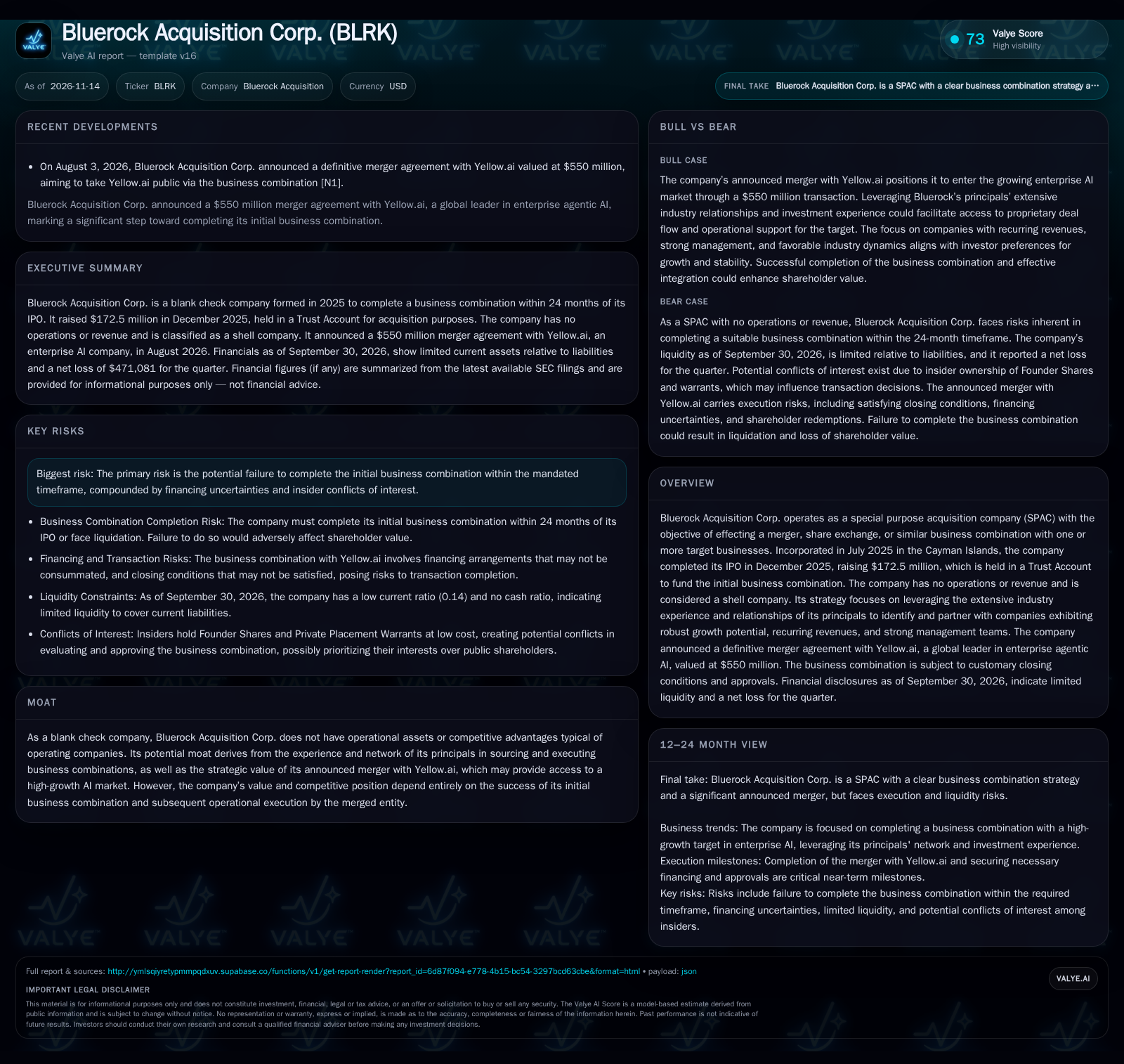
Bluerock Acquisition Corp. is a SPAC that completed a $172.5 million IPO in December 2025 and, as of late 2026, remains a pre-revenue shell with a reported current ratio and a net loss. Its announced business combination with Yellow.ai, a global enterprise AI company, is valued at $300 million and is contingent on closing conditions and external financing. The outcome of this merger—amid reported liquidity position and the 24-month SPAC deadline—will define shareholder value, with success hinging on deal execution, financing, and post-merger integration.[S2] [N1]
Bluerock Acquisition Corp. stands at a critical crossroads typical of late-phase SPACs: with its IPO proceeds sequestered in trust, no operating business, and a looming 24-month deadline, the company’s future hinges entirely on the successful closure of its $300 million merger with Yellow.ai. The coming months will test both the sponsor’s deal-making acumen and the market’s appetite for enterprise AI growth stories.
A SPAC at the Precipice: Bluerock’s Merger, Liquidity, and Timeline Pressures
Bluerock Acquisition Corp. is a blank check company that completed its IPO in December 2025, raising $172.5 million by issuing 17,250,000 units at $10.00 each, with proceeds held in a Trust Account earmarked exclusively for a business combination.[S2] The company has not commenced operations or generated any revenue to date, and remains a shell entity under the Exchange Act.[S2] As of September 30, 2026, Bluerock reported current assets of $249,713 and current liabilities of $1,810,720, resulting in an acute current ratio of 0.14 and a cash ratio of 0, signaling a severe liquidity crunch at the operating company level.[S2] The company signed a definitive merger agreement with Yellow.ai—a global enterprise agentic AI company—on July 31, 2026, valuing Yellow.ai’s equity at approximately $300 million, with closing subject to customary conditions and $30 million in PIPE financing commitments.[S2] [N1] The merger must occur within 24 months of Bluerock’s IPO or the company faces mandatory liquidation, making the next few quarters decisive for the future of the listing.
SPAC Economics: Trust Capital Structure, Dilution, and the Path to Revenue
Bluerock’s economic model is typical of SPACs: it has no operating income, and its only source of value creation is in executing a business combination that unlocks the trust capital for the merged entity. The $172.5 million raised at IPO is sequestered in a Trust Account, legally protected from operating expenses and accessible solely for the acquisition or for redemption by shareholders if the deal fails.[S2] The operating company (pre-merger) is funded by a small working capital pool, which as of September 30, 2026, is nearly exhausted, reflected in the low current and cash ratios.[S2]
The proposed merger with Yellow.ai is valued at $300 million, implying that Bluerock will need to supplement the trust capital with external financing and/or equity rollover from the target. The $5 million PIPE equity and $25 million convertible note commitments are intended to bridge this gap, but these amounts are modest relative to the transaction size and subject to closing conditions.[S2]
From a unit economics perspective, the merged company’s future value will depend on Yellow.ai’s ability to generate recurring revenue, achieve operating leverage from AI software scaling, and manage post-merger dilution—especially as SPAC redemptions can sharply reduce available cash, forcing reliance on external financing or sponsor support. If the deal closes, the merged entity may face substantial integration and public company costs before achieving self-sustaining economics.
SPAC as a Strategic Vehicle: Sourcing Advantage or Commodity Shell?
Bluerock’s only potential competitive advantage lies in the strategic value of its announced target and the principals’ network, not in any operating assets or proprietary technology.[S2] The sponsor’s ability to source and execute a deal with a credible, high-growth company—here, Yellow.ai—can be a differentiator in a crowded SPAC market, where many vehicles compete for a finite pool of attractive targets.
However, Bluerock faces counterforces common to late-phase SPACs: shareholder redemptions, PIPE investor skepticism, and intense competition from both traditional IPOs and direct listings as alternative routes for high-growth companies. The announced merger with Yellow.ai, a company positioned in the enterprise AI segment, puts Bluerock in a highly contested space with numerous public and private players seeking access to public capital for AI-driven business models.
The ultimate competitive position will depend on the merged company’s ability to deliver recurring revenue, establish product-market fit in enterprise AI, and leverage public market visibility—outcomes that remain highly contingent until the combination closes and Yellow.ai’s financials and operating metrics are disclosed.
If the Yellow.ai Merger Closes Smoothly: Unlocking Enterprise AI Value in Public Markets
In the favorable scenario, Bluerock successfully closes the Yellow.ai merger within the SPAC deadline, secures the committed PIPE and convertible note financing, and manages redemptions at a level that preserves enough trust capital to fund Yellow.ai’s growth plan.[S2] [N1] The merged entity benefits from public market access, enabling Yellow.ai to invest aggressively in product development, go-to-market expansion, and talent acquisition.
Upside would be confirmed by the closing of the transaction on schedule, full funding of the PIPE and note commitments, and post-merger disclosures demonstrating robust recurring revenue growth, gross margin expansion, and early evidence of operating leverage from Yellow.ai’s platform. Further confirmation would come from positive investor reception, low redemption rates, and the ability to attract additional follow-on capital at reasonable terms.
This scenario could position the merged company as a credible public player in enterprise AI, benefiting from heightened market interest and the validation of a successful de-SPAC process.
Execution Friction: Partial Funding, High Redemptions, and a Narrow Window
The most plausible path is that Bluerock faces significant execution challenges: PIPE and note financing may be delayed or sized down, and a high percentage of public shareholders may redeem their shares, reducing net cash available for Yellow.ai post-merger.[S2] The company manages to close the transaction—possibly with last-minute adjustments to valuation, deal structure, or sponsor support—but emerges with less cash than initially targeted.
In this scenario, the merged entity must operate with constrained resources, potentially delaying strategic investments or requiring additional rounds of capital raising soon after listing. Confirmation would come from a completed but restructured deal, high redemption disclosures, and post-merger filings revealing tight liquidity and a focus on cost management.
This outcome would leave the merged company at a disadvantage relative to better-capitalized peers and could constrain its ability to capitalize fully on the enterprise AI opportunity until further capital is secured.
Deal Failure and Liquidation: The Risk of No Business Combination
The adverse scenario is that Bluerock fails to close the Yellow.ai merger within the mandated 24-month window, due to inability to satisfy closing conditions, secure sufficient financing, or overcome a wave of shareholder redemptions that leave too little cash to meet minimum deal requirements.[S2]
In this case, Bluerock would be forced to liquidate, returning the trust capital to public shareholders and leaving sponsor shares and warrants worthless. This outcome would be confirmed by public filings announcing deal termination, liquidation plans, and the absence of any operating business combination.
Such a result would underscore the acute risks facing late-phase SPACs with reported liquidity position, high execution risk, and a rapidly closing window for completing a transaction.
Milestones That Will Define Bluerock’s SPAC Outcome and Yellow.ai’s Public Debut
Progress on closing conditions for the Yellow.ai merger, including regulatory and shareholder approvals, would be a leading indicator of deal viability.
Actual funding and disbursement of the $5 million PIPE equity and $25 million convertible note financing—if disclosed—are critical to confirming transaction liquidity.
Public shareholder redemption rates at deal closing will determine the net cash available for the merged entity; high redemptions would signal skepticism and liquidity challenges.
Disclosure of Yellow.ai’s post-merger financials, including recurring revenue, gross margin, and growth rates, would help test the merger’s strategic rationale.
Any material changes to the merger valuation, structure, or sponsor support arrangements—if disclosed—would indicate execution friction or shifting risk allocation.
Updates on Bluerock’s ability to secure additional financing or backstop arrangements in the event of high redemptions would clarify capital sufficiency.
Timely SEC and market filings confirming either successful deal closing or liquidation intent will be definitive in determining the outcome for shareholders.
Disclaimer: This is research-only, informational analysis and not investment advice. It may include AI-generated interpretation and general industry context. Always verify important details using primary sources.

Comments