
Digital Asset Acquisition Corp.: Post-Termination Reset and the Challenge of SPAC Value Creation
Digital Asset Acquisition Corp.
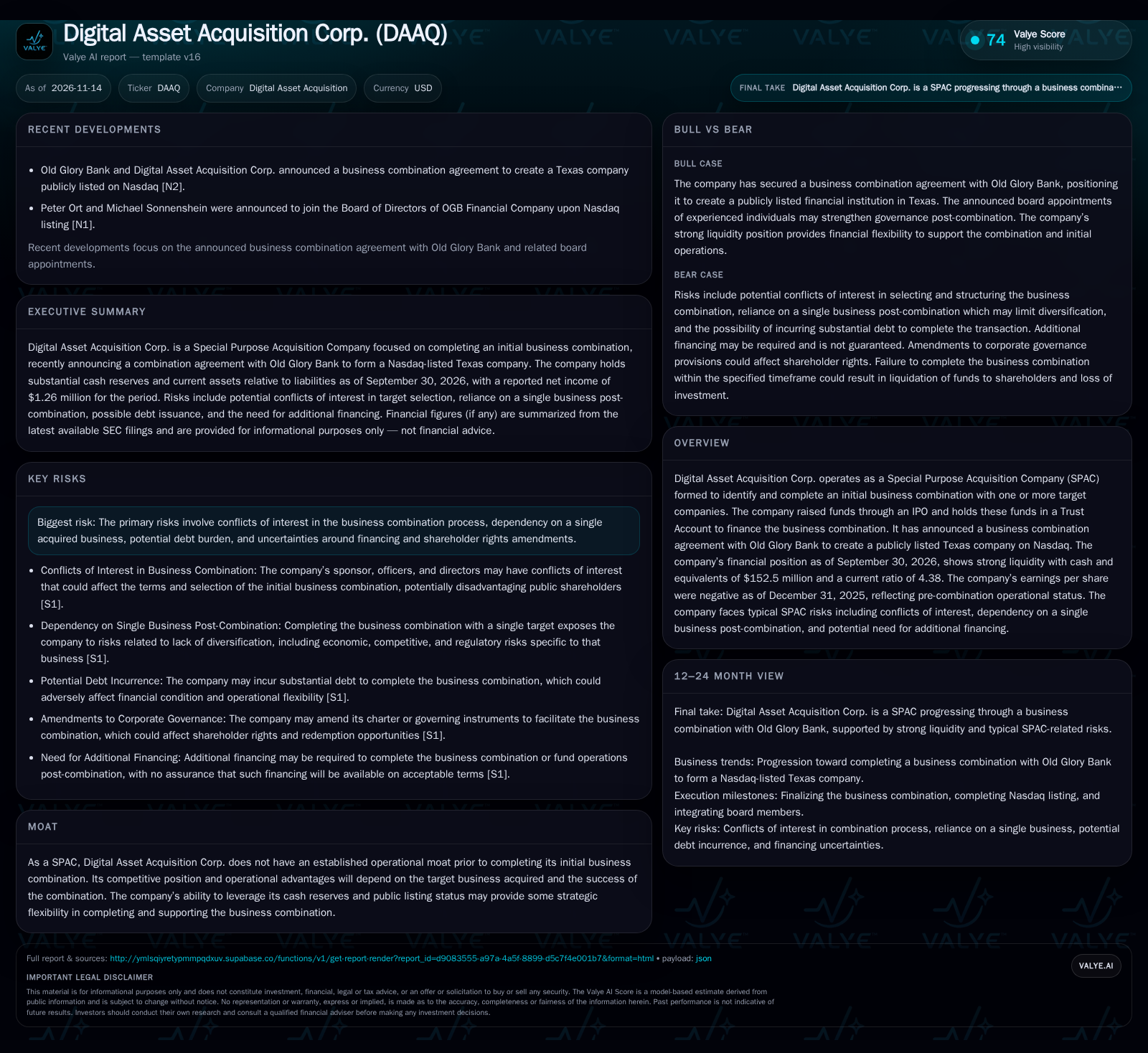
DAAQ’s planned merger with Old Glory Bank was mutually terminated in August 2026, leaving the SPAC with $152.5 million in cash and a narrowing window to source a new target. The company has not generated any operating revenue and remains subject to typical SPAC risks: potential conflicts, single-business dependency, and the possibility of needing further financing. The outcome now hinges on management’s ability to identify and close a compelling deal before the clock runs out. [S2]
Digital Asset Acquisition Corp. (DAAQ) highlights the volatility and execution risk inherent in the SPAC model as of late 2026. With its planned merger with Old Glory Bank now abandoned, the company is left with a significant cash reserve but no operating business. The next phase will test management’s sourcing ability, deal-making discipline, and adaptability under a compressed timeline and a SPAC market that has become more discerning and less forgiving. Investors and analysts should focus less on the balance sheet snapshot and more on the mechanisms, incentives, and hurdles that will shape whether DAAQ can pivot to a viable business combination—or be forced into liquidation.
Merger Termination Resets the SPAC’s Strategic Timetable
The most consequential recent development for Digital Asset Acquisition Corp. is the mutual termination of its business combination agreement with Old Glory Bank in August 2026. This action nullifies the previously announced plan to form a Nasdaq-listed Texas financial institution and leaves DAAQ with no operating business or forward path, but with $152.5 million in cash and cash equivalents as of September 30, 2026. The company’s financials reflect pre-combination status: no operating revenue, net income derived from interest on trust assets, and a current ratio of 4.38. This combination of high liquidity and the absence of a deal heightens execution pressure, as DAAQ must now identify and close a new transaction before its statutory deadline or face liquidation and the return of funds to shareholders. [S2]
SPAC Economics: Fee Drag, Incentives, and the Deal-or-Liquidate Dilemma
The core economic mechanics of a SPAC revolve around sourcing and closing a business combination within a fixed timeframe, typically 18-24 months from IPO. DAAQ’s trust account, currently at $152.5 million, represents both its primary asset and a use-it-or-lose-it capital base. Until a merger is completed, the company generates only minimal interest income—insufficient to offset the inevitable drag of administrative expenses, sponsor fees, and the opportunity cost of idle capital. If DAAQ completes a merger, the economics pivot to the acquired business’s fundamentals and the dilution from sponsor promote and warrant redemptions.
If the SPAC fails to close a deal, the trust is returned to shareholders, and sponsors lose their at-risk capital. This creates a strong incentive to pursue a transaction, even if target quality is suboptimal. Conversely, the need for additional financing to support a larger deal can erode returns for public shareholders and introduce further risk, especially in a tighter SPAC financing environment. The economics thus become a race against time, with every month of inaction reducing the probability of a high-quality outcome.
Beyond the fundamental fee drag and incentive structure, the timing of deal closure critically impacts the net value delivered to public shareholders. As the SPAC approaches its deadline, the urgency to consummate a transaction intensifies, potentially compressing due diligence and negotiation rigor. This dynamic can lead to a suboptimal deal structure or acceptance of a lower-quality target, which in turn may impair post-merger performance and investor confidence. Moreover, the sponsor's promote—typically a fixed percentage of post-merger equity—can disproportionately dilute public shareholders if the deal valuation is suppressed by time pressure. Therefore, the interplay between time constraints and economic incentives creates a delicate balance that can either preserve or erode shareholder value depending on execution discipline.
Crowded SPAC Market, Scarce High-Quality Targets
DAAQ operates in a SPAC ecosystem that has become notably more competitive and discerning since the 2021–2022 boom. The universe of credible, willing targets has shrunk, as many attractive private companies have either already listed, secured alternative financing, or raised valuation expectations beyond what public markets now reward. SPACs now compete not only against each other but also against direct listings, private equity, and strategic acquirers.
As a post-termination SPAC, DAAQ faces additional stigma: targets may perceive it as a less desirable partner, and shareholder redemptions can spike if a new deal is seen as a consolation prize rather than a compelling business. Without operational track record, the only levers for differentiation are sponsor reputation, board composition, and the ability to move quickly on a credible, well-priced target. Unless DAAQ can demonstrate unique sourcing networks or strategic value to a target, its competitive position is undifferentiated and subject to the same structural headwinds facing most of its peers.
In addition to the shrinking pool of attractive targets, the evolving regulatory environment surrounding SPAC transactions adds another layer of complexity. Heightened scrutiny from securities regulators and increased disclosure requirements raise the cost and duration of deal execution, potentially deterring some private companies from engaging with SPACs. This regulatory tightening may disproportionately affect post-termination SPACs like DAAQ, which must demonstrate robust governance and compliance frameworks to reassure both targets and investors. Consequently, the regulatory backdrop not only influences the availability of targets but also shapes the competitive dynamics by favoring SPACs with stronger institutional backing and proven operational capabilities.
Furthermore, the reputational impact of a terminated merger can create a signaling effect in the market, influencing target companies' perceptions of the SPAC's viability and sponsor credibility. Potential targets may view a post-termination SPAC as facing heightened redemption risk and diminished potential financial flexibility, which can complicate negotiations and necessitate more favorable terms to compensate for perceived execution risk. This scenario can exacerbate valuation pressures and lengthen the timeline to deal closure. Therefore, beyond immediate financial metrics, intangible factors such as market reputation and sponsor track record become critical competitive differentiators in a crowded and discerning SPAC landscape.
A High-Conviction Target and Efficient Execution Could Salvage Value
The most favorable outcome for DAAQ is the rapid identification and negotiation of a business combination with a private company that is both high-quality and public market–ready.
Evidence that would confirm this scenario includes a prompt announcement of a new LOI (letter of intent) or merger agreement, low redemption rates at the time of shareholder vote, and the ability to secure additional financing on reasonable terms. If the acquired business demonstrates post-combination revenue growth, profitability, and trading liquidity, it would further validate the upside thesis.
Most Probable Trajectory: Time Decay, Mediocre Targets, and Redemption Risk
Given the current SPAC market and the late-stage status of DAAQ’s lifecycle, the most plausible outcome is a race against time to secure a deal—likely with a target of moderate quality, limited negotiating leverage, and potentially higher valuation concessions. Shareholder redemptions may run high, eroding available cash for the post-combination company and increasing the risk that additional financing will be needed on less favorable terms.
Confirmation of this scenario would include a delayed deal announcement, a target with less proven financials or sector tailwinds, and above-average redemption rates. If the merger closes but the resulting company struggles for investor attention or trading liquidity, it would reinforce this middle-ground outcome.
Liquidation Risk and Sponsor Capital Loss Loom if No Deal Emerges
The adverse scenario is that DAAQ fails to identify or close a business combination before its statutory deadline. In this case, the trust account is liquidated and returned to public shareholders, and the sponsor’s at-risk capital is forfeited. This outcome becomes more likely if market conditions deteriorate further, regulatory scrutiny increases, or DAAQ is unable to secure a willing and qualifying target.
Indicators of this scenario would include lack of deal news as the deadline approaches, explicit disclosures about extension votes or liquidation planning, and a steady burn of administrative expenses with no offsetting business progress.
Testing DAAQ’s Pivot: What Will Determine Whether Value Is Created or Lost
Announcement timing and substance of any new business combination agreement—speed and target quality will be critical to thesis validation.
Shareholder redemption rates at any proposed deal vote (if disclosed)—high redemptions would signal weak confidence and constrain deal economics.
PIPE or alternative financing commitments secured alongside a new deal—terms and investor quality would reveal market confidence.
Nature of the new target’s business model, financials, and sector—will the target be differentiated and public market–ready?
Sponsor and board alignment, including any new appointments or departures—changes may signal strategic shifts or governance concerns.
Extension votes or proxy filings for deadline relief—any move to extend the SPAC timeline would indicate execution challenges.
Administrative burn rate and trust account balance—ongoing costs versus timeline to deal or liquidation.
Public communications regarding regulatory, market, or competitive developments that could alter the deal landscape.
Disclaimer: This is research-only, informational analysis and not investment advice. It may include AI-generated interpretation and general industry context. Always verify important details using primary sources.

Comments