
Churchill Capital Corp XI: Sourcing Advantage Meets Execution and Liquidity Pressures in SPAC Search Phase
Churchill Capital Corp XI, a Michael Klein-led SPAC with $414 million in trust, faces the classic blank-check tension: strong sourcing credibility but no target, and a sharply negative liquidity profile outside the trust. As the deadline to complete a business combination approaches, the interplay between sourcing prowess, execution discipline, and financial constraints will determine whether Churchill XI delivers value or risks forced liquidation.
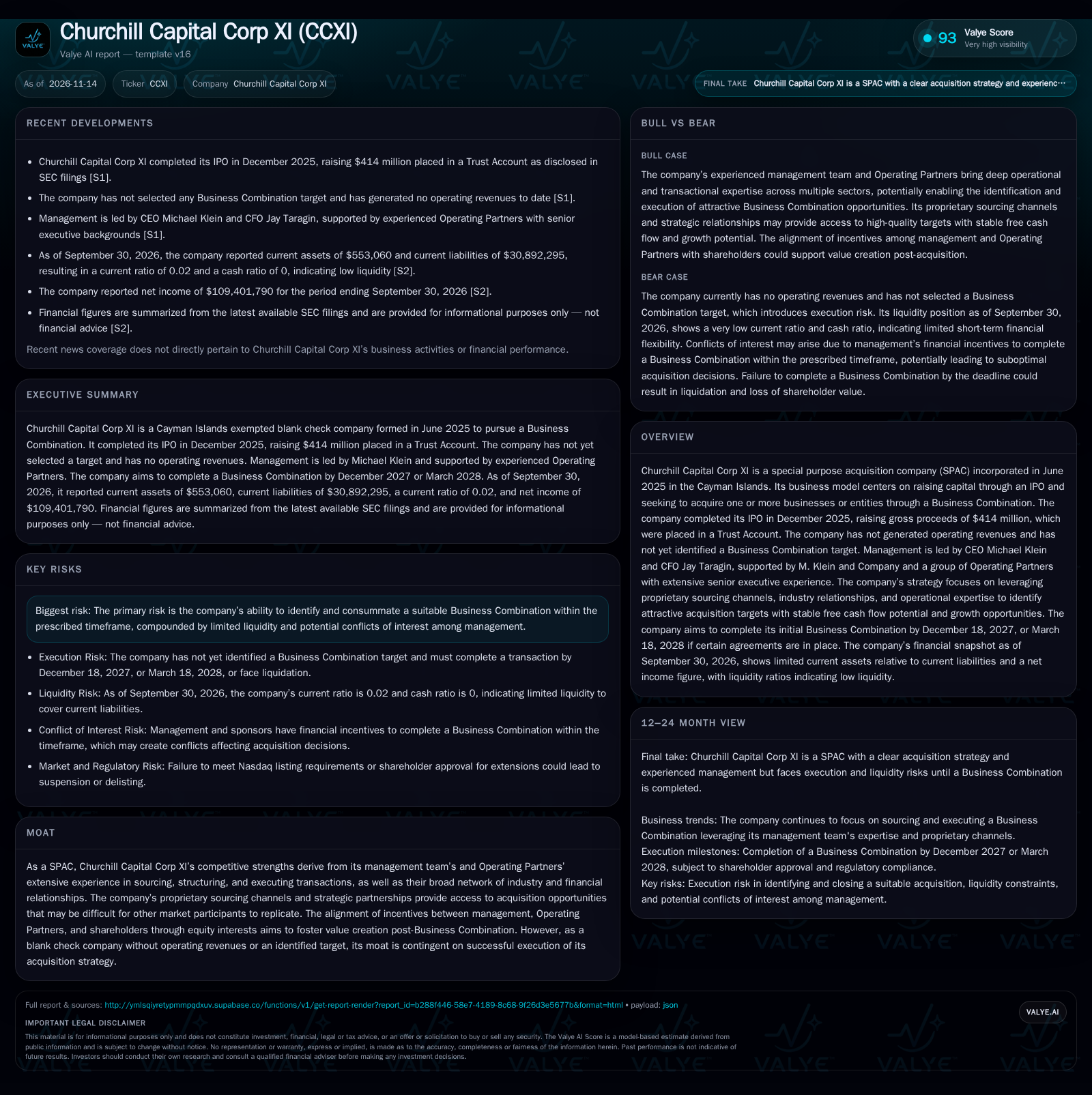
Churchill Capital Corp XI has raised $414 million via its IPO and private placement, with proceeds held in trust pending a business combination. Despite a seasoned management team and robust sourcing channels, the company has yet to identify a target and shows extremely low liquidity outside the trust, with current assets of $553,060 against liabilities of $30.9 million. The clock is ticking toward a December 2027 (or March 2028) deadline, heightening execution and financial risks if a suitable acquisition is not found and closed in time. The next phase will test whether sourcing and operational expertise can overcome SPAC structural headwinds.
Churchill Capital Corp XI, launched in mid-2025 under the stewardship of Michael Klein, exemplifies the high-stakes dynamics of the modern SPAC market. With $414 million locked in trust and a deadline-driven mandate to find and merge with a promising operating company, Churchill XI’s fortunes hinge on its management’s ability to outcompete rival acquirers and secure a value-creating deal before time and liquidity run out. The company’s sharply negative liquidity profile outside the trust heightens the urgency, making the next 12-18 months critical for both execution and discipline. Whether Churchill XI emerges as a successful consolidator or faces forced liquidation will depend on the interplay between its sourcing advantages, market conditions, and the inherent structural pressures of the SPAC vehicle.
IPO Proceeds in Trust, Liquidity Pinch Outside: The Immediate Churchill XI Landscape
Churchill Capital Corp XI raised $414 million via its December 2025 IPO and a concurrent private placement, placing the proceeds in a trust account as required by SPAC structure. As of September 30, 2026, the company had not identified a business combination target and reported no operating revenues. The balance sheet reveals a stark liquidity mismatch: just $553,060 in current assets versus $30.9 million in current liabilities, for a current ratio of 0.02 and a cash ratio of zero. This means that, outside the protected trust, Churchill XI’s ability to meet short-term obligations is extremely limited—a common but acute issue for SPACs deep into their search phase. The company must complete a business combination by December 2027 (or March 2028 if a letter of intent is signed), or risk mandatory liquidation and return of trust capital to public shareholders. [S1] [S2]
How Value Is Created (or Destroyed) in the Churchill XI SPAC Model
As a SPAC, Churchill XI’s business model is binary: value is created if management sources and closes a high-quality business combination at favorable terms before the deadline, and destroyed if the trust is returned to shareholders upon liquidation. The economics hinge on deal sourcing, negotiation, and post-merger value creation. If a deal is consummated, the trust funds (minus redemptions and transaction costs) become the acquisition currency, often with additional PIPE (private investment in public equity) financing to bolster the pro forma company’s balance sheet.
Pricing power is limited; Churchill XI must compete with other SPACs, private equity, and strategics for targets. Operating leverage emerges only post-merger, if the acquired business can grow and expand margins. Until then, fixed costs (legal, advisory, listing fees) and working capital needs are funded through sponsor loans and small cash balances, creating a negative carry outside the trust. The $414 million in trust is insulated from operational drains, but cannot be accessed for general expenses. The company’s reported net income of $109.4 million as of September 30, 2026, is likely driven by changes in warrant or trust asset valuations, not recurring operations. [S2]
If a business combination fails, all non-trust expenses are effectively a sunk cost, and sponsors lose their at-risk capital and promote. This creates an incentive to close a deal—sometimes at the expense of quality—before the deadline.
Sourcing Networks and Sponsor Reputation as Competitive Levers—But Not Moats
Churchill XI’s competitive edge derives from its management team’s extensive transactional experience and industry relationships, especially those of Michael Klein and the affiliated M. Klein and Company. These networks may provide early access to attractive targets and proprietary sourcing channels, potentially reducing competition from other SPACs or private equity firms.
However, in the current environment, the SPAC market is crowded and targets have become more selective, often leveraging multiple bidders to drive up valuations. The reputation of the sponsor can influence a target’s willingness to engage, but does not guarantee exclusivity or favorable pricing. Moreover, Churchill XI faces indirect competition from traditional acquirers, growth equity, and even direct listings for high-quality companies. The absence of a defined sector focus means Churchill XI can cast a wide net, but also risks diluting its sourcing efficiency and sector expertise.
Ultimately, Churchill XI’s durable advantage lies less in structural moats and more in the executional discipline and judgment of its sponsor team. The ability to identify, negotiate, and close a value-accretive deal before the clock runs out is the only true differentiator.
If Churchill XI Lands a High-Quality Target: The Path to Value Creation
The most favorable scenario is that Churchill XI leverages its sponsor network to source a high-quality, cash-generative private company with strong growth prospects—ideally in an industry where public comparables trade at attractive multiples. The management team’s operational expertise could then be used to underwrite and improve the acquired business, potentially driving margin expansion and inorganic growth.
Confirmation of this scenario would include the announcement of a definitive agreement with a credible, scalable target, limited redemptions at the merger vote, and the ability to raise additional PIPE capital on attractive terms. A successful de-SPAC would be further evidenced by the post-merger company delivering on its projected financials, maintaining or expanding valuation multiples, and demonstrating clear synergy or operational improvements. Falsification would occur if the announced target is of low quality, faces significant redemptions, or if the PIPE market is unreceptive, leading to deal collapse or dilution.
Most Likely: Sourcing and Execution Strain Intensifies as Deadline Approaches
The most plausible outcome is that Churchill XI continues to evaluate multiple targets, but faces increasing time and liquidity pressure as the December 2027 deadline approaches. In this scenario, the incentives to close a deal grow as the window narrows, potentially leading to a choice between a marginal acquisition or liquidation.
Typical signals would include periodic extensions, sponsor loans to fund working capital (as evidenced by the July 2026 note), and intensifying efforts to secure a letter of intent or agreement to buy time. Confirmation would come from a target announcement with moderate redemptions, but not necessarily a high-quality business. Falsification would be the absence of any progress toward a deal, mounting working capital stress, or regulatory hurdles that prevent an extension or transaction.
Clock Runs Out: Forced Liquidation and Value Erosion
In the adverse scenario, Churchill XI fails to identify or close a business combination before the December 2027 (or March 2028) deadline, triggering mandatory liquidation. In this case, trust funds are returned to public shareholders, but sponsors lose their at-risk capital and promote, and all non-trust expenses become unrecoverable sunk costs.
This outcome could be confirmed by continued lack of target announcements, regulatory or shareholder barriers to extension, or a deteriorating PIPE market that makes closing a deal unviable. Early warning signs would include rising sponsor loans, persistent negative liquidity outside the trust, and increasing market skepticism about the company’s ability to deliver a deal.
Thesis-Testing Developments for Churchill XI: What to Track as the SPAC Clock Ticks
Announcement of a definitive business combination agreement, including target quality, sector, and valuation.
Level of public shareholder redemptions at the merger vote, if disclosed, as this affects available cash and deal viability.
Ability to raise PIPE or alternative financing to support the transaction, especially if redemptions are high.
Changes in working capital, current asset/liability balances, and any new sponsor loans (e.g., extensions or bridge financing).
Progress or delays in regulatory approvals, shareholder votes, or extension filings.
Any evidence of management or sponsor conflicts of interest, including side deals or compensation linked to deal completion.
Market reaction to target announcements, including share price response and analyst commentary, if disclosed.
Disclosure of specific acquisition criteria or sector focus, which would clarify sourcing strategy and competitive positioning.
Disclaimer: This is research-only, informational analysis and not investment advice. It may include AI-generated interpretation and general industry context. Always verify important details using primary sources.

Comments