
Forbright, Inc.: Branch Sales, Deposit Shifts, and the Search for a Durable Banking Model
Forbright, Inc. reported $20.6M in Q3 2026 net income and executed a major branch and deposit sale to Trustar Bank, signaling a strategic shift in its operational footprint. With limited financial transparency and recent earnings volatility, the company's evolving business model raises questions about future growth, cost structure, and competitive positioning in a consolidating regional banking landscape.
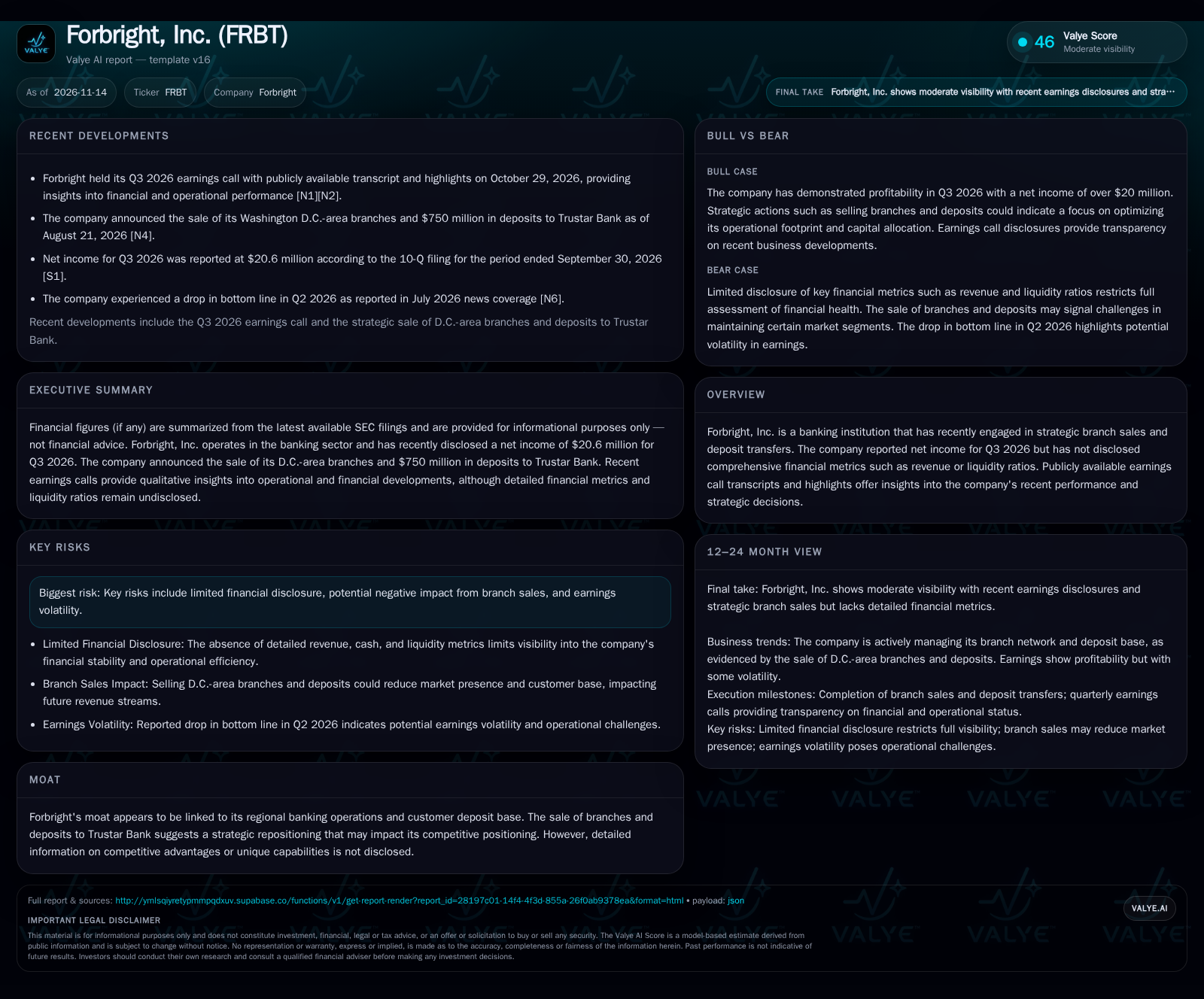
Forbright, Inc. is in the midst of a significant transition after selling its D.C.-area branches and $750 million in deposits to Trustar Bank. While the company posted $20.6 million in Q3 2026 net income, details on its broader financial health remain sparse. The strategic divestiture suggests a move to streamline operations or reallocate capital, but it also reduces the company's deposit base and regional reach. The sustainability of Forbright's earnings and its ability to redefine its competitive edge will hinge on how it redeploys resources and adapts to a changing banking environment. [S1] [N1] [N4]
Forbright, Inc. stands at a strategic crossroads after selling its Washington D.C.-area branches and $750 million in deposits to Trustar Bank. This move, coupled with a reported Q3 2026 net income of $20.6 million and earlier earnings volatility, signals a company actively reshaping its footprint amid sector headwinds. However, with scant disclosure on its underlying financials and liquidity, investors are left to interpret the implications of these shifts: is Forbright tightening its focus for sustainable profitability, or retreating from competitive pressure in key markets? The answers will shape its role in an industry where scale, efficiency, and adaptability are increasingly critical. [S1] [N4] [N6]
Strategic Divestiture and Quarterly Profit: What Recent Moves Reveal
Forbright, Inc. reported net income of $20.6 million for Q3 2026, demonstrating near-term profitability. However, the company’s financial transparency remains limited, with no disclosure of revenue, liquidity ratios, or detailed asset quality metrics in recent SEC filings. The most consequential recent event is the announced sale of its Washington D.C.-area branches and $750 million in deposits to Trustar Bank as of August 21, 2026. This divestiture materially reduces Forbright’s physical footprint and customer deposit base in a major urban market, while presumably freeing up capital and reducing branch-related operating costs. The context for these moves includes a reported drop in earnings in Q2 2026, highlighting volatility in the company’s financial performance. [S1] [N4] [N6]
How the Business Makes Money—and How That Could Change
Forbright’s core business economics likely center on the traditional banking model: gathering low-cost deposits and lending at higher rates, with fee income from ancillary services. The sale of $750 million in deposits and associated branches suggests a deliberate reduction in funding base and potentially in fixed costs (real estate, staffing, compliance). While the immediate impact could be lower operating expenses, it also means reduced earning assets unless proceeds are redeployed efficiently. The bank’s ability to maintain or grow net interest income will depend on whether it can replace these deposits with new, cost-effective funding or higher-yielding loan products. Without revenue or loan book disclosures, it is unclear if Forbright is shifting toward a leaner, more digitally focused model, or simply contracting. In either case, the bank’s operating leverage will now be tested: a smaller footprint could improve efficiency ratios if cost cuts outpace lost revenue, but it could also reduce scale advantages and limit fee-generating opportunities. Capital needs may shift if the company is repositioning for asset-light or specialized lending strategies, but this remains speculative without further disclosure.
A key consideration in evaluating Forbright's evolving business economics is the nature of its deposit base prior to the sale. If the divested deposits were primarily low-cost core deposits, their loss could increase the company's overall funding costs unless replaced by equally inexpensive alternatives. Conversely, if these deposits were relatively expensive or volatile, shedding them might improve net interest margins. Additionally, the company’s ability to pivot toward fee-generating services or non-interest income streams will be critical in offsetting reduced scale. The transition from a branch-heavy model to potentially more digital or specialized lending operations also implies shifts in capital allocation priorities, risk profiles, and regulatory capital requirements, which could materially affect profitability and growth potential.
Competitive Dynamics in a Consolidating Regional Banking Market
Forbright’s competitive position appears in flux. The sale of key branches and deposits to Trustar Bank may cede market share in the D.C. area to a direct regional competitor. Regional and community banks are under increasing pressure from both larger institutions—who benefit from scale, technology, and regulatory arbitrage—and fintech entrants offering digital-first banking experiences. If Forbright is retreating from traditional branch-based competition, it could be repositioning toward niche lending, digital channels, or specialty finance. However, without evidence of unique technology, product differentiation, or a robust digital platform, it risks being squeezed between larger banks’ resource advantages and smaller players’ agility. The company’s future moat, if any, will depend on its ability to cultivate sticky customer relationships, specialized expertise, or cost advantages in its chosen segments. Recent actions suggest a possible search for a new identity rather than a defense of an established competitive edge.
In the context of a consolidating regional banking market, Forbright’s strategic choices must account for the intensifying role of technology and customer preferences. Larger banks leverage scale to invest heavily in digital platforms, enabling seamless omni-channel experiences and personalized financial products. Fintech competitors often outpace traditional banks in agility and innovation, capturing younger and digitally native customer segments. Forbright’s retreat from physical branches might be a step toward embracing these trends, but success depends on the speed and effectiveness of its digital transformation. Without clear differentiation—whether through superior customer service, niche lending expertise, or innovative product offerings—the company risks becoming marginalized as customers gravitate toward more technologically advanced or cost-effective providers.
How Branch Sales Could Catalyze a Leaner, More Profitable Forbright
A favorable scenario hinges on Forbright redeploying capital from its branch and deposit sale into higher-margin, lower-cost operations—such as digital banking, specialty lending, or targeted commercial banking niches. If management uses the freed resources to invest in technology, streamline operations, or pursue underserved markets, the result could be an improved efficiency ratio and more stable earnings, with less exposure to costly branch infrastructure. Confirmation of this scenario would require future disclosures showing stable or rising net interest income, improving return on assets, and evidence of customer acquisition or retention in new channels. Additional signs would include new product launches, digital platform investments, or strategic partnerships that offset the lost deposit base. This scenario would be falsified if future earnings deteriorate, non-interest expense fails to decline, or customer attrition accelerates without compensating growth elsewhere.
Post-Divestiture Stability Hinges on Execution and Market Response
The most plausible near-term outcome is a period of operational and earnings adjustment as Forbright integrates the effects of its branch and deposit sale. The company may achieve modest improvements in cost structure, but will likely face headwinds in offsetting lost funding and market presence. Earnings may stabilize at a lower run-rate, reflecting a smaller balance sheet and reduced fee income. This scenario would be confirmed by sequentially stable (but not growing) net income, steady or slightly declining operating expenses, and limited disclosure of new business lines or growth initiatives. It would be falsified by renewed earnings volatility, regulatory concerns, or significant further asset sales signaling ongoing contraction rather than stabilization.
When Shrinking Signals Weakness: Risks of Eroding Scale and Market Presence
A negative trajectory arises if the branch and deposit sale is a symptom of competitive retreat, not strategic repositioning. Forbright could face declining relevance as its customer base shrinks, scale advantages diminish, and fixed costs become harder to cover. If the company is unable to replace lost deposits with alternative funding or to generate fee income from new channels, net interest margins and profitability could deteriorate. This risk is compounded by the lack of detailed financial disclosure, which obscures asset quality, funding mix, and capital adequacy. Confirmation of this scenario would include ongoing declines in net income, further asset or branch sales, negative trends in non-performing loans (if disclosed), or regulatory actions. It would be partially falsified if the company demonstrates new customer growth, product innovation, or improved financial transparency.
Concrete Evidence Needed to Clarify Forbright’s Trajectory
Disclosure of net interest income and margin trends, if provided, would clarify the impact of deposit base reduction.
Non-interest expense and efficiency ratio trends would help test whether cost savings are realized post-divestiture.
Customer retention and attrition data following the branch sale would illuminate the stickiness of Forbright’s remaining franchise.
Evidence of new product launches, digital banking initiatives, or lending specialization would support a repositioning narrative.
Sequential net income and return on assets figures would test the sustainability of recent profitability.
Asset quality metrics, such as non-performing loan ratios (if disclosed), would reveal potential credit risks.
Additional branch or asset sales would signal whether the company is shrinking further or has stabilized its footprint.
Disclaimer: This is research-only, informational analysis and not investment advice. It may include AI-generated interpretation and general industry context. Always verify important details using primary sources.

Comments