
KPET Ultra Paceline Corp: Blank-Check Structure, Interest Income, and the Strategic Stakes of the Search Phase
KPET Ultra Paceline Corp is a newly listed blank check company with no operating business, substantial cash reserves, and positive net income driven by interest on IPO proceeds. The company's future value hinges entirely on its ability to identify, negotiate, and close a business combination before its window expires—raising high-stakes questions about target selection, market timing, and sponsor alignment.
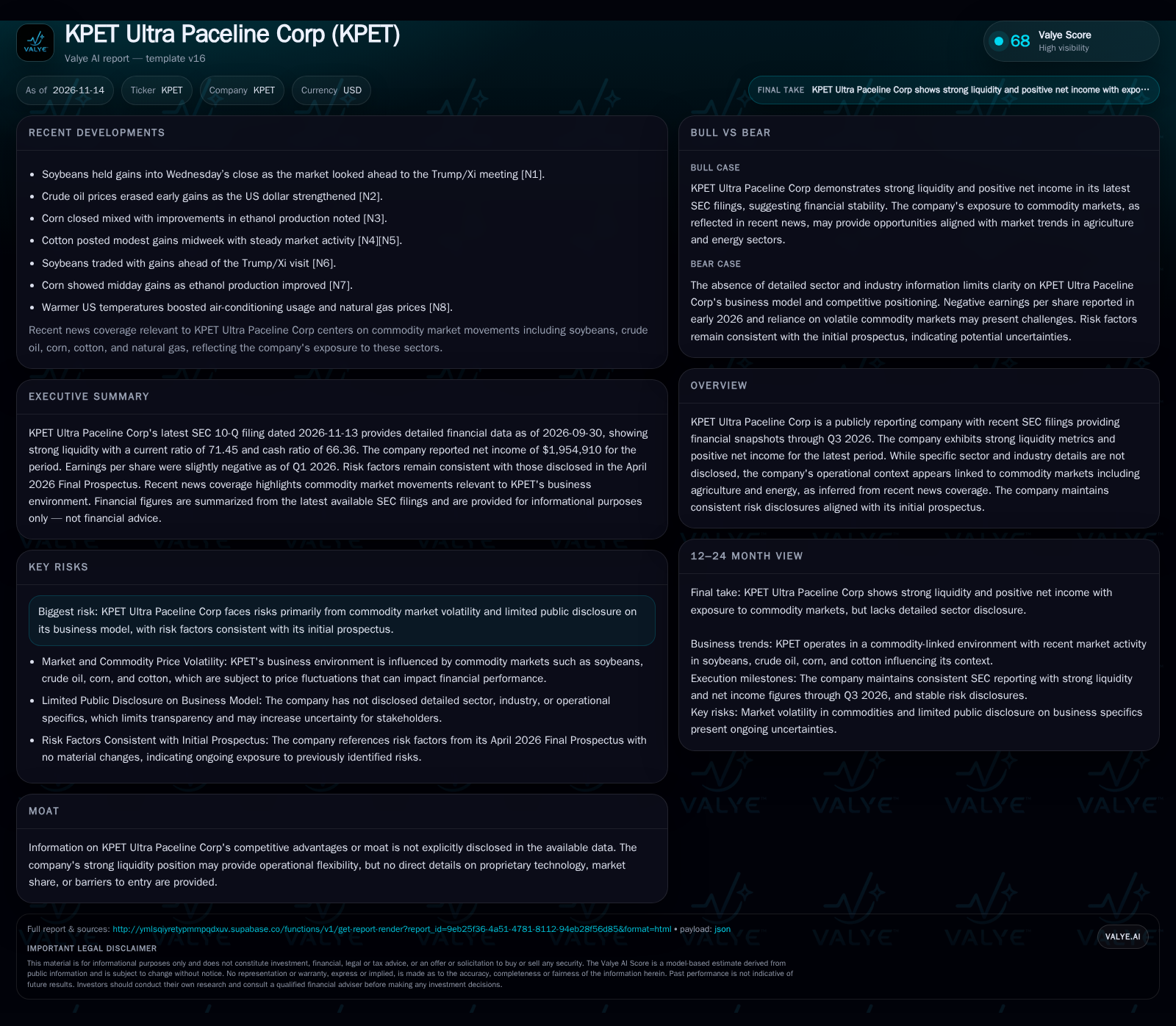
KPET Ultra Paceline Corp is a SPAC (blank check company) with $200 million in IPO proceeds and over $1.2 million in cash outside its trust account as of Q3 2026. Its positive net income is entirely from interest earned on those proceeds, not business operations. The company's future depends on executing a successful business combination; until then, its economics, risk profile, and upside are defined by SPAC mechanics, not operating performance. Commodity market news is contextually relevant only to the extent KPET targets a business in those sectors.
KPET Ultra Paceline Corp stands at the classic crossroads for a post-IPO SPAC: flush with cash, no operating revenues, and an open mandate to find a business combination. Its Q3 2026 financials reflect the hallmark of the blank-check model—interest income on idle IPO proceeds, not operating performance. While the company references commodity market dynamics in its context, no target or sector commitment has been disclosed. The real test for KPET will come not from its current financials, but from the quality, timing, and terms of the acquisition it ultimately pursues.
SPAC Structure Defines KPET's Current Financial Picture
KPET Ultra Paceline Corp is a blank check company (SPAC), incorporated in late 2025 and listed via a $200 million IPO in April 2026. As of September 30, 2026, KPET has not commenced any operating business; its sole activities have been organizational setup, IPO execution, and the search for an acquisition target. The company reported net income of $1,954,910 for Q3 2026, but this is entirely attributable to interest income on trust assets, not commercial operations. These metrics reflect the financial structure of a SPAC, where proceeds are held in trust pending a business combination, rather than the economics of an operating enterprise. Until a deal is consummated, KPET's only recurring income source is interest on its trust account, and its risk disclosures remain unchanged from its IPO prospectus [S1].
SPAC Economics: How Money Is Made (and Lost) Before a Deal
KPET’s business model, pre-acquisition, is entirely financial: it earns interest on the cash held in its trust account while incurring modest administrative and compliance expenses. There are no revenues from operations, no customers, and no commercial pricing or volume dynamics. The only potential for value creation (or destruction) lies in the terms and execution of the eventual business combination. If KPET successfully identifies and merges with an attractive target, future economics will be dictated by that operating business. Until then, KPET’s capital structure is simple: nearly all assets are cash or equivalents, and liabilities are minimal, mostly routine payables. The company’s operating leverage is negative at this stage—expenses are fixed while income is variable based on prevailing interest rates on trust assets. Importantly, the clock is ticking: if KPET fails to close a deal within its allowed timeframe (typically 18-24 months post-IPO), it must liquidate and return trust proceeds to shareholders, with sponsors losing their at-risk capital. Thus, the business model is binary: successful acquisition leads to operating company economics; failure triggers liquidation.
The SPAC Competitive Landscape: Sponsor Reputation and Target Access
In the SPAC ecosystem, competitive advantage is less about traditional moat factors and more about sponsor reputation, deal-sourcing networks, and the ability to identify and negotiate a value-accretive merger. KPET faces competition not from industry peers, but from other SPACs and private equity vehicles also seeking attractive targets—often in crowded sectors such as technology, health care, or commodities. The market for high-quality targets is highly competitive; target companies may use SPACs as a path to public markets, but can also choose traditional IPOs or private funding. KPET’s ability to stand out will depend on the experience and credibility of its sponsor group, its willingness to offer favorable deal terms, and agility in responding to changing market conditions. If KPET pursues targets in commodity-linked sectors (as suggested by recent news context), it will face additional competition from specialized SPACs and strategic buyers in those industries. However, without a disclosed target or sector focus, KPET’s current competitive positioning remains undefined.
Upside Hinges on Sourcing a High-Quality, Timely Business Combination
The most favorable outcome for KPET shareholders is the successful identification and completion of a business combination with a company that delivers strong growth, profitability, and public market appeal. In this scenario, KPET leverages its cash and sponsor relationships to secure a target in a sector with secular tailwinds—potentially commodities, energy, or agriculture if current news context is predictive. Confirmation of the upside scenario would come in the form of a definitive merger agreement with a well-regarded private company, transparent pro forma financials, and a clear value creation thesis. This would likely be accompanied by positive market reaction, strong PIPE (private investment in public equity) participation, and credible projections for post-merger revenue and margin growth. Falsification would occur if KPET fails to announce a compelling target, faces shareholder redemptions that materially reduce trust proceeds, or closes a deal at an unattractive valuation.
Most Probable Path: Incremental Steps Toward a Deal Amid Market Frictions
The most plausible outcome for KPET is a gradual progression through the typical SPAC lifecycle: ongoing target search, due diligence expenses, periodic extensions, and eventual announcement of a business combination—likely in a competitive, late-stage environment. In this scenario, KPET may face headwinds such as increased shareholder redemptions (especially if market sentiment is negative), regulatory scrutiny, and the need to sweeten deal terms to attract a PIPE or satisfy public investors. Confirmation would come from regular SEC filings disclosing progress, target shortlists, or preliminary negotiations, as well as sponsor willingness to backstop redemptions or extend the search window. Falsification would be indicated by repeated extension votes without substantive deal progress, high redemption rates, or failure to secure external capital for a prospective merger.
Failure to Secure a Business Combination: Liquidation Risk Looms
The adverse scenario for KPET is the inability to identify, negotiate, or close a business combination within the allotted timeframe—leading to liquidation of the trust and return of capital to shareholders. This outcome would result in sponsor losses (forfeited at-risk capital and warrants), wasted opportunity costs, and no upside for public holders beyond nominal interest earned. Signs of this scenario would include prolonged silence on deal progress, repeated shareholder votes to extend the SPAC’s life with little justification, or failure to attract a PIPE in a challenging capital market. Additionally, if commodity or public equity market volatility spikes, targets may become more expensive or less willing to merge, compounding execution risk. This scenario could also be triggered by regulatory or legal setbacks affecting the SPAC structure more broadly.
Milestones and Metrics That Will Shape KPET’s Investment Thesis
Announcement of a definitive business combination agreement, including details on target sector, financials, and deal structure.
Shareholder redemption rates at the time of merger vote—a high rate would signal weak confidence and reduce available capital.
PIPE (private investment in public equity) participation and terms, if disclosed, as a test of institutional investor appetite.
Updates on trust account balance and interest income, which determine the capital available for a deal or liquidation.
Sponsor willingness to backstop redemptions, contribute additional capital, or amend terms to facilitate a successful merger.
SEC filings and press releases signaling progress on target identification, due diligence, or negotiation milestones.
Any shift in risk disclosures, especially regarding sector focus or regulatory challenges, as evidence of evolving strategy.
Disclaimer: This is research-only, informational analysis and not investment advice. It may include AI-generated interpretation and general industry context. Always verify important details using primary sources.

Comments