
RMG ML Sports Holdings: Strong Financials Despite Strategic Uncertainty
Despite reporting strong quarterly earnings and a reported liquidity position, RMG ML Sports Holdings remains an enigma to public investors due to a near-total lack of operational transparency. The company’s financial health is clear, but its long-term trajectory, value-creation mechanisms, and sector exposure are hidden, making any forward-looking assessment highly speculative.
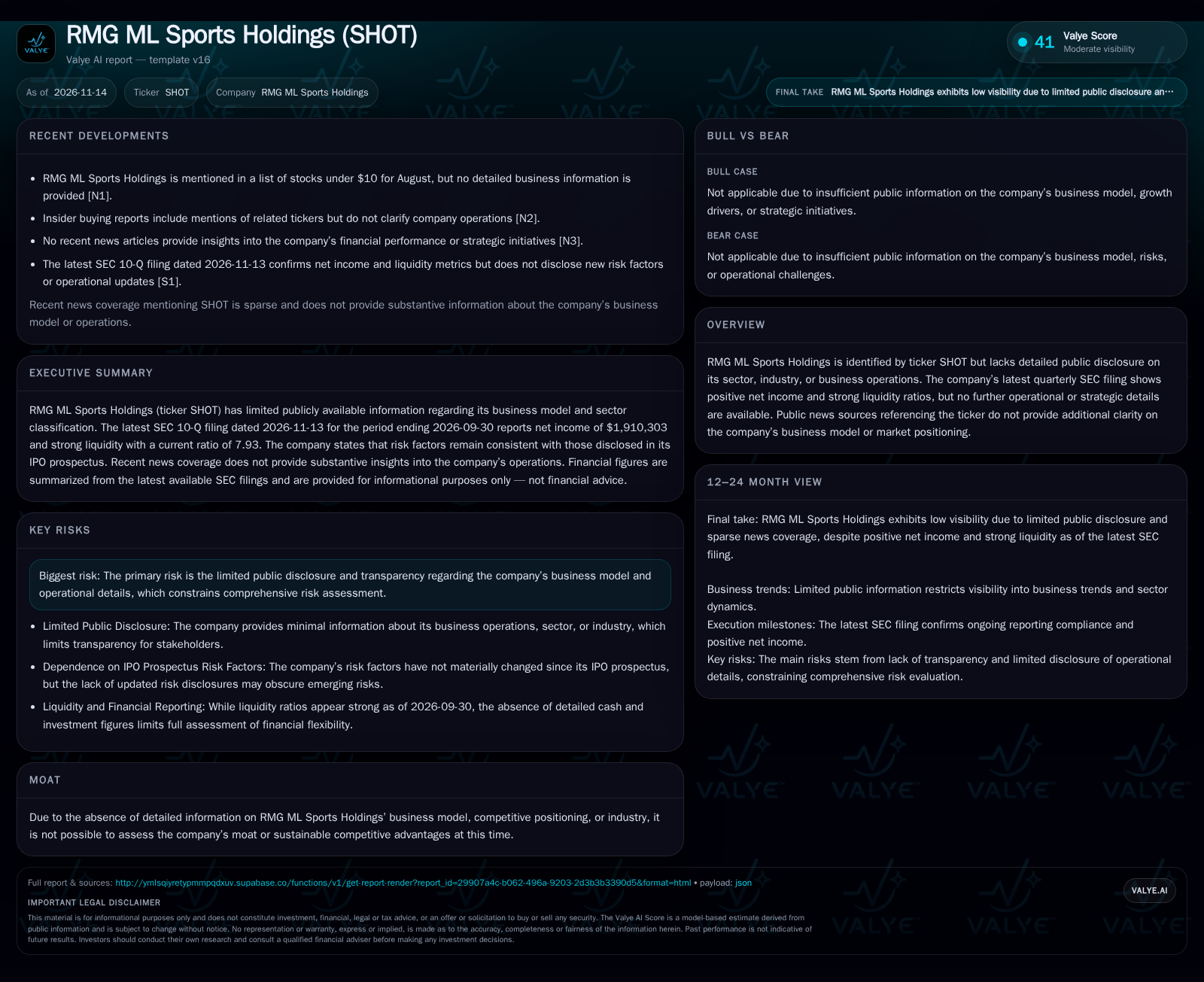
RMG ML Sports Holdings (SHOT) posted $1.9M in net income and a current ratio of 7.93 as of Q3 2026, signaling strong short-term financial health. However, the absence of public detail on its business model, operations, or sector leaves investors with little basis for evaluating sustainability, growth prospects, or risk beyond the available financial snapshot. This opacity is the defining trait of the current investment thesis.
Yet, for all its apparent health, the company’s business fundamentals—sector, revenue sources, customer base, or strategic direction—are entirely opaque. For investors and analysts, this creates a paradox: strong numbers, but no narrative, no context, and no way to project the future with any confidence. The result is a thesis that hinges less on the company’s performance and more on the risks and opportunities inherent in extreme disclosure gaps.
Robust Financial Performance Contrasts with Unclear Strategic Direction
RMG ML Sports Holdings reported net income of $1,910,303 for the quarter ending September 30, 2026, and reported liquidity-ratio trends of 7.93, with $1.16M in current assets against $147K in current liabilities [S1]. These figures reflect a strong short-term financial position, suggesting the company is not facing imminent liquidity pressure. However, the most material fact shaping the investment thesis is the complete absence of public information regarding the company’s sector, operations, or business model. The latest SEC filing confirms that risk factors have not changed since the IPO prospectus, and no new operational updates or strategic developments are disclosed. This leaves financial results as the only transparent data points, while every other dimension of the business remains opaque.
Analyzing Profit Margins Without Clear Economic Framework
The company reported cash and liquidity metrics for the period; these figures do not by themselves establish operating runway, investment capacity, financial flexibility, or financing capacity. In the absence of disclosure, several business models are plausible—from asset-light licensing or management fees, to high-margin investment returns, to holding interests in operating sports or entertainment assets. Each of these models carries different implications for revenue predictability, cost structure, and capital intensity. For example, a licensing or management-fee business would likely have high gross margins and low fixed costs, while an asset-heavy operator would face significant depreciation and variable expenses. The reported net income could result from a windfall event, ongoing operations, or investment gains. Without clarity on revenue composition, pricing power, or cost drivers, it is impossible to ascertain whether current profitability is sustainable or anomalous. The reported current ratio could indicate either prudent cash management or a lack of reinvestment opportunities, depending on the underlying business context.
Further complicating the economic analysis is the unknown capital structure and financing strategy underlying RMG ML Sports Holdings. If the company relies primarily on equity capital with minimal leverage, the reported net income might reflect conservative financial management but also limited growth investment. Conversely, significant debt or hybrid financing could amplify earnings volatility and risk, especially if cash flows are uneven or tied to cyclical assets. Understanding the cost of capital and capital allocation priorities would help clarify whether the company is optimizing shareholder value or merely preserving liquidity. Additionally, the absence of disclosed capital expenditures or R&D spending obscures the company’s capacity to innovate or adapt, which are critical for long-term profitability in dynamic industries.
Competitive Positioning Remains Unclear in an Opaque Market
Because RMG ML Sports Holdings discloses neither its industry nor operational focus, its competitive context is entirely speculative. If the company is involved in sports management, media rights, or event promotion, it could face competition from established holding companies, entertainment conglomerates, or specialized sports franchises. Alternatively, if SHOT acts as an investment vehicle or SPAC-like entity, its peer set could include alternative asset managers or blank-check companies. Without insight into its product offerings, customer relationships, or distribution channels, it is impossible to gauge switching costs, barriers to entry, or the durability of any competitive advantage. The absence of detail also precludes analysis of regulatory risk, technological substitution, or sector-specific headwinds. In effect, SHOT’s competitive position cannot be assessed until the company chooses to disclose its strategic and operational identity.
In the absence of disclosed operational details, one can consider industry-agnostic competitive factors that might influence RMG ML Sports Holdings’ positioning. For instance, if the company operates in a fragmented market with low entry barriers, competitive pressures could erode margins and limit pricing power. Alternatively, if it holds unique intellectual property, exclusive contracts, or network effects, it could enjoy sustainable advantages. Another dimension is the scale and scope of operations; a small, niche player may face different competitive dynamics than a diversified conglomerate. Moreover, regulatory environments and technological trends might create either headwinds or tailwinds, depending on the sector, which remain unknowable without disclosure. Therefore, competitive positioning assessment requires not only market structure analysis but also insight into strategic execution capabilities.
Potential Transparency Milestone Could Unlock Significant Value
The most favorable scenario for RMG ML Sports Holdings is one in which the company discloses a scalable, defensible business model with recurring revenues, strong customer relationships, and a clear pathway to growth. For example, if SHOT were revealed to own profitable sports franchises, media rights, or technology platforms with high switching costs, the combination of current profitability and operational leverage could justify a premium valuation. Confirmation of long-term contracts, exclusive assets, or partnerships would further bolster the case. Evidence that would support this scenario includes detailed segment reporting, customer or contract disclosures, and strategic updates outlining growth initiatives. The upside would be further validated if subsequent quarters show consistent profitability and capital deployment into high-return opportunities. Conversely, if transparency reveals a one-time gain or unsustainable revenue stream, the upside case would be quickly falsified.
Consistent Earnings Expected Despite Continued Strategic Ambiguity
The most plausible middle path is that RMG ML Sports Holdings continues to report positive net income and maintains reported liquidity position, but does not meaningfully expand public disclosure. In this scenario, the company’s valuation and investor interest are likely capped by uncertainty, regardless of reported profitability. Investors may treat the company as a cash-generating but unproven entity, assigning a discount for opacity and unknown risks. The base case would be confirmed by continued quarterly profits and reported balance sheet position metrics, but no new operational details. It would be challenged if disclosure improves, revealing either a high-quality business or, conversely, hidden vulnerabilities. Over time, persistent lack of transparency could lead to reduced trading liquidity, exclusion from indexes, or a shrinking investor base.
Unknown Risks Include One-Off Gains, Hidden Liabilities, and Strategic Drift
The primary downside scenario is that the current net income reflects a transient gain—such as the sale of an asset, investment windfall, or accounting anomaly—rather than ongoing operational strength. If future filings reveal a sharp drop in earnings or liquidity due to undisclosed liabilities, failed investments, or operational losses, the market could rapidly reprice risk. Another risk is that the lack of disclosure masks strategic drift, governance issues, or regulatory non-compliance. Evidence confirming the downside would include sudden negative earnings, deterioration in balance sheet health, or adverse auditor commentary. Conversely, regular and stable financial performance—absent operational detail—would not by itself falsify the risk, as structural vulnerabilities could remain hidden until a negative event forces disclosure.
Events That May Impact Confidence in RMG ML Sports Holdings’ Outlook
Disclosure of the company’s primary revenue sources, business lines, or sector focus would materially change the analytical context.
Segment-level financial reporting or management commentary explaining the drivers of net income would help test the sustainability of current profitability.
Evidence of recurring contracts, customer retention, or backlog—if disclosed—would clarify revenue visibility and risk.
Material changes in the current ratio or net income across quarters could indicate shifting business dynamics or one-time events.
Auditor commentary, going-concern warnings, or restatements in future filings would signal hidden risks or operational fragility.
Announcements of major asset sales, acquisitions, or strategic partnerships would provide insight into capital allocation and growth priorities.
Public communication of corporate strategy, governance practices, or leadership changes would help assess management quality and alignment.
Disclaimer: This is research-only, informational analysis and not investment advice. It may include AI-generated interpretation and general industry context. Always verify important details using primary sources.

Comments