
Annovis Bio’s Multi-Target Neurodegeneration Strategy: Pivotal Phase 3 Readouts and the Capital Imperative
With full enrollment in its Phase 3 Alzheimer’s trial and a unique approach targeting multiple neurotoxic proteins, Annovis Bio stands at a clinical inflection point—yet faces acute funding and regulatory pressures that could shape its ability to translate promising early data into a commercial reality.
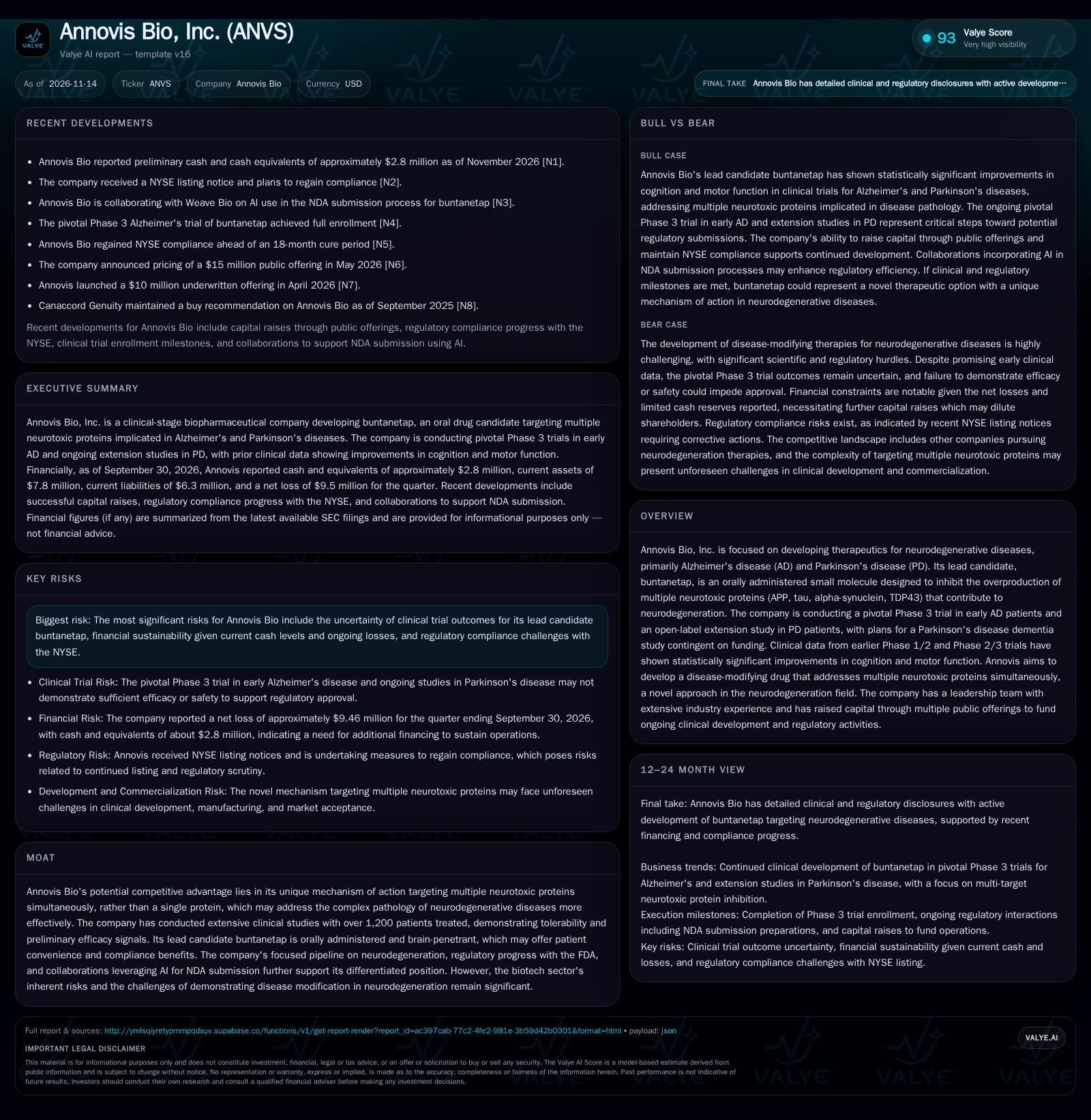
Annovis Bio has reached full enrollment in its pivotal Phase 3 trial for buntanetap in early Alzheimer’s, aiming to validate a first-in-class approach inhibiting several neurotoxic proteins. Regulatory progress and NYSE compliance have stabilized the near-term platform, yet the efficacy and safety outcomes from its Phase 3 studies—and subsequent capital-raising ability—will determine whether Annovis can emerge as a competitive force in neurodegenerative disease therapeutics. [N1] [N2] [N4] [S2]
Annovis Bio, Inc. is at a pivotal stage in its quest to redefine neurodegenerative disease treatment. Its lead candidate, buntanetap, is designed to simultaneously target several neurotoxic proteins implicated in Alzheimer’s and Parkinson’s diseases—an approach that, if validated, could challenge the single-target paradigm dominating the field. The coming quarters will test whether its differentiated strategy can overcome the formidable risks that have stymied so many neurodegeneration contenders. [N1] [N4] [S2]
Latest Milestones: Pivotal Phase 3 Enrollment and Financial Strain Define the Moment
Annovis Bio achieved full enrollment in its pivotal Phase 3 clinical trial for buntanetap in early Alzheimer’s disease, marking a critical step toward a potential NDA submission. This milestone is especially significant given the complexity and high failure rate of late-stage neurodegeneration trials. [N4]
The company reported preliminary cash and cash equivalents of approximately $2.8 million as of November 2026, with a net loss of $9.46 million for the most recent quarter. [N1] [N6] [S2]
Regulatory progress is evident: Annovis regained NYSE compliance ahead of the allowed cure period, and ongoing collaboration with Weave Bio is intended to support its NDA submission process using AI tools. These efforts reflect both operational discipline and the urgency to maintain investor and regulatory confidence amid high-stakes clinical readouts. [N2] [N3] [N5]
Commercialization Prospects and the Economics of Multi-Target Neurodegeneration Therapies
Annovis Bio’s business model hinges on the successful development and approval of buntanetap as a disease-modifying therapy for Alzheimer’s and Parkinson’s. If clinical efficacy is confirmed, buntanetap could be positioned as a first-in-class oral therapy that addresses the multifactorial nature of neurodegeneration, potentially allowing for premium pricing relative to symptomatic-only treatments.
The economics of neurodegenerative drug development are characterized by high fixed costs—most notably, R&D and regulatory expenses—contrasted with potentially high operating leverage if a product reaches market. The chronic nature of Alzheimer’s and Parkinson’s would support recurring prescription revenue, but commercial success depends on demonstrating meaningful clinical benefit and securing favorable payer coverage.
Given Annovis’s limited resources, near-term capital needs are acute. Without a partnership or non-dilutive funding, additional equity raises are likely if the Phase 3 results are positive but regulatory approval and launch remain 12-24 months out.
Differentiation Versus Entrenched Rivals: Mechanistic Novelty and Market Realities
The principal differentiator for Annovis Bio is its approach of targeting multiple neurotoxic proteins (APP, tau, alpha-synuclein, TDP43) via buntanetap, whereas most late-stage competitors focus on single proteinopathies—such as anti-amyloid or anti-tau antibodies in Alzheimer’s. If Annovis can demonstrate robust clinical data, this multi-target strategy could disrupt established development paradigms.
However, the competitive landscape is crowded and capital intensive. Large pharmaceutical incumbents and biotech peers are advancing their own late-stage candidates, many with greater resources, deeper clinical pipelines, and established commercial infrastructures. The presence of multiple disease-modifying therapies in development or on the market could intensify payer scrutiny and limit pricing power, especially if efficacy or safety profiles are only incrementally differentiated.
Switching frictions in neurology are typically moderate—physicians and patients may be receptive to new therapies with superior efficacy or convenience, but entrenched therapies and cautious clinical guidelines can slow adoption. Annovis’s oral dosing and brain penetrance could be commercial advantages, but real-world uptake will depend on both regulatory labeling and head-to-head or real-world evidence post-approval.
Clinical Validation Unlocks Market Access and Strategic Optionality
If the pivotal Phase 3 Alzheimer’s trial demonstrates clear, statistically significant benefits on both symptomatic and disease-modifying endpoints—with an acceptable safety profile—Annovis could rapidly transition to NDA filing and regulatory review. Positive data would likely drive investor enthusiasm, improve capital access, and could attract partnership or acquisition interest from larger pharmaceutical players seeking differentiated neurodegeneration assets.
Confirmation of buntanetap’s multi-target efficacy could enable Annovis to pursue additional indications, such as Parkinson’s disease dementia, leveraging existing trial infrastructure and regulatory pathways. This would expand addressable market size and diversify revenue prospects.
Evidence supporting this scenario would include: robust Phase 3 efficacy and safety data, expedited regulatory feedback, non-dilutive financing or partnership announcements, and early payer or guideline endorsements. Falsification would come from inconclusive or negative trial results, regulatory delays, or inability to secure funding for post-trial operations.
Translational Hurdles and Funding Cycles Shape the Probable Path Forward
The most plausible near-term outcome is that Annovis delivers Phase 3 results that are directionally positive but require additional analysis or follow-up studies to fully satisfy regulatory or clinical adoption standards. This would extend the company’s timeline to potential commercialization and increase pressure to secure further funding.
Operationally, Annovis is likely to continue a cycle of clinical milestone-driven capital raises, with dilution risk for shareholders unless non-dilutive options emerge. Regulatory progress—such as acceptance of NDA filings or clear guidance on data sufficiency—would be a key confirming signal that the development path remains intact.
This scenario would be confirmed by continued but measured fundraising activity, ongoing regulatory correspondence, and incremental clinical disclosures. It would be falsified by unexpected negative safety signals, a major regulatory setback, or inability to raise sufficient capital to complete the necessary studies.
Adverse Trial Outcomes and Funding Shortfalls Threaten Viability
Should the pivotal Phase 3 trial fail to demonstrate statistically significant efficacy or reveal new safety concerns, Annovis could face a rapid erosion of investor confidence and limited access to additional capital. In this scenario, the company may be forced to curtail operations, pause development programs, or seek strategic alternatives under duress.
Regulatory actions, such as renewed NYSE compliance warnings, could further destabilize the platform.
Downside confirmation would come from negative or equivocal Phase 3 results, failed or highly dilutive capital raises, increased regulatory scrutiny, or public disclosures of program discontinuations or restructuring.
Milestones and External Factors That Will Shape Annovis Bio’s Strategic Trajectory
Topline efficacy and safety results from the pivotal Phase 3 Alzheimer’s trial; this will be the critical gating event for regulatory and commercial strategy.
Frequency, size, and terms of future capital raises—especially the ability to secure non-dilutive funding or attract partnership investment.
Progress and feedback from the FDA regarding NDA submission timelines and acceptance criteria, including the impact of AI-enabled submission processes.
Enrollment progress and interim outcomes from the open-label extension study in Parkinson’s disease, which could inform label expansion or support payer discussions.
Regulatory status and ongoing compliance with NYSE listing requirements, as any setbacks could affect investor confidence and access to public markets.
Demonstrated ability to expand the clinical pipeline or initiate new studies (e.g., Parkinson’s disease dementia), contingent on available capital.
If disclosed, early signals of payer interest, health technology assessment outcomes, or guideline inclusion for buntanetap post-approval would help test commercial adoption potential.
Operational cost trends and cash burn rates, as further acceleration could require earlier or more dilutive fundraising.
Disclaimer: This is research-only, informational analysis and not investment advice. It may include AI-generated interpretation and general industry context. Always verify important details using primary sources.

Comments