
GCGR: SPAC Economics, Interest Windfall, and the High-Stakes Search for a Merger
General Catalyst Global Resilience Merger Corp. (GCGR) is a newly listed SPAC with no operating business, generating net income solely from interest on IPO proceeds while it seeks a merger target.
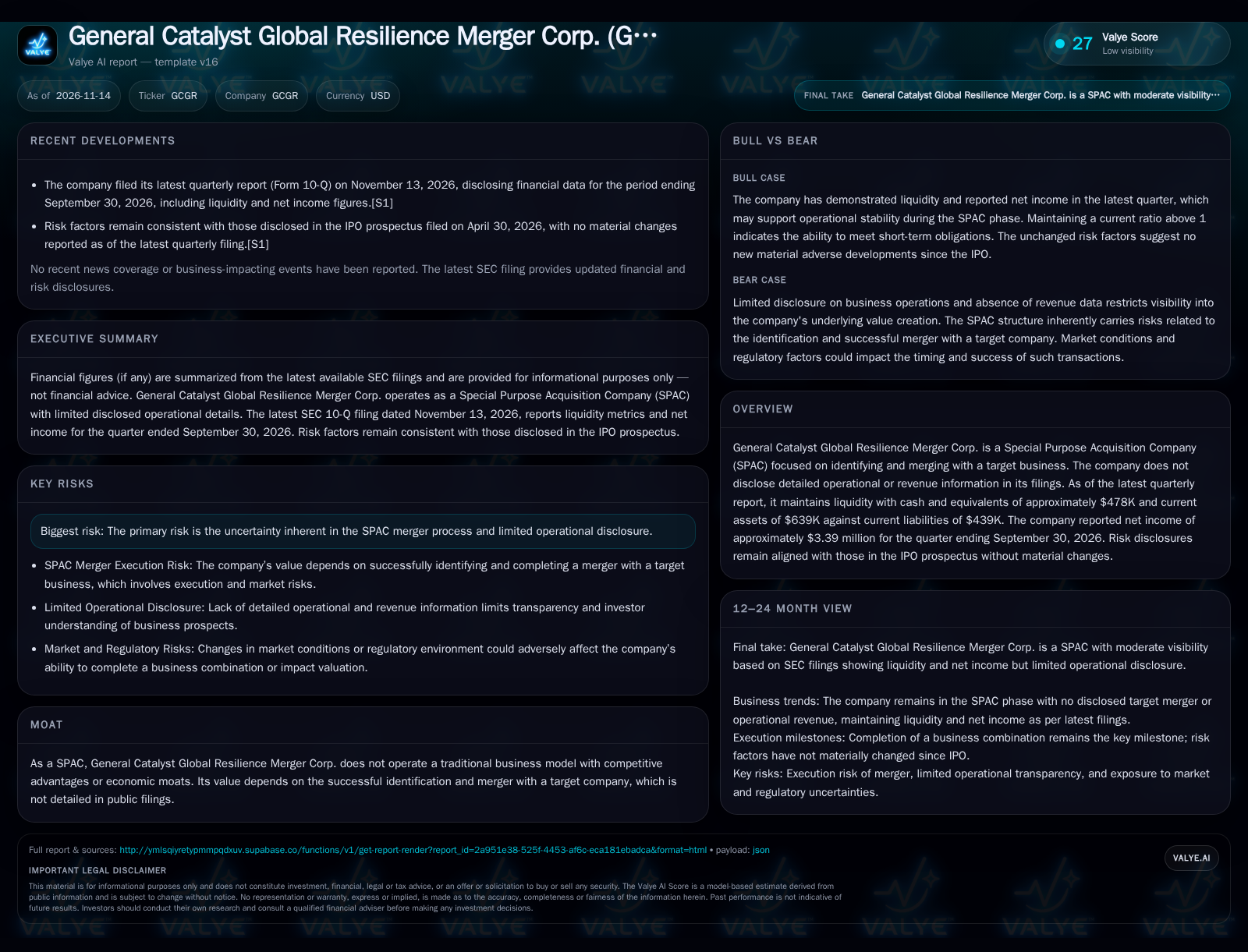
GCGR is a blank-check company with no operations or revenue, recently reporting net income driven exclusively by interest on IPO proceeds. Its liquidity currently exceeds near-term liabilities, but the company’s future hinges on identifying and closing a merger. Key risks include execution uncertainty, limited transparency, and market headwinds for SPAC transactions.[S1]
General Catalyst Global Resilience Merger Corp. (GCGR) exemplifies the classic SPAC lifecycle: flush with capital from a recent IPO, but with no operations, revenue, or identified merger target as of its latest quarterly report. The company’s reported net income is purely a function of interest earned on the trust account, not business activity. The core question for investors is whether GCGR can convert its capital base and sponsor brand into a value-creating combination in a challenging SPAC market.[S1]
GCGR’s Financial Snapshot: Interest Income Drives Reported Net Income, No Operating Business in Place
As of September 30, 2026, General Catalyst Global Resilience Merger Corp. reported net income of $3.39 million for the quarter, entirely attributable to interest earned on the IPO trust account. No operating revenues or business activities have commenced; all activity since inception has focused on organizational setup and identifying a target for merger. The company holds $477,704 in cash and cash equivalents, with current assets of $639,309 against current liabilities of $439,048, resulting in a current ratio of 1.46 and a cash ratio of 1.09. These metrics indicate that, for now, GCGR can meet its immediate obligations, but the absence of an identified acquisition target and lack of operational disclosure means there is no underlying business to analyze beyond the trust account mechanics.[S1]
SPAC Unit Economics: Interest Arbitrage and the Binary Value of a De-SPAC
GCGR’s economics are entirely typical for a SPAC in its pre-combination phase: it generates non-operating income by holding IPO proceeds in a trust account, earning interest that funds public company expenses and delivers accounting net income. There is no revenue from operations, no customer base, and no cost of goods sold. Expenses consist mainly of professional and compliance costs. Fixed costs are relatively low, but the model is highly capital intensive in the sense that the only value is the pool of capital raised ($402.5 million from the IPO and $9.05 million from private placement securities) and the optionality to merge with a private business. The economics pivot dramatically upon a successful merger: the SPAC’s cash may be used for acquisition, redemptions, or transaction expenses, and the merged entity would then assume a new business model, revenue stream, and cost structure. Until then, the only source of value creation (or erosion) is the management of trust proceeds and the ability to find a compelling target before the SPAC’s deadline.
The reliance on interest income as the sole source of reported net income underscores the delicate balance SPACs must maintain between preserving capital and managing operational costs. Given that the trust account funds are typically invested in low-risk, short-duration instruments to ensure liquidity and capital preservation, the yield environment plays a critical role in shaping the SPAC's financial runway. In a rising interest rate environment, the SPAC benefits from higher interest accruals, which can marginally extend the period before sponsor capital contributions become necessary. Conversely, a declining rate environment compresses interest income, increasing pressure on sponsors to fund ongoing expenses or expedite deal sourcing to avoid capital erosion. This dynamic creates an implicit dependency on macroeconomic conditions that can materially affect the SPAC’s potential financial flexibility prior to consummating a merger.
SPAC Sponsor Reputation Versus Market Saturation: What Sets GCGR Apart?
GCGR does not have a conventional competitive moat; its only differentiator is sponsor reputation and deal-sourcing capability. The SPAC landscape is crowded, with many vehicles chasing a shrinking pool of attractive private targets as regulatory scrutiny and market skepticism of de-SPACs have increased. In theory, GCGR could have an edge if its sponsor—General Catalyst—can leverage relationships, sector expertise, or brand credibility to secure a high-quality deal. However, there is no evidence yet of a proprietary pipeline or deal in progress. The principal substitutes are other SPACs targeting similar sectors and direct IPO or private equity routes for private companies. The risk is that without a compelling target, GCGR may be forced into a suboptimal transaction or face liquidation, eroding the value proposition for public shareholders.
Sponsor Leverage and Market Timing Could Deliver a High-Quality Merger
The most favorable outcome is that GCGR’s sponsor leverages its network to identify a private company with strong growth prospects, clear regulatory path, and robust business fundamentals. If such a target is secured and the transaction closes before the SPAC’s deadline, shareholders could benefit from both the optionality of public market valuation and potential upside from a differentiated asset. Confirmation of this scenario would include a merger announcement with a credible, growth-focused business, transparency on deal terms, and positive market or analyst reaction. Evidence falsifying this scenario would be extended silence, delays, or a merger with a marginal or distressed asset, or repeated extensions of the SPAC’s timeline without substantive progress.
The Probable Path: Transaction Search, Cost Burn, and the SPAC Clock
The most plausible outcome is that GCGR continues to burn modest amounts of cash on compliance and target search while earning interest income, with no operating business until a deal is announced or the SPAC period expires. In the current environment, many SPACs face difficulty finding suitable targets, leading to extensions, sponsor concessions, or eventual liquidation and return of capital to shareholders. Confirmation would come from continued SEC filings showing stable trust balances, ongoing interest income, and absence of deal news. Falsification would be a sudden merger announcement or a public update on a signed letter of intent.
Adverse Outcome: Poor Target, Forced Deal, or Liquidation Risk
The principal risks are that GCGR either fails to find a target and is forced to liquidate—returning capital to shareholders but erasing any sponsor upside—or that it consummates a merger with a low-quality or overvalued business under time pressure. In both cases, public shareholders may see limited or negative returns. Negative confirmation would include repeated extensions of the SPAC’s deadline, lack of transparency, or a merger with a target that is not well received by the market. The risk of redemptions is also high in a weak SPAC market, which could reduce available cash for the target and undermine deal economics.
Milestones That Will Test Whether GCGR Can Deliver Shareholder Value
Announcement of a definitive agreement with a merger target, including sector, business model, and valuation details.
Updates on any extensions or amendments to the SPAC’s timeline or charter, which would indicate progress or lack thereof.
Redemption rates at the time of any announced merger, as high redemptions could drain trust proceeds and impair transaction value.
Changes in trust account balance or interest income, which would signal either capital deployment, redemptions, or increased expense burn.
Sponsor contributions, concessions, or backstops—if disclosed—could reveal sponsor commitment or deal fragility.
Any regulatory or litigation developments affecting the SPAC or the de-SPAC process, which could complicate or delay a transaction.
Evidence of enhanced sponsor engagement or public communication, such as investor presentations or target pipeline updates, would help test the thesis.
Disclaimer: This is research-only, informational analysis and not investment advice. It may include AI-generated interpretation and general industry context. Always verify important details using primary sources.

Comments