
Peraso’s mmWave Ambition: Can Proprietary Wireless Technology Break Through Capital and Adoption Barriers?
Recent capital infusions give Peraso Inc. a lifeline as it pivots fully to millimeter wave (mmWave) semiconductors, but with steep revenue declines and persistent losses, the company’s future now hinges on converting technical strengths into sustained commercial traction in fixed wireless, military, and emerging consumer applications.
Peraso Inc. has secured $20 million in new capital and exited its legacy memory IC business to focus exclusively on mmWave wireless semiconductor devices and modules. Despite proprietary beamforming and beamtracking technology aimed at high-growth fixed wireless and secure communications markets, the company faces steep revenue declines, ongoing losses, and Nasdaq compliance risk. The thesis now depends on Peraso’s ability to translate technical differentiation into real customer adoption and recurring orders before dilution and governance shifts erode its optionality.
Peraso Inc.’s strategic pivot to millimeter wave (mmWave) semiconductors for high-capacity wireless applications comes at a critical juncture. With its legacy memory IC business shuttered, the company is doubling down on proprietary wireless chips and antenna modules targeting fixed wireless, military, and consumer markets. Yet, steep revenue declines and ongoing losses have forced a reliance on fresh capital infusions—including $20 million from private and strategic investors—to shore up a precarious balance sheet. The next phase for Peraso will test whether its technical advantages in beamforming and low-latency wireless can overcome entrenched competition, customer adoption hurdles, and dilution-fueled governance shifts.
Capital Infusions and Strategic Pivot Define Peraso’s Immediate Outlook
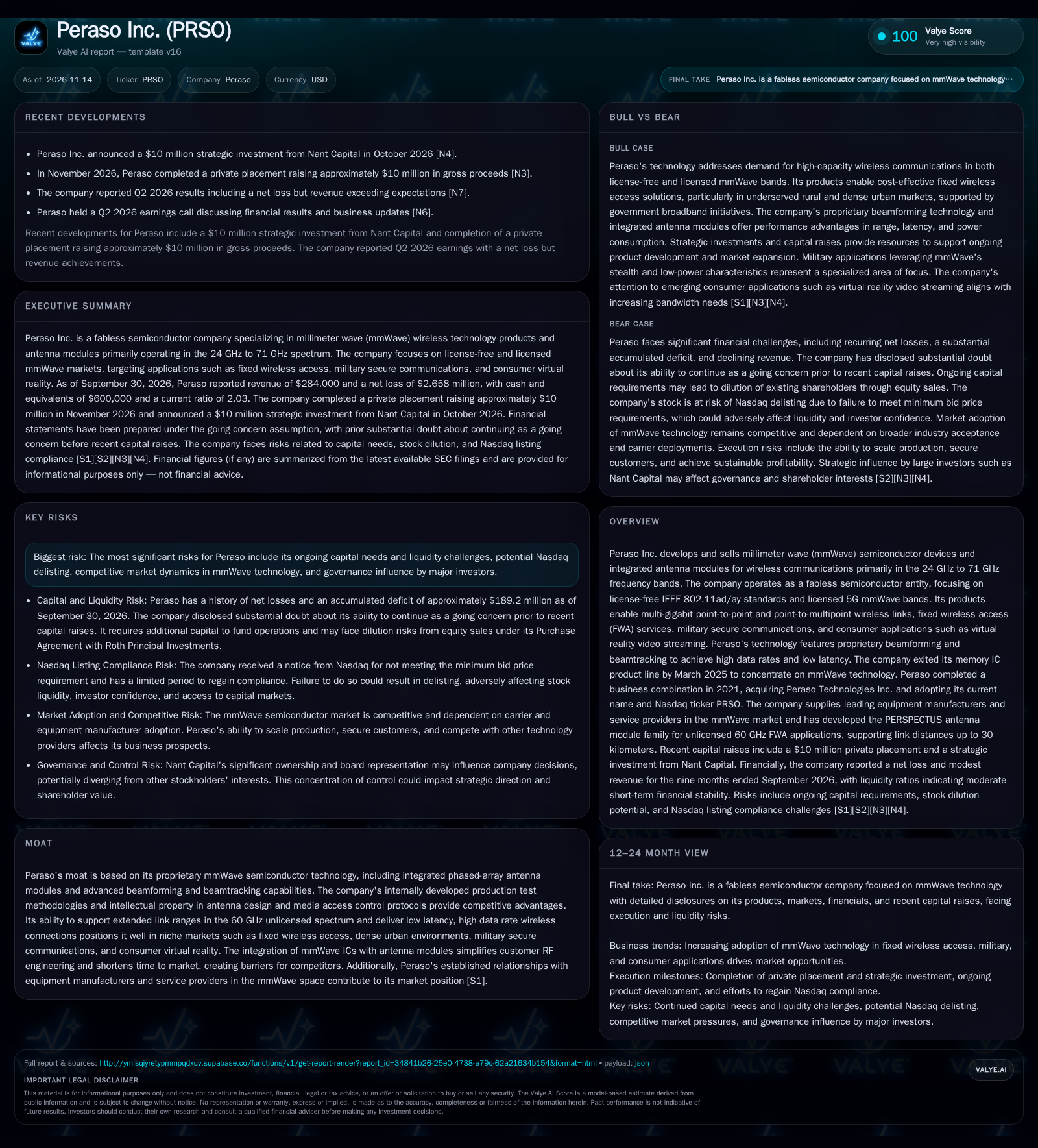
Peraso Inc. recently secured $20 million in new funding: a $10 million private placement completed in November 2026 and a $10 million strategic investment from Nant Capital in October 2026 [N3] [N4]. This follows a period of substantial financial stress, highlighted by a 73% year-over-year revenue decline for the nine months ended September 30, 2026 (to $284,000) and a net loss of $2.658 million [S2]. As of the end of Q3 2026, the company had $600,000 in cash and a current ratio of 2.03, but had previously disclosed substantial doubt about its ability to continue as a going concern [S2].
Peraso has now fully exited its memory IC product line, focusing exclusively on mmWave wireless semiconductors and antenna modules [S1]. The company’s near-term trajectory will be shaped by its ability to deploy new capital toward product development and commercial expansion, while managing dilution and governance changes as Nant Capital may become its largest shareholder and designate up to two board members [S2].
How Peraso’s mmWave Focus Could Reshape Its Revenue Model
Peraso’s business model is now centered on designing and selling mmWave integrated circuits and antenna modules for high-bandwidth wireless communications. As a fabless semiconductor company, Peraso avoids the heavy capital expenditures of chip manufacturing, but must invest in R&D, customer support, and go-to-market activities to win design slots with equipment makers and service providers.
Revenue potential in the mmWave market is highly sensitive to volume adoption in fixed wireless access (FWA) and related infrastructure. Peraso’s proprietary beamforming and beamtracking, which enable sub-5 ms latency and up to 3 Gbps data rates, may command premium pricing relative to commodity hardware in specialized applications such as rural broadband, military communications, and enterprise-grade point-to-point links [S1]. However, the company’s recent revenue collapse suggests either delayed customer adoption or competitive displacement, raising questions about pricing power and sales cycle duration.
Operating leverage could be significant if Peraso can scale design wins into production volumes, as the incremental cost of producing additional chips is low compared to the fixed costs of R&D and SG&A. However, ongoing net losses and a $189 million accumulated deficit as of Q3 2026 indicate that the company has yet to reach this inflection point [S2]. The need for recurring capital raises, and a $25 million equity purchase agreement with Roth Principal Investments, highlight persistent funding requirements and the risk of shareholder dilution [S2].
Technical Differentiation vs. Market Adoption: Can Peraso’s Moat Hold?
Peraso’s competitive premise rests on proprietary mmWave ICs, integrated phased-array antenna modules, and advanced beamforming/beamtracking technology [S1]. These features could provide meaningful advantages in latency, range, and system integration—attributes valued in fixed wireless, military, and emerging consumer VR/AR applications. The company’s ability to deliver modules supporting 30 km links in the unlicensed 60 GHz band could be especially attractive for rural broadband and WISP markets.
However, the mmWave semiconductor landscape is crowded with both established chipmakers and agile startups competing for the same design wins. Barriers to entry include technical complexity, but customer switching costs may be moderate if competitors can deliver similar performance at lower total system cost. Equipment manufacturers and carriers often require proven reliability at scale, which can favor incumbents or vertically integrated players.
Peraso’s historical relationships with equipment makers and WISPs may offer some commercial momentum, but the absence of recurring or multi-year contract disclosures leaves its customer stickiness and revenue visibility uncertain. The company’s future moat will depend on both sustained technical edge and the ability to lock in high-volume, repeat customers in targeted verticals.
From Niche to Necessary: What Could Drive a Peraso Turnaround?
A favorable scenario for Peraso hinges on translating its technical advantages into real market adoption. If the company’s beamforming-enabled modules prove to deliver superior reliability and cost per bit in rural broadband or dense urban deployments, it could secure design wins with leading wireless ISPs or network equipment providers. Government broadband subsidies—especially in underserved regions—could accelerate FWA deployments, creating a rising tide for mmWave adoption.
Military and defense communications, where Peraso’s stealth and low-power attributes are valued, could offer another high-margin vertical if procurement cycles convert to recurring orders [S1]. Emerging consumer AR/VR applications, though speculative, could provide additional upside if bandwidth and latency requirements surpass the capabilities of legacy Wi-Fi or sub-6 GHz wireless.
Confirmation of this scenario would come from sequential revenue growth, new customer announcements, or multi-year supply agreements. Gross margin expansion, R&D productivity (such as new product launches or design wins), and disclosure of repeat orders from blue-chip customers would provide further evidence of a durable turnaround.
Commercial Friction and Incremental Progress as the Default Outlook
The most plausible near-term trajectory for Peraso is one of gradual, uneven progress. The company may use its recent capital injection to stabilize operations and invest in targeted customer acquisition, but design-in cycles for infrastructure-grade wireless components are long and often require extensive validation. Incremental wins in niche FWA or military projects could offset continued weakness in legacy or commoditized segments.
Revenue is likely to remain lumpy, and persistent net losses may continue until Peraso either secures a marquee customer or demonstrates sustained growth in a specific vertical. The risk of further dilution remains, especially if the company draws on its $25 million equity facility to plug ongoing cash burn [S2].
Evidence supporting this scenario would include modest sequential revenue growth, regular but small design wins, and measured R&D spending. Falsification would be a return to cash crisis, loss of Nasdaq listing, or the absence of any identifiable commercial momentum over multiple quarters.
Dilution, Delisting, and the Perils of Prolonged Adoption Gaps
A negative outcome for Peraso could materialize if customer adoption remains slow and revenue fails to recover, forcing the company to rely heavily on dilutive equity sales. The $25 million purchase agreement with Roth Principal Investments, while providing a capital backstop, could result in significant shareholder dilution if used extensively in a weak market [S2].
Failure to regain Nasdaq minimum bid compliance would jeopardize Peraso’s listing, reducing liquidity and access to institutional capital. Persistent net losses and cash burn could quickly erode the benefit of recent capital raises, especially if new customer traction does not materialize.
Governance risk is heightened if Nant Capital, as the largest shareholder with board representation, steers company strategy in ways that do not align with broader shareholder interests. Confirmation of this downside scenario would come from continued revenue declines, high dilution rates, delisting notices, and lack of new customer or product announcements.
Milestones That Will Determine Whether Peraso’s Wireless Ambitions Pay Off
Quarterly revenue growth, especially any rebound or stabilization after the steep 2026 decline, will be critical to test whether new product focus is translating into sales traction.
Gross margin trends, if disclosed, would help assess whether proprietary technology is commanding pricing power or being commoditized.
Announcements of new design wins, strategic partnerships, or multi-year supply agreements—particularly with tier-one equipment makers or large WISPs—would indicate commercial validation.
Updates on Nasdaq compliance, including any regaining of minimum bid price or alternative listing strategies, will affect access to capital and investor confidence.
Disclosure of customer concentration or repeat orders, if provided, would clarify the durability and stickiness of Peraso’s revenue base.
Progress on R&D milestones, such as new product launches or expanded antenna/module capabilities, would demonstrate continued innovation.
Utilization of the Roth Principal Investments equity facility—frequency, pricing, and dilution impact—should be monitored for signs of capital stress.
Any changes in board composition or strategic direction following Nant Capital’s increased influence could materially affect governance and future priorities.
Disclaimer: This is research-only, informational analysis and not investment advice. It may include AI-generated interpretation and general industry context. Always verify important details using primary sources.

Comments