
Live Oak Acquisition Corp. VI: SPAC Economics, Execution Risk, and the Search for a Compelling Deal
Live Oak Acquisition Corp. The company's future now hinges entirely on its ability to source and close a value-accretive business combination within the market’s tightening SPAC window.
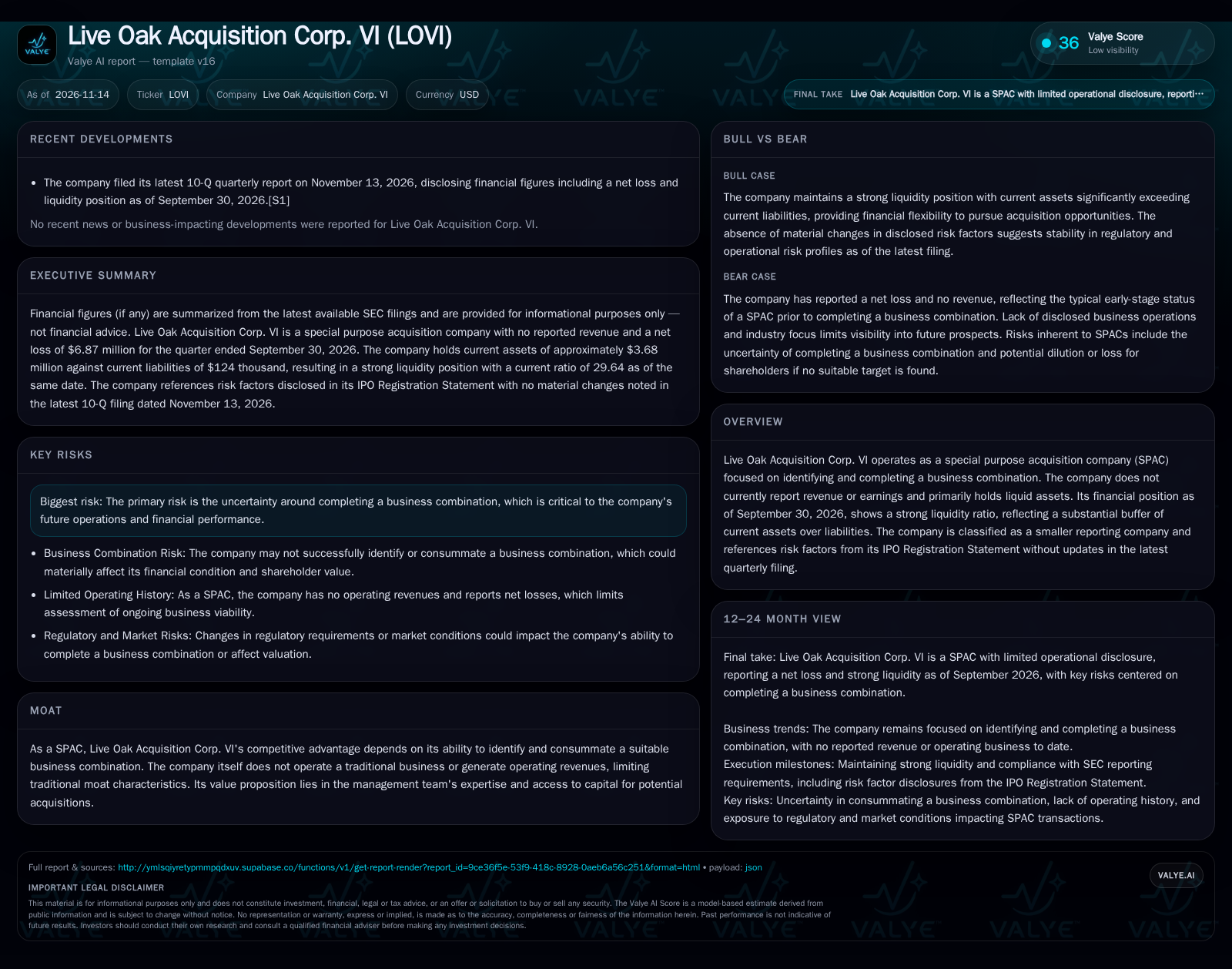
Live Oak Acquisition Corp. VI is a newly public SPAC with $3.68 million in current assets and minimal liabilities as of September 30, 2026, but no revenue or operating business to date. [S1]
Live Oak Acquisition Corp. Its future now rests entirely on sourcing and closing a compelling acquisition before regulatory and market headwinds close the opportunity. The next phase will test both the management team’s deal-making skill and the market’s appetite for new public listings via SPACs. [S1]
Liquidity Buffer and the Absence of a Target: Where the SPAC Stands Now
Live Oak Acquisition Corp. VI completed its IPO in late September 2026, raising $230 million through the sale of 23 million units at $10 each and simultaneously selling 4.6 million private placement warrants. These proceeds were placed into a trust account, reserved for the eventual acquisition of a target company.As of September 30, 2026, the company reported $3.68 million in current assets and $124,178 in current liabilities, resulting in an unusually reported current ratio of 29.64. However, the company disclosed no revenue and a net loss of $6.87 million for the quarter, reflecting typical SPAC operating expenses prior to a deal. No business combination, target industry, or acquisition timeline has been announced, leaving the company in a pre-deal, capital-holding phase. [S1]
SPAC Economics: Trust Structure, Cost Burn, and the Mechanics of Value Creation
The economic model of a SPAC like Live Oak Acquisition Corp. VI is highly binary and event-driven. The trust account, initially funded with $230 million, is intended to be preserved in low-risk instruments until a business combination is identified. The company incurs ongoing administrative, legal, and diligence costs, which are typically covered by interest income or sponsor contributions until a deal is closed. The lack of revenue is by design, but net losses accrue as professional fees and compliance costs mount during the search period.
Value creation for public shareholders depends on the management team’s ability to source and negotiate a deal with a private operating company that possesses significant growth or profitability prospects. If a deal is consummated, the SPAC may convert into an operating company, with the economics determined by the acquired entity’s business model, capital structure, and future performance. If no deal is completed within the regulatory timeframe—often 24 to 36 months post-IPO—remaining funds in the trust are returned to shareholders, typically at or near the initial $10 per unit, with little or no upside. The primary capital at risk is the sponsor’s at-risk capital (warrants and founder shares), which may be rendered worthless if no deal is completed.
The trust structure inherently aligns public shareholders' interests with capital preservation until a viable deal emerges, but it also imposes a rigid timeline that can compress due diligence and negotiation processes. This temporal constraint may force the SPAC to weigh the trade-off between deal quality and deadline-driven execution, potentially leading to suboptimal transactions or increased dilution to attract investor support. Moreover, the sponsor’s incentive alignment through warrants and founder shares introduces a risk of misaligned motivations, where sponsors might prioritize deal completion over maximizing shareholder value. Understanding these dynamics is crucial to evaluating the SPAC’s potential to generate meaningful returns beyond the trust's nominal value.
Execution as the Only Moat: The Role of Sponsor Reputation in SPAC Sourcing
Unlike operating companies, SPACs do not benefit from product moats, recurring revenue, or established customer relationships. The only competitive differentiator is the management team’s track record, network, and reputation in sourcing attractive targets and executing deals. In a crowded SPAC market with heightened regulatory scrutiny and a shrinking pool of high-quality targets, sponsor reputation, deal sourcing relationships, and negotiation skill become decisive.
Competing SPACs, private equity funds, and direct IPOs all vie for the same universe of acquisition candidates. As the post-2021 SPAC cycle matured, many high-profile deals faced valuation resets or failed to close, increasing skepticism among target companies and investors. This environment raises the bar for Live Oak Acquisition Corp. VI: the company must not only find a willing target, but must do so on terms that create value for public shareholders and withstand post-merger scrutiny.
In addition to reputation, the sponsor’s ability to differentiate its deal sourcing approach can be a pivotal factor. This may involve leveraging proprietary industry insights, access to niche sectors, or specialized operational expertise that enhances deal evaluation and post-merger integration. The scarcity of high-quality targets amplifies the importance of these capabilities, as does the need to structure deals that can withstand heightened investor and regulatory scrutiny. Furthermore, the sponsor’s capacity to mobilize PIPE investors and strategic partners can materially affect the transaction’s financial robustness and market reception, thereby influencing the ultimate success of the business combination.
Unlocking Value Through a High-Quality Business Combination
The positive scenario for Live Oak Acquisition Corp. VI is predicated on successfully identifying a private company with strong growth prospects, credible management, and a clear path to profitability. If the SPAC team can leverage its network and reputation to source a differentiated target—potentially in a sector with secular tailwinds or limited public comparables—the resulting merger could unlock significant value for shareholders.
Evidence supporting this scenario would include the announcement of a definitive merger agreement with a well-regarded target, positive market reaction, and the disclosure of favorable transaction terms (such as minimal dilution, high redemption rates, or strong PIPE participation). Further validation would come from post-merger operational performance that meets or exceeds projections, supporting the rationale for the public listing.
A compelling deal may also unlock strategic benefits beyond immediate financial metrics, such as entry into high-growth markets, technology acquisition, or operational synergies that enhance competitive positioning. If the target company exhibits scalable business models with recurring revenue streams or defensible market niches, the merged entity could attract long-term investor interest and command premium valuations. Additionally, the SPAC’s ability to structure earnouts or performance-based incentives can align management incentives post-merger, mitigating execution risk and fostering sustainable growth. These factors collectively contribute to transforming the SPAC from a financial vehicle into a viable operating company with durable shareholder value.
The Most Likely Path: Prolonged Search and Heightened Deal Scrutiny
The most plausible outcome is that Live Oak Acquisition Corp. VI will spend the coming quarters searching for and negotiating with potential targets, incurring ongoing expenses and gradually drawing down non-trust cash. Given the tightening market for SPAC deals, increased regulatory oversight, and a more skeptical investor base, any proposed business combination will likely face intense scrutiny regarding valuation, management quality, and post-merger growth prospects.
This scenario would be confirmed by a series of extensions, incremental updates on the search process, or the announcement of a deal that is ultimately met with tepid market response or high redemption rates. Falsification would come from either a rapid, high-quality deal announcement or from the company failing to secure a target and dissolving before the regulatory deadline.
The protracted search and heightened scrutiny scenario may also result in increased opportunity costs, as capital remains tied up in the trust without generating returns. This environment could pressure the sponsor to consider less attractive targets or accept unfavorable deal terms to avoid liquidation, potentially diluting shareholder value. Regulatory developments or shifts in market sentiment could further complicate deal execution, requiring more extensive disclosures, governance enhancements, or investor protections that lengthen timelines and increase costs. Monitoring these evolving conditions is essential to assess whether the SPAC can adapt its strategy effectively to navigate the complex deal-making landscape.
Deal Failure, Liquidation, and Shareholder Value Erosion
The adverse scenario centers on the company’s inability to source or close a business combination within the regulatory window. In this outcome, ongoing costs erode the trust balance, and shareholders ultimately receive only their pro rata share of the remaining trust assets—typically close to, but potentially below, the $10 per share IPO price—while warrants and founder shares expire worthless.
Downside evidence would include repeated extensions without substantive deal progress, announcements of failed negotiations or terminated agreements, or a formal notice of liquidation. Additional risk factors include changes in market conditions that depress target valuations, regulatory changes that increase compliance burdens, or sponsor fatigue leading to diminished search intensity.
Milestones That Will Determine Whether Live Oak Acquisition Corp. VI Delivers Shareholder Value
Announcement of a signed letter of intent or definitive agreement with a credible private company, including initial transaction terms and sector focus.
Shareholder redemption rates at the time of a proposed merger, if disclosed, as a proxy for market confidence in the transaction.
PIPE (private investment in public equity) participation, size, and terms, as these indicate third-party validation of the deal.
Rate of trust account depletion due to ongoing expenses, and any changes in the company’s stated cash position outside the trust.
Any requests for extensions of the SPAC’s operating window, including rationale and shareholder vote outcomes.
Updates on regulatory changes affecting SPAC mergers, especially SEC rule changes or Nasdaq listing requirements.
Sponsor or management team changes, as these could affect deal sourcing capability and market perception.
Public communication regarding the SPAC’s acquisition criteria, target sector, or geographic focus, if disclosed.
Disclaimer: This is research-only, informational analysis and not investment advice. It may include AI-generated interpretation and general industry context. Always verify important details using primary sources.

Comments