
Vine Hill Capital Investment Corp. II: SPAC Experience Meets the Clock on Sourcing a $500M+ Deal
Vine Hill Capital Investment Corp. II (VHCP) enters the high-stakes SPAC market with a $230 million IPO war chest, an experienced leadership team, and a mandate to secure a substantial business combination within two years. The company’s fate now hinges on sourcing, executing, and integrating a $500M+ acquisition before the window closes.
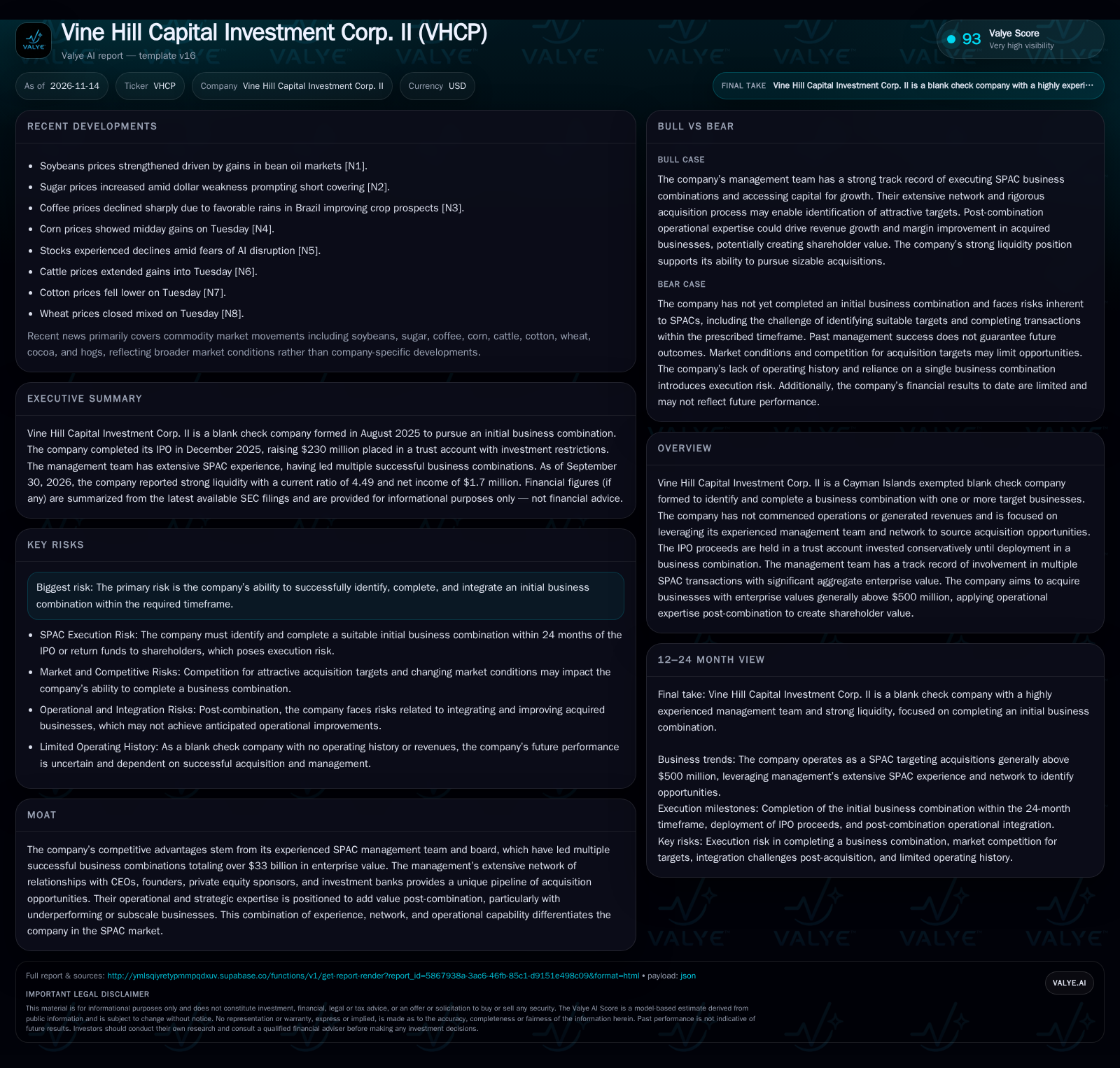
VHCP is a Cayman-based SPAC with $230 million in trust and a management team experienced in large-scale SPAC transactions. With no current operations or revenues, its sole focus is effecting a $500M+ acquisition within 24 months post-IPO. Success rides on identifying the right target and executing a transaction before the deadline, leveraging its deep SPAC and M&A expertise.
Vine Hill Capital Investment Corp. II (VHCP) exemplifies the modern special purpose acquisition company: a blank-check entity with no operations, a substantial pool of capital locked in trust, and a seasoned team with deep SPAC and M&A credentials. Having raised $230 million in December 2025, VHCP now faces the classic SPAC challenge—sourcing and closing a transformative $500M+ acquisition before its two-year clock runs out. The company’s future—and investor returns—will depend on management’s ability to leverage its network, execute a disciplined acquisition process, and deliver post-merger operational value.
Where VHCP Stands: Capital, Timeline, and Management Track Record
VHCP is a newly formed Cayman Islands SPAC with no operations or revenues as of September 30, 2026; all activities to date relate to its formation, IPO, and preparation for a business combination [S2]. The company completed its $230 million IPO in December 2025, with all proceeds held in a trust account invested in government securities or money market funds that cannot be released except for an approved acquisition or shareholder redemption [S1].
The management team, led by CEO Nicholas Petruska and CFO Daniel Zlotnitsky, brings a notable track record, having participated in 11 SPAC business combinations totaling $33.2 billion in enterprise value [S1]. The board and advisors include individuals with deep investment banking, M&A, and private equity experience. The company reported cash and liquidity metrics for the period; these figures do not by themselves establish operating runway, investment capacity, financial flexibility, or financing capacity. [S2]
The core operational mandate is clear: identify and close a business combination with an enterprise value of $500 million or greater within 24 months of the IPO, or otherwise return funds to shareholders [S1].
The Economics of the Blank-Check Model: Trust, Dilution, and Incentive Alignment
The SPAC business model is simple in its early phase: raise capital via an IPO, invest proceeds in low-risk instruments, and seek a private company to merge with. VHCP’s $230 million trust functions as both acquisition currency and a guarantee to public shareholders—redeemable if a suitable deal does not materialize. The trust earns modest investment income but generates no operating revenues prior to acquisition [S2].
Upon executing a business combination, the economic equation changes dramatically. VHCP may issue additional shares, use debt, or a combination thereof to finance a larger transaction. This can create meaningful dilution for existing shareholders, especially if anti-dilution provisions trigger a greater conversion of founder shares or if redemptions reduce the public float. The company’s structure gives sponsors and management a significant equity stake if a deal succeeds, aligning their upside with that of new shareholders but also incentivizing deal completion even if target quality is uncertain.
SPACs face fixed costs (legal, accounting, sponsor expenses) during the search phase, but true operating leverage only emerges post-merger. The success of the business combination will ultimately hinge on the acquired company’s ability to generate cash flow, scale efficiently, and justify the valuation paid. If the acquisition underperforms, the initially reported balance sheet position can quickly erode.
How VHCP Competes for Deals in a Crowded SPAC Arena
The SPAC landscape is intensely competitive, with dozens of blank-check companies vying for a limited pool of high-quality targets. VHCP’s principal advantage is its leadership’s extensive SPAC and M&A pedigree—having executed multiple high-value deals, management is likely to have deep relationships with private equity, investment banks, and company founders [S1]. This network may help generate proprietary deal flow and access off-market transactions.
However, VHCP also faces counterforces: many private companies now have alternative routes to liquidity, including traditional IPOs, direct listings, or strategic sales. Competition among SPACs can drive up valuations, eroding the potential for post-merger value creation. The market has also become more discerning, with investors scrutinizing deal quality and sponsor incentives more closely than in earlier SPAC cycles.
The company’s focus on sectors "complementary to management’s background" may help in sourcing and integration, but it also narrows the universe of potential targets. Ultimately, VHCP’s ability to differentiate itself will depend on the credibility of its acquisition process, speed in execution, and the operational support it can offer post-merger.
What a Successful SPAC Outcome Looks Like for VHCP
The favorable scenario for VHCP is one where its network yields access to a high-quality private company seeking public capital or strategic partnership. If management identifies a $500M+ target with strong growth prospects, robust cash flow, and scalable operations, the deal could attract minimal shareholder redemptions, ensuring ample cash for the combined entity.
Post-merger, the operational expertise of VHCP’s team could drive value through cost efficiencies, improved governance, or accelerated growth initiatives. Success would be marked by strong aftermarket performance, positive analyst coverage, and the potential for additional capital raises or strategic add-ons. Confirmation of this scenario would come from a definitive merger announcement with a credible, growth-oriented target, low redemption rates, and evidence of management involvement in post-merger integration.
Most Likely Trajectory: A Competitive Search and a Conventional SPAC Deal
The most plausible outcome is that VHCP, leveraging its reputation and contacts, identifies a viable target within the prescribed 24-month window. The deal is likely to face some shareholder redemptions, resulting in a smaller cash pool for the merger but still sufficient to close the transaction.
The acquired company is solid but not a standout outlier, and the post-merger entity faces typical integration challenges. The market response is muted, with shares trading near trust value, reflecting skepticism about long-term upside but limited downside due to the redemption safety net. Evidence supporting this scenario would be a merger announcement with a target in a sector familiar to management, average redemption levels, and standard post-merger financial projections.
When the SPAC Clock Runs Out: Risks of Deal Failure or Value Erosion
The principal risk is failure to identify and close a suitable business combination within the 24-month deadline. In that case, VHCP would be required to return trust funds to shareholders, with investors receiving their pro-rata share and the sponsors forfeiting their at-risk capital and founder equity. This outcome results in no return for sponsors and only modest interest income for public shareholders.
Alternatively, a rushed or suboptimal deal—driven by time pressure or competitive bidding—could lead to overpaying for a weak target. High redemption rates might strip the transaction of cash, leaving the merged company undercapitalized. If the post-merger business underperforms or faces integration difficulties, shares could trade below trust value, eroding investor confidence and limiting access to future capital. Signs of this scenario would include repeated deadline extensions, a last-minute deal announcement, high redemptions, or weak post-merger financial results.
Milestones That Will Determine VHCP’s SPAC Outcome
Announcement of a definitive business combination agreement, including sector, target profile, and transaction structure.
Shareholder redemption rates at the time of deal vote—if disclosed—which will indicate market confidence and available capital for the merger.
Details on use of additional financing (PIPEs, debt, or sponsor backstops) to supplement trust proceeds, if any.
Management’s ongoing involvement in the post-merger entity—disclosures around board seats, operational roles, or earn-outs would help test alignment.
Projected financials and growth targets for the target company, including whether they are supported by due diligence and third-party validation.
Market reaction to the merger announcement and post-merger trading activity relative to trust value.
Any extensions, amendments, or changes to the SPAC’s timeline or structure that might signal difficulty in closing a deal.
If disclosed, sponsor and insider purchases or sales of shares/warrants around the business combination window.
Disclaimer: This is research-only, informational analysis and not investment advice. It may include AI-generated interpretation and general industry context. Always verify important details using primary sources.

Comments