
Identiv, Inc.: reported balance sheet position, Leadership Realignment, and the Challenge of Scaling Digital ID in Healthcare
Identiv’s reported liquidity position and leadership with healthcare and tech expertise position it for strategic moves in digital identification, but limited revenue disclosure and modest profitability raise questions about scalability and durable competitive advantage.
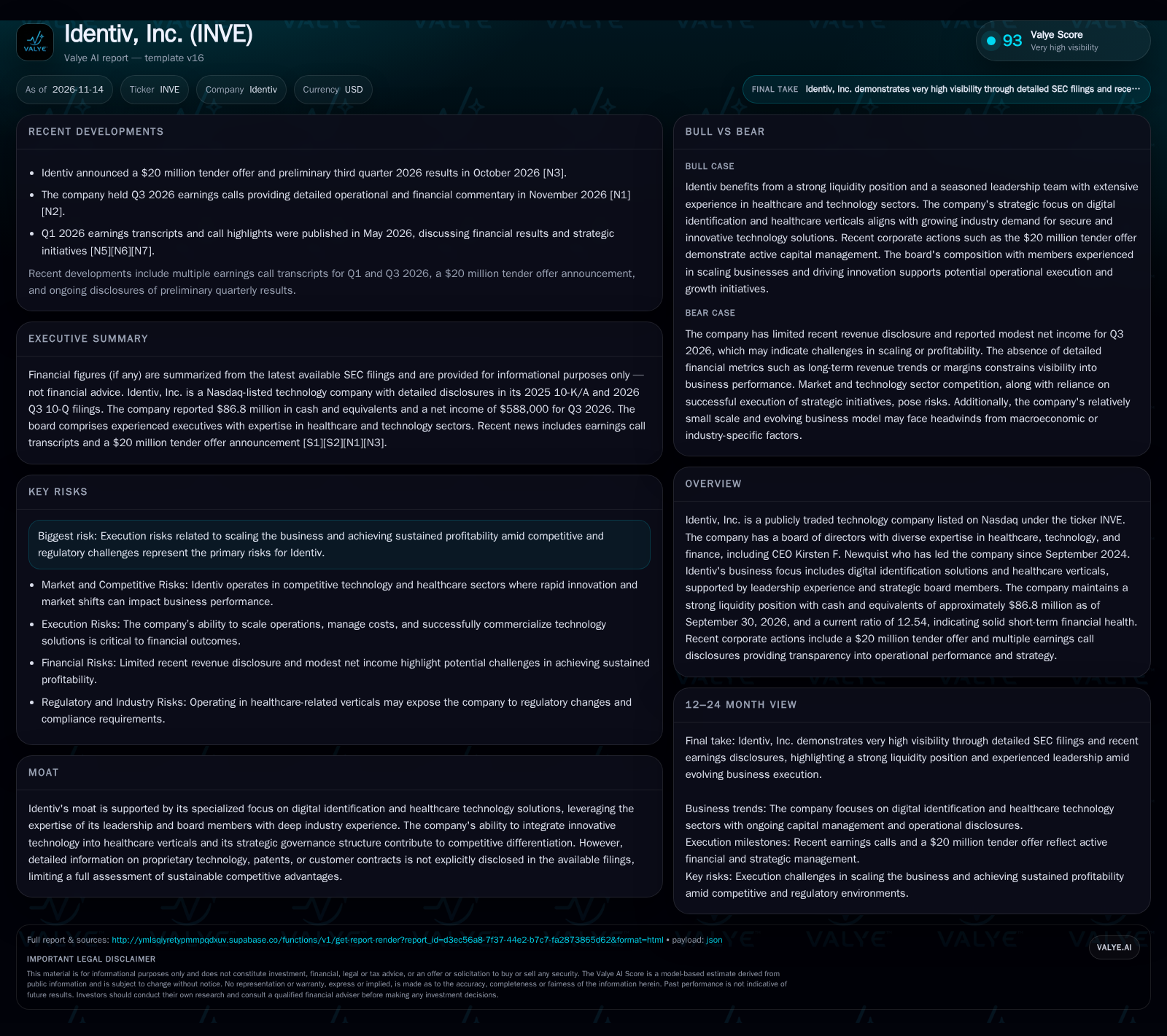
Identiv, Inc. (Nasdaq: INVE) holds a reported liquidity position with $86.8 million in cash as of September 30, 2026, and a current ratio of 12.54. The company is led by a new CEO with healthcare and tech experience and is focusing on digital identification solutions in healthcare verticals. Despite this, revenue transparency is limited and net income remains modest, suggesting scaling and profitability are unresolved challenges. A $20 million tender offer signals active capital management but does not clarify long-term growth or margin potential. Real progress will hinge on Identiv’s ability to translate strategic positioning into recurring, defensible revenue streams. [S1] [S2] [N1] [N3]
Identiv, Inc. enters late 2026 with a rare combination of financial solidity and a leadership team tailored for technology-driven healthcare solutions. With a new CEO and board bringing sector-specific expertise, Identiv is actively repositioning itself toward digital identification opportunities in healthcare—a segment with rising regulatory demands and digital transformation tailwinds. However, limited disclosure on current revenue scale and only modest net income for Q3 2026 leave open questions about the company’s ability to achieve sustainable, scalable profitability. The recently announced $20 million tender offer signals shareholder engagement, but long-term value creation will ultimately depend on Identiv’s execution in converting its strategic positioning and capital resources into sticky, growing revenue streams. [S1] [S2] [N1] [N3]
Recent Financial Strength and Strategic Actions Define Identiv’s 2026 Backdrop
As of September 30, 2026, Identiv reported $86.8 million in cash and equivalents, with current assets of $88.5 million against current liabilities of $7.1 million, resulting in a current ratio of 12.54 and a cash ratio of 12.3 [S2]. This points to a balance sheet with reported liquidity position and minimal immediate financial strain. Q3 2026 saw net income of $588,000 and EPS of $0.02, a modest profit that does not yet signal robust earnings power [S2]. Leadership is now under CEO Kirsten F. Newquist, whose healthcare and technology background aligns with the company’s stated sector focus since September 2024 [S1]. Notably, Identiv initiated a $20 million tender offer in October 2026, reflecting active capital management and a willingness to return capital or restructure the shareholder base [N3]. However, recent filings provide limited visibility into top-line trends, with the last concrete revenue figure dating to Q2 2018. These facts frame Identiv as a financially secure but operationally opaque technology company with a renewed focus on digital ID and healthcare.
How Identiv Could Monetize Digital Identification in Healthcare
Identiv’s commercial model appears oriented around digital identification solutions and healthcare technology, likely involving a mix of hardware (e.g., secure readers, sensors) and software (authentication platforms, compliance tools). In the healthcare vertical, customers may include hospitals, clinics, and device manufacturers that require secure access control, patient identification, or regulatory compliance. If Identiv’s offerings are integrated into clinical workflows or device ecosystems, the company could pursue recurring revenue via software subscriptions, service contracts, or maintenance fees, while hardware sales may be more transactional and lower margin. The cost structure in this sector is typically characterized by high R&D and SG&A as a percentage of revenue, especially for smaller players, with gross margins dependent on the software-to-hardware mix. Operating leverage could be substantial if Identiv can shift toward higher-margin, recurring software and service revenue, but this transition often requires significant upfront investment in product development and customer acquisition. The company reported cash and liquidity metrics for the period; these figures do not by themselves establish operating runway, investment capacity, financial flexibility, or financing capacity.
Assessing Identiv’s Potential Moat in a Fragmented and Regulated Landscape
Identiv competes in sectors where digital identity, security, and healthcare intersect—markets characterized by rapid innovation, regulatory complexity, and the need for trust and reliability. While the company’s board and CEO bring relevant expertise, there is no explicit evidence of proprietary technology, patented platforms, or major customer contracts in recent disclosures. In digital ID, competitors range from large industrials and IT security firms to specialized healthcare technology vendors. Healthcare customers are notoriously sticky once integrated, but breaking into hospital or clinical workflows can be slow and costly. Regulatory barriers may provide some defensibility if Identiv’s solutions address compliance pain points, but they also raise execution and cost risks. Without evidence of a dominant platform, network effects, or irreplaceable IP, Identiv’s moat likely hinges on execution, customer relationships, and the ability to tailor solutions to evolving regulatory requirements. The question is whether the company can achieve critical mass in its chosen verticals before larger or more specialized players crowd out its offerings.
A Pathway to Growth: Recurring Revenue and Healthcare Sector Entrenchment
In a favorable scenario, Identiv successfully leverages its leadership’s healthcare and technology expertise to win key contracts in the digital ID space, especially in hospital and clinical settings. If the company’s products become embedded in critical workflows or compliance regimes, switching costs could rise, supporting recurring revenue streams from software subscriptions, service agreements, or bundled solutions. Evidence for this scenario would include disclosure of multi-year contracts, rising deferred revenue, improved gross margins indicating a software/service mix shift, and accelerating top-line growth. Strategic partnerships with healthcare providers or device manufacturers, as well as regulatory certifications or endorsements, would further confirm Identiv’s entrenchment. If recurring revenue outpaces hardware sales and operating leverage materializes, the company could achieve sustainable profitability and justify further investment or strategic acquisition interest.
Incremental Progress Amid Ongoing Execution Hurdles
The most plausible trajectory is one of gradual operational improvement but continued volatility in revenue and earnings. The company may achieve modest growth through targeted wins in healthcare or digital ID, but is likely to face pricing pressure, slow customer adoption, and competitive encroachment from larger players. Confirmation of this scenario would include continued modest profitability, episodic contract announcements, and incremental improvements in operating metrics without a clear shift toward high-margin, recurring revenue. Persistent lack of disclosure on customer concentration, backlog, or unit economics would reinforce the sense that Identiv is still searching for a scalable, defensible economic engine.
If Revenue Stagnates and Competitive Pressures Mount
The primary risk is that Identiv’s recent profitability proves unsustainable, with limited revenue growth and rising costs as the company attempts to scale in competitive, regulated markets. If customer adoption is slow, sales cycles lengthen, or competitors offer better-integrated or lower-cost solutions, Identiv may struggle to achieve meaningful top-line expansion. A continued lack of transparency on revenue, margin trends, or contract wins would suggest the company is unable to convert its strategic positioning and capital base into durable revenue streams. Regulatory setbacks or integration failures in healthcare could further exacerbate operational challenges.
Milestones That Will Reveal Identiv’s Ability to Scale and Sustain Profitable Growth
Quarterly revenue disclosures—especially sequential growth or segment breakdowns—would clarify whether Identiv is gaining traction in its target verticals.
Gross margin trends, if disclosed, would reveal the company’s success in shifting toward higher-margin, recurring software or service revenue.
Announcement of multi-year contracts, major healthcare customer wins, or strategic partnerships would signal entrenchment and potential switching costs.
Deferred revenue balances and backlog figures, if reported, would help assess visibility and durability of future revenue streams.
Operating expense trends and R&D investment levels would indicate whether Identiv is scaling efficiently or facing cost pressure.
Evidence of regulatory approvals, certifications, or compliance milestones in healthcare verticals would support the company’s value proposition.
Any updates on capital allocation—further tender offers, share repurchases, or investments—would provide insight into management’s confidence and strategic priorities.
Customer concentration risk disclosures, if available, would help gauge revenue stability and potential vulnerability to contract losses.
Disclaimer: This is research-only, informational analysis and not investment advice. It may include AI-generated interpretation and general industry context. Always verify important details using primary sources.

Comments