
Origin Investment Corp I: SPAC Execution Window, Sector Focus, and the Challenge of Value Creation Pre-Combination
Origin Investment Corp I is a Cayman Islands SPAC with $69.7 million in trust, targeting Asian growth companies across technology, biotech, and clean energy. With no operating revenue and no target identified as of late 2026, the company’s success now hinges on sourcing a credible acquisition before regulatory deadlines and market conditions shift.
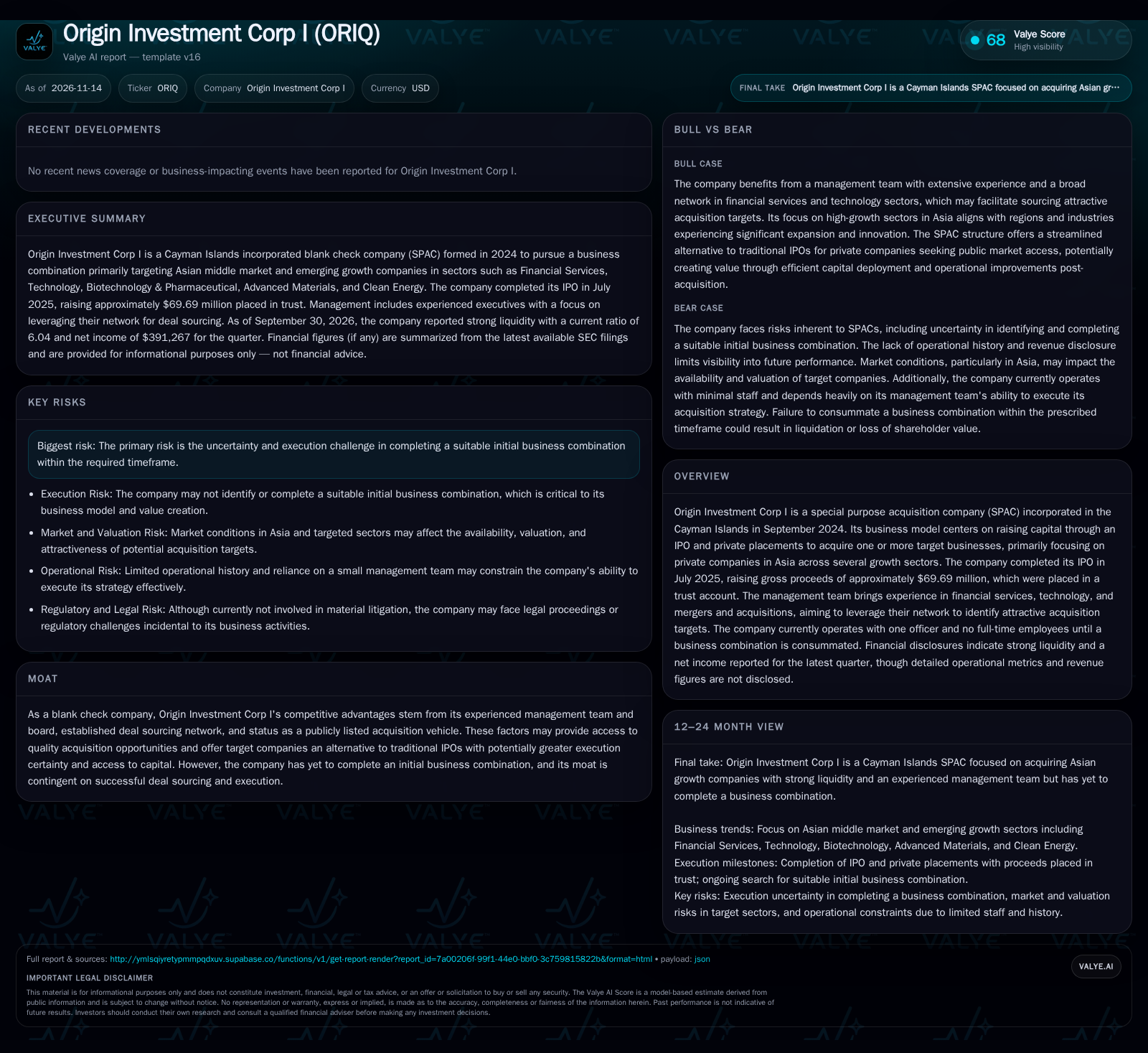
Origin Investment Corp I is a blank check company with $69.7 million in trust from its 2025 IPO, seeking to merge with an Asian middle-market or emerging growth business. As of September 2026, it has not entered substantive acquisition talks or generated operating revenue. The thesis now centers on whether the management team can source and execute a value-accretive deal before regulatory timelines expire and market conditions evolve. [S2]
Origin Investment Corp I stands at a crossroads familiar to many SPACs: flush with $69.7 million in trust and a mandate to acquire an Asian growth company, it has yet to identify or engage with a target as of September 2026. The company’s future now depends on its management’s ability to source and execute a compelling transaction before the regulatory window closes. With no operating revenue and significant competition for quality targets, the next year will determine whether Origin Investment Corp I can transition from a cash shell to a value-creating public entity—or risk delisting and liquidation.
Where Origin Investment Corp I Stands: Trust, Timelines, and the Absence of a Deal
As of September 30, 2026, Origin Investment Corp I has placed approximately $69.7 million—raised through its July 2025 IPO and sponsor private placement—into a trust account, which remains untouched except for interest income. The company’s financials reflect this static phase: net income of $391,267 for the quarter was derived solely from interest on trust assets, with no operating revenue generated. Critically, the company has not yet selected or initiated substantive discussions with any business combination target. The clock is ticking on its regulatory window: under Nasdaq rules, Origin Investment Corp I must complete a business combination within 36 months of IPO or face suspension of trading and delisting, which would likely trigger liquidation and capital return to shareholders. [S2]
SPAC Economics: Trust, Sponsor Incentives, and the Dilution Equation
Origin Investment Corp I’s business model is typical of SPACs: it raises capital in exchange for units (shares and warrants), holds the proceeds in trust, and seeks to merge with a private company—typically one that values the speed and certainty of a SPAC transaction over a traditional IPO. Until an acquisition is completed, the company generates no operating revenue; its only income comes from interest on the trust (which is returned to shareholders if no deal is completed).
The economics for public shareholders are highly contingent. If the SPAC finds an attractive target and negotiates favorable terms, shareholders may benefit from equity appreciation and warrant value. However, the structure also embeds dilution from sponsor shares and warrants, which are designed to compensate the management team for successful deal execution but can erode returns for public holders if a 'bad deal' is struck or if the post-merger company underperforms.
Sponsor incentives are asymmetric: the sponsor’s return is highly leveraged to deal completion, incentivizing a transaction even in less-than-ideal markets. This can create misalignment with public shareholders, particularly if market conditions deteriorate or if the best available target is marginal. The trust structure ensures capital preservation in most cases, but opportunity cost mounts as the SPAC nears its deadline without a deal.
Operating leverage, capital needs, and post-merger economics are entirely contingent on the target business’s profile—none of which is visible or analyzable until a letter of intent or definitive agreement is announced.
Competing for Asian Growth: SPAC Crowding, Direct Listings, and Target Scarcity
Origin Investment Corp I’s stated focus on Asian middle-market and emerging growth companies in sectors like technology, biotech, advanced materials, and clean energy places it in a crowded field. Numerous SPACs and private equity funds are competing for similar targets, many of which now have increased access to direct IPOs, private rounds, or strategic acquirers.
The company’s potential advantage lies in its management team’s Asia-focused network and sector experience, which could help source proprietary or under-the-radar deals. However, the market for high-quality targets has become more competitive, and regulatory scrutiny—both in the U.S. and in key Asian markets—has increased. SPACs are also facing more skepticism from both targets and investors, given the variable post-merger performance of recent deals.
Relevant peers include other Asia-focused SPACs, late-stage venture and growth equity funds, and cross-border M&A consortia. The competitive landscape is fluid, and the relative attractiveness of a SPAC transaction to a target company depends on both market sentiment and the perceived value-add of the sponsor team.
If a High-Quality Asian Growth Target Emerges: How Origin Investment Corp I Could Unlock Value
The optimal outcome for Origin Investment Corp I would be the identification and successful merger with a high-growth, cash-generative Asian company—ideally in technology, biotech, or clean energy—seeking a public listing and expansion capital. In this scenario, the management’s regional expertise and network translate into sourcing a proprietary deal, negotiating favorable terms, and attracting additional PIPE (private investment in public equity) financing to support the transaction.
This pathway could lead to strong post-deal performance if the acquired company demonstrates clear revenue growth, operating leverage, and robust free cash flow. Public shareholders would benefit both from the return of capital certainty up to the deal vote and from potential upside if the combined entity is well-received by the market.
Confirmation would come in the form of a definitive agreement with a credible, growth-oriented target, favorable deal terms (limited dilution, strong PIPE participation, and sponsor alignment), and positive market reaction at deal announcement and closing. Falsification would be a lack of deal progress, an unattractive or highly dilutive transaction, or negative market response to the announced target.
Most Likely Outcome: Protracted Search, Heightened Competition, and the Pressure of the SPAC Clock
The most plausible scenario is that Origin Investment Corp I continues its search for a target into 2027, facing intensifying competition from other SPACs and direct capital markets options for Asian growth companies. The management team may enter negotiations with one or more potential targets, but deal terms could be less favorable due to market conditions, regulatory hurdles, or target company leverage.
This scenario might result in a business combination with a less differentiated or later-stage company, with higher dilution or limited PIPE participation. Shareholder redemptions could be high if the market does not perceive incremental value, and post-merger performance would be uncertain. Alternatively, if no suitable target is found, the SPAC could be forced to liquidate and return capital.
Evidence supporting this scenario would include public signals of target engagement, LOIs, or deal rumors, but also persistent delays or extensions. Confirmation would be the announcement of a deal with middling market reaction, high redemption rates, or a transaction at the outer edge of the SPAC’s regulatory window. Falsification would be either a rapid, high-quality transaction or a clear, early liquidation announcement.
When the Clock Runs Out: Liquidation Risk and the Impact of Market Deterioration
If Origin Investment Corp I fails to identify and close a business combination before the 36-month Nasdaq deadline, it will be required to liquidate, returning trust capital (minus expenses) to shareholders. This scenario could result from an inability to source credible targets, adverse market or regulatory developments in Asia, or shifting investor sentiment that makes a deal unattractive or infeasible.
Even before liquidation, the risk of value erosion is real: sponsor incentives may drive pursuit of a weak or highly dilutive deal, or the market may react negatively to any perceived 'last-minute' transaction. High redemption rates could further shrink the deal’s effective capital base, limiting its appeal to targets and eroding the post-merger company’s financial profile.
Confirmation of this scenario would be persistent lack of deal progress, repeated deadline extensions, or a formal announcement of liquidation. Falsification would require clear evidence of a credible and market-supported transaction well ahead of regulatory deadlines.
Milestones That Will Define Origin Investment Corp I’s Next Chapter
Announcement of a letter of intent (LOI) or definitive agreement with a target company—especially one with strong growth and cash flow in the stated sectors.
Level of PIPE commitments or strategic co-investment at deal announcement, which would signal external validation and deal structure strength.
Shareholder redemption rates at the time of the business combination vote, as high redemptions would indicate low confidence or poor deal quality.
Sponsor and management team’s participation in the post-merger entity (rollover, additional investment, or lock-up terms) to test alignment.
Regulatory and disclosure developments in both the U.S. and Asia that could affect cross-border deal feasibility or timing.
Progress toward the 36-month Nasdaq deadline, including any requests for deadline extensions or signals of potential liquidation.
If disclosed, the target’s historical and projected revenue, EBITDA, and free cash flow metrics, to assess the economics of the potential combination.
Market reaction (trading volume, price movement, analyst commentary) at deal announcement and closing, which would help test the market’s confidence in the transaction.
Disclaimer: This is research-only, informational analysis and not investment advice. It may include AI-generated interpretation and general industry context. Always verify important details using primary sources.

Comments