
United Acquisition Corp. I: SPAC Clock Ticks as Sourcing Pressure Mounts Ahead of Business Combination Deadline
With $100 million in trust and a 24-month window to secure a deal, United Acquisition Corp. I faces the classic SPAC challenge: leveraging management’s network and capital base to identify a compelling acquisition target before time runs out.
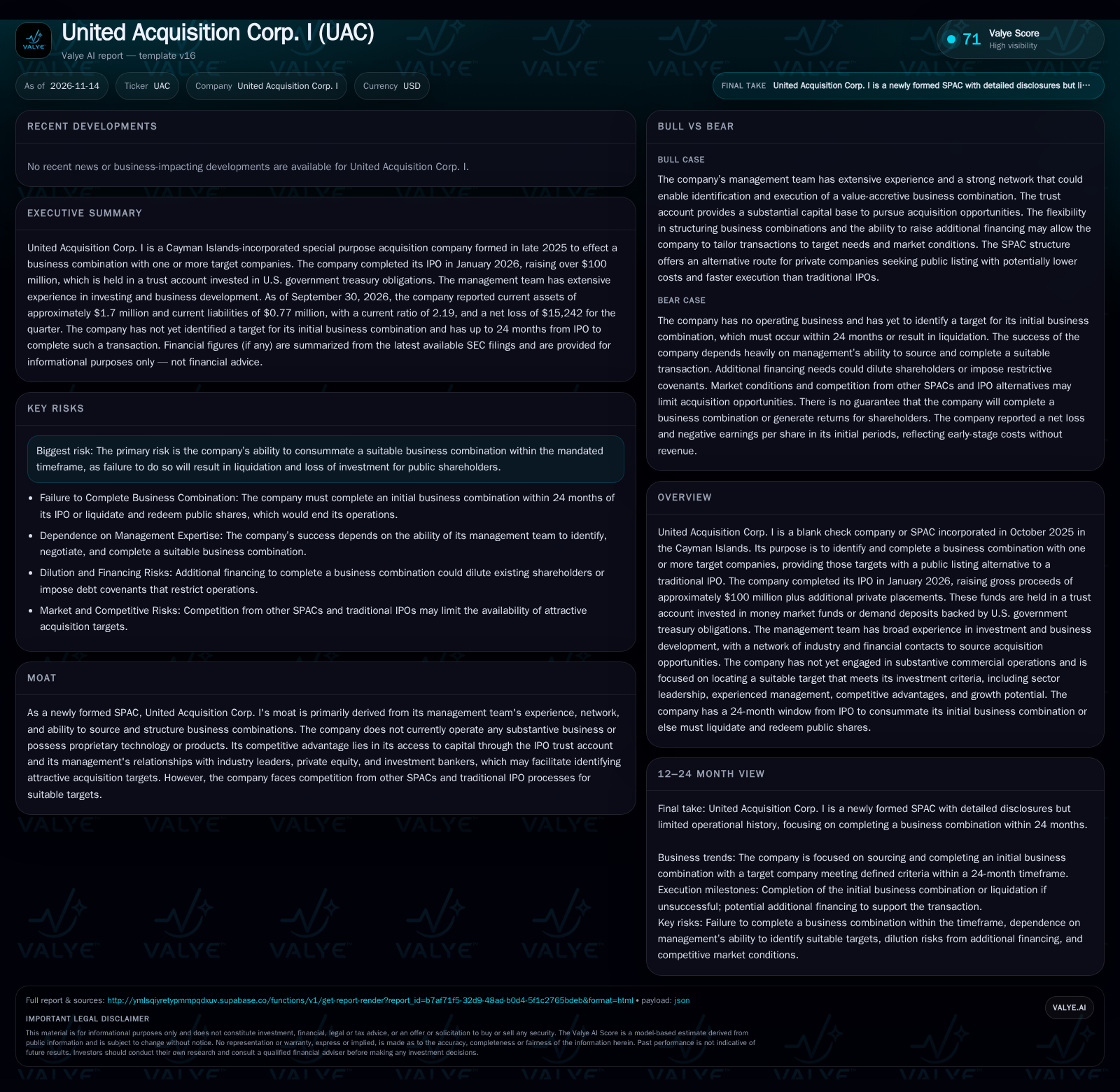
United Acquisition Corp. I raised $100 million in its January 2026 IPO and has until early 2028 to complete a business combination or liquidate. The SPAC has not yet announced a target and reported a net loss for the latest quarter, reflecting early-stage costs without revenue. The outcome now hinges on management’s ability to source, negotiate, and close a transaction that meets both regulatory and market expectations before the deadline, with dilution and competition as key risks. [S1] [S2]
United Acquisition Corp. I epitomizes the modern SPAC: flush with IPO capital, guided by a high-profile sponsor, and racing against a strict deadline to deliver a transformative business combination. With $100 million in trust and a 24-month window from January 2026, the company’s future now revolves around its ability to identify, negotiate, and close a deal with a sector-leading or high-growth target. The clock is ticking, and with no announced acquisition as of November 2026, the next 12 months are critical for execution. The company’s trajectory will depend on management’s sourcing capability, deal structuring, and the competitive dynamics of the SPAC market.
IPO Proceeds, Deal Timeline, and Sourcing Status Define Near-Term Reality
United Acquisition Corp. I completed its IPO in January 2026, raising $100 million, with additional proceeds from private placements, all held in a trust account invested in U.S. government treasury obligations or similar instruments. The company reported current assets of $1.7 million and current liabilities of $774,955 as of September 30, 2026, resulting in a current ratio of 2.19. No business combination target has yet been identified or announced. Critically, the company faces a 24-month window from IPO closing—expiring in early 2028—to consummate a qualifying transaction or else liquidate and return funds to shareholders. The reported net loss of $15,242 for the recent quarter is typical for a pre-deal SPAC, driven by administrative and compliance costs rather than revenue-generating activity. These facts set the stage for the company’s next phase: deal sourcing and negotiation under a tightening timeline. [S1] [S2]
SPAC Economics: Capital Structure, Deal Incentives, and Dilution Dynamics
United Acquisition Corp. I’s business model centers on deploying IPO and private placement proceeds—held in trust—to acquire a target that meets regulatory and investor criteria. Until a deal is consummated, the company earns minimal interest income, while incurring public company and deal-sourcing expenses. The economics pivot at the time of a business combination: the trust capital is injected into the merged entity, often combined with additional PIPE (private investment in public equity) financing or debt to meet minimum valuation requirements (the target must be valued at least 80% of trust assets at the time of agreement).
SPAC sponsors and management typically receive founder shares and warrants, creating strong incentives to close a deal even if the target is only marginally attractive. However, if additional financing is required, public shareholders may face dilution, especially if redemptions are high or if the deal structure relies on convertible notes or earn-outs. The fixed cost base pre-combination is low, but legal, due diligence, and compliance costs can spike during the deal phase. If a business combination is not completed within 24 months, the SPAC redeems shares and returns funds, with sponsors losing their at-risk capital. Thus, the capital structure and deal incentives can create tension between speed, quality of target, and shareholder outcomes.
Competing for Targets: Networks, SPAC Saturation, and Alternative Paths to Public Markets
United Acquisition Corp. I’s principal competitive assets are its management team’s experience, sponsor reputation, and access to $100 million in trust capital. However, the SPAC market remains crowded, with numerous vehicles chasing a finite pool of attractive targets—particularly those with the scale, management depth, and readiness for public scrutiny that regulators and investors now demand.
Competition also comes from traditional IPOs, direct listings, and private equity exits, all offering alternative routes for high-growth companies seeking liquidity or public capital. Target companies may use SPACs as negotiating leverage or pursue whichever path offers the best terms, speed, and certainty. In this context, United Acquisition Corp. I’s ability to source proprietary deals or leverage sponsor relationships could prove decisive, but it is not unique. The SPAC’s lack of operating history or proprietary technology means it must compete primarily on deal structure, speed, and sponsor credibility. The risk of overpaying or accepting less-than-ideal targets rises as the deadline approaches and competition intensifies.
Catalyst Chain: Proprietary Deal Sourcing Yields High-Quality Target and Shareholder Value
The most favorable scenario involves United Acquisition Corp. I leveraging its management network to identify a compelling, underexploited target—ideally a sector leader or high-growth disruptor—that is ready for public markets but not yet courted by other SPACs or IPOs. The SPAC could negotiate favorable terms, minimize redemptions by presenting a credible growth story, and supplement trust capital with PIPE financing if needed, limiting dilution to public shareholders.
Evidence that would confirm this scenario includes a timely announced business combination with a well-regarded, growth-oriented target, positive initial investor reaction, low redemption rates, and the ability to secure any required additional financing on attractive terms. Early indications of operational readiness and robust governance in the target would further validate the upside path. Conversely, delay in deal announcement or lack of PIPE investor interest would weaken this scenario.
Most Likely Outcome: Conventional SPAC Merger with Moderate Redemptions and Dilution
Given the crowded SPAC landscape and tightening timeline, the most plausible trajectory is that United Acquisition Corp. I announces a business combination with a mid-tier target—likely a growth company with some, but not all, of the ideal attributes. The deal may require additional financing, resulting in moderate dilution for public shareholders, and could see public redemptions in line with recent SPAC market averages.
Confirming evidence would include a deal announcement within the next 6-12 months, with the transaction structure relying on both trust capital and PIPE funds. Redemption levels above 30-40% would suggest limited investor enthusiasm but would still allow deal completion if supplemental capital is secured. Delays past the 18-month mark, or a transaction with a less differentiated target, would indicate a base-case outcome rather than a home run.
Risk of Missed Deadline: No Deal or Low-Quality Target Forces Liquidation or Value Destruction
The principal downside scenario is failure to identify and close a business combination before the 24-month window expires. This could result from heightened competition, insufficiently attractive targets, or inability to secure necessary financing. In such a case, United Acquisition Corp. I would be forced to liquidate, redeeming public shares at trust value and leaving sponsors with unrecoverable at-risk capital.
Alternatively, management could rush to close a deal with a suboptimal target—one lacking scale, growth, or governance—leading to high redemptions, dilution, and poor post-merger trading performance. Evidence supporting this scenario would include prolonged silence on deal progress, last-minute announcements, high investor redemptions, or PIPE financing on punitive terms. A failed shareholder vote or regulatory rejection would also confirm the downside.
What Will Determine United Acquisition Corp. I’s Success or Liquidation?
Announcement timing and quality of the initial business combination target—especially whether the target meets stated criteria for sector leadership, management depth, and growth potential.
Level of public shareholder redemptions at the time of deal vote; a useful metric would be the percentage of trust shares redeemed versus retained.
Ability to secure PIPE or other supplemental financing on favorable terms, if disclosed, indicating confidence from institutional investors.
Dilution impact on public shareholders from additional financing or sponsor incentives; if disclosed, the final post-merger ownership structure.
Regulatory and shareholder approval status for any announced business combination, as delays or rejections would threaten deal closure.
Progress updates on deal sourcing or negotiations from management, including 8-K filings or public statements.
Market reception and trading performance of peer SPACs completing business combinations in similar timeframes, as a comparative gauge of investor appetite.
Disclaimer: This is research-only, informational analysis and not investment advice. It may include AI-generated interpretation and general industry context. Always verify important details using primary sources.

Comments