
Amaze Holdings: Can an Asset-Light Creator Commerce Platform Overcome Severe Liquidity Pressure?
Amaze Holdings has repositioned itself as a technology-driven platform for the creator economy, aiming to leverage first-party transaction data and scalable, third-party-powered operations.
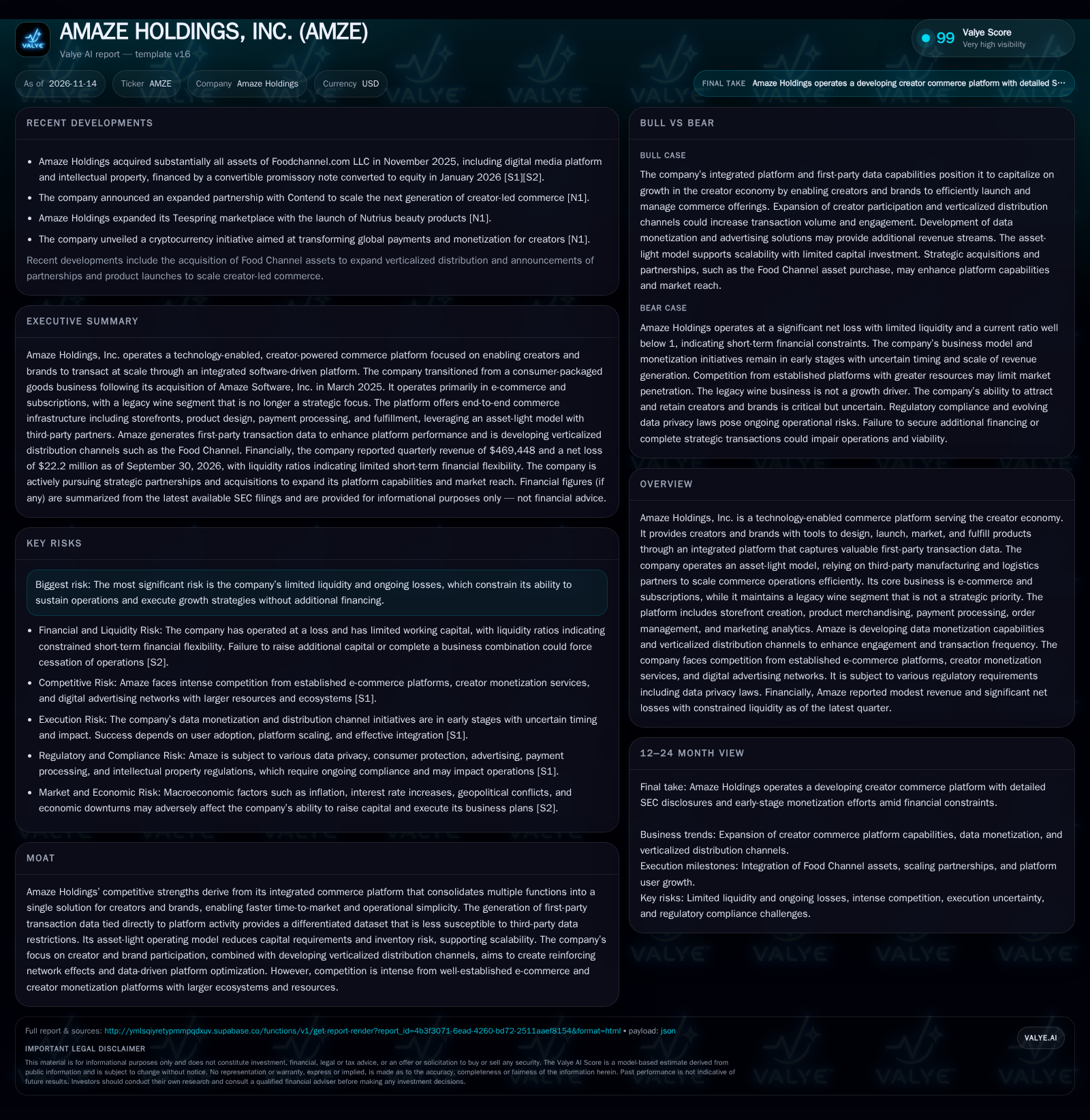
Amaze Holdings now operates as a tech-enabled creator commerce platform following its acquisition of Amaze Software, offering creators and brands integrated tools for product design, launch, and fulfillment. Execution on verticalized distribution and first-party data monetization remains in early stages, and entrenched competition poses further challenges. [S1] [S2]
Amaze Holdings, Inc. has radically repositioned itself from a legacy consumer-packaged goods business to a technology-enabled platform serving the fast-evolving creator economy. Its core value proposition now centers on providing creators and brands with integrated tools for designing, launching, and managing commerce offerings, all while generating valuable first-party transaction data. However, as of late 2026, Amaze faces a stark financial reality: quarterly revenues remain modest, net losses are substantial, and liquidity is acutely constrained. This duality—compelling platform potential versus existential financial risk—defines the current investment debate.
Severe Liquidity Constraints and Early-Stage Platform Momentum
As of September 30, 2026, Amaze Holdings reported quarterly revenue of $469,448 and a net loss of $22,231,693, with basic and diluted EPS at -$1.09 per share. The company reported cash and liquidity metrics for the period; these figures do not by themselves establish operating runway, investment capacity, financial flexibility, or financing capacity. Cash and cash equivalents were only $156,000 at the end of 2024, and the company continues to operate at a loss with severely limited working capital [S2].
Strategically, the business completed the acquisition of Amaze Software in March 2025 and Food Channel assets in late 2025, marking a pivot from consumer-packaged goods to a software-driven, creator-focused commerce platform [S1]. These moves signal a commitment to the creator economy and digital infrastructure, but the financial runway remains highly limited. The company is actively seeking a business combination or strategic transaction to acquire a revenue-generating business [S2].
Asset-Light Model and the Search for Operating Leverage
Amaze’s core business model relies on an asset-light approach, leveraging third-party manufacturing, logistics, and payment partners to minimize capital intensity and inventory risk [S1]. The platform enables creators and brands to design, market, and fulfill products through integrated storefronts, with Amaze capturing transaction and engagement data at every point. This potentially allows the company to scale commerce activity without proportional increases in fixed costs.
Revenue is primarily generated from e-commerce activity and subscriptions, though the commercial mechanics—such as take rates, pricing tiers, or minimum guarantees—are not disclosed. If the company can drive higher transaction volumes and engagement, fixed platform costs could be leveraged to improve margins over time. However, the current cost base is high relative to revenue, as evidenced by substantial net losses, suggesting that either scale or improved monetization per transaction is required for break-even.
The legacy wine segment remains a non-core, lower-priority operation and is not expected to contribute materially to future growth [S1]. Meanwhile, the company is investing in verticalized distribution (e.g., Food Channel) and data-driven optimization, which could support higher-value advertising or analytics revenue streams if successfully executed.
The asset-light model, while reducing capital expenditure and inventory risks, inherently shifts significant operational dependencies onto third-party partners. This reliance introduces potential vulnerabilities related to partner performance, cost fluctuations, and supply chain disruptions, which could materially affect service quality and margin stability. Moreover, the platform’s ability to negotiate favorable terms with these partners will be critical in preserving gross margins, especially as transaction volumes scale. If Amaze can establish long-term, volume-based agreements or exclusive partnerships, it may enhance cost predictability and operational resilience, thereby supporting more sustainable unit economics.
Platform Integration and Data May Offer Differentiation, but Scale Is a Hurdle
Amaze competes with multiple categories: established e-commerce platforms (such as Shopify), creator monetization services (like Patreon), print-on-demand and fulfillment providers, and digital advertising/data platforms. Many competitors have deeper resources, larger user bases, and entrenched ecosystems [S1].
Amaze’s integrated platform—combining storefront creation, product design, fulfillment, and analytics—could reduce friction for creators and brands seeking an all-in-one solution. The generation of first-party transaction data is a potential differentiator, especially as regulatory changes (e.g., data privacy restrictions) make third-party data less reliable for targeting and personalization.
However, network effects and switching costs may be modest unless the platform can reach a critical mass of creators and brands, or offer materially better economics or audience access. The risk is that creators default to larger, more established platforms unless Amaze can prove superior monetization, ease of use, or unique data-driven capabilities.
If Platform Scale Unlocks Data Monetization and Creator Loyalty
In a favorable scenario, Amaze successfully scales its creator and brand base, driving higher transaction volume across its platform. The accumulation of rich, first-party transaction data enables the company to optimize product recommendations, personalize marketing, and potentially offer proprietary advertising or analytics services—creating new, higher-margin revenue streams.
Verticalized distribution channels, such as the Food Channel, could foster deeper engagement within specific niches, increasing repeat transaction frequency and attracting advertisers or sponsors targeting those communities.
Evidence that would confirm this scenario includes: sequential growth in active creator and brand accounts, rising transaction volume per creator, introduction and adoption of new data-driven monetization features, and improvement in gross margins as fixed platform costs are leveraged. Strategic partnerships or acquisitions that expand user reach or platform capabilities would further support the upside thesis.
Early-Stage Platform Execution Meets Persistent Financial Strain
The most plausible near-term outcome is that Amaze continues to develop its platform and verticals, but growth in transaction volumes and creator participation remains modest due to resource constraints and entrenched competition. Data monetization and new revenue streams progress slowly, with the company still dependent on core e-commerce activity for the bulk of its revenue.
Operating losses persist as the company invests in platform features and user acquisition without achieving the scale required for profitability.
Liquidity Crisis and Failure to Achieve Platform Traction
Under an adverse scenario, Amaze is unable to raise additional capital or secure a strategic transaction in time, resulting in an inability to meet obligations and potential cessation of operations. Platform adoption stalls as creators and brands gravitate toward larger, better-capitalized competitors, and the company’s initiatives in data monetization and verticalized channels fail to gain meaningful traction.
Regulatory compliance costs and competitive marketing pressure further erode the company’s already thin financial cushion. If customer acquisition costs rise or retention weakens, losses could deepen and hasten a liquidity crisis.
Evidence for this scenario includes further deterioration in liquidity ratios, missed payments or public disclosures about going-concern doubts, layoffs or operational retrenchment, and stagnation or decline in platform activity metrics.
Milestones That Will Clarify Amaze Holdings’ Platform Viability
Sequential growth in active creator and brand accounts, if disclosed, would indicate whether the platform is gaining traction with its target users.
Transaction volume per creator or per storefront, if provided, would help assess engagement depth and monetization efficiency.
Gross margin trends, especially as verticalized channels and data monetization features are introduced, would reveal the potential for operating leverage.
Evidence of new data-driven features (e.g., advertising, analytics, personalization engines) being launched and adopted would support the value-add thesis.
Announcements or filings regarding additional capital raises, strategic partnerships, or business combinations are critical to assessing short-term viability.
Disclosures about customer acquisition costs and retention/churn rates, if available, would clarify the sustainability of user growth.
Any material regulatory developments or compliance costs, especially in data privacy, could impact both operating expenses and the company’s ability to monetize its data asset.
Disclaimer: This is research-only, informational analysis and not investment advice. It may include AI-generated interpretation and general industry context. Always verify important details using primary sources.

Comments