
Nuo Therapeutics: Aurix System’s Commercial Traction, Supply Chain Risks, and the Challenge of Scaling Advanced Wound Care
Nuo Therapeutics, anchored by its FDA-cleared Aurix System and bolstered by Medicare reimbursement and a U.S. distribution partnership with Smith+Nephew, has demonstrated revenue growth but remains exposed to critical reagent supply disruptions and persistent financial losses. The company’s ability to secure alternative reagents, broaden market adoption, and navigate competitive and regulatory complexities will determine whether it can move from niche commercial player to durable wound care contender.
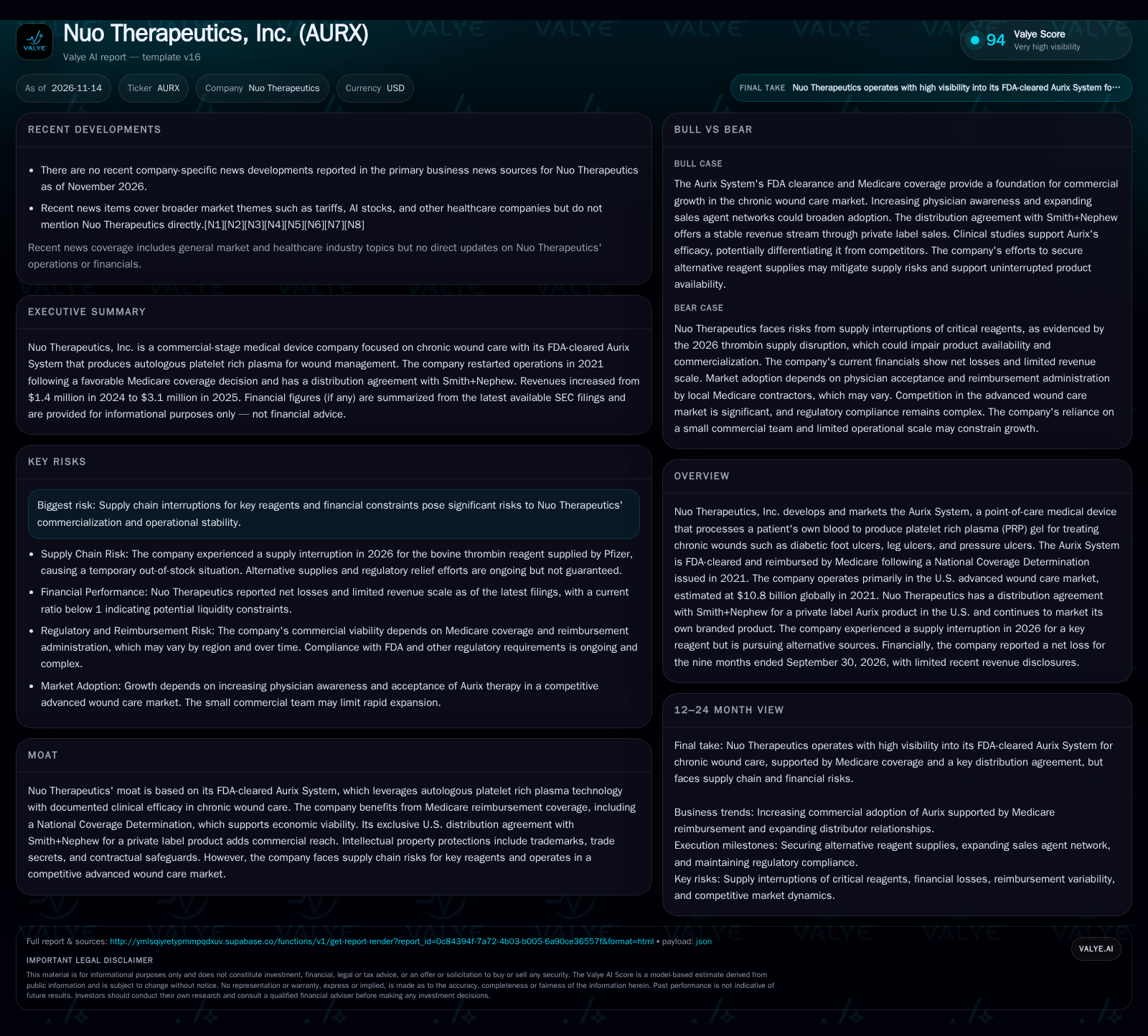
Nuo Therapeutics markets the Aurix System for chronic wound care, leveraging FDA clearance and Medicare reimbursement to drive recent commercial growth. While a distribution agreement with Smith+Nephew and expanding sales networks have increased revenues, a 2026 supply interruption and ongoing net losses underscore operational and financial vulnerabilities. The company’s near-term trajectory hinges on resolving supply chain risks and achieving broader physician adoption while maintaining compliance and competitive positioning.[S2]
Nuo Therapeutics, Inc. occupies a distinctive niche in the advanced wound care sector with its Aurix System—an FDA-cleared device that produces autologous platelet rich plasma (PRP) for chronic wound management. Backed by Medicare reimbursement and a high-profile distribution agreement with Smith+Nephew, the company has achieved notable revenue growth since resuming operations in 2021. However, a recent supply chain disruption and ongoing net losses highlight the fragility of its current business model. The next chapter for Nuo hinges on addressing supply dependencies, scaling market adoption, and navigating the evolving regulatory and competitive environment.
Recent Revenue Growth, Supply Chain Vulnerability, and Financial Snapshot
Nuo Therapeutics has demonstrated commercial momentum, increasing revenues from approximately $1.4 million in 2024 to $3.1 million in 2025, supported by both direct sales of its Aurix-branded product and private label distribution through Smith+Nephew. This expansion follows the restoration of Medicare reimbursement, which has enabled broader market access.[S2]
In August 2026, however, the company experienced a two-week supply interruption due to a shortage of bovine thrombin reagent provided by Pfizer. This event temporarily halted product availability and exposed a significant operational risk, prompting efforts to secure alternative supplies and regulatory flexibility.[S2]
Financially, as of September 30, 2026, Nuo Therapeutics reported cash and equivalents of $80,941, current assets of $1.98 million, current liabilities of $2.45 million, and a net loss of $424,928 for the first nine months of 2026. The company reported a current ratio of 0.81 for the period. [S2]
How Aurix Generates Revenue—and the Economics of Chronic Wound Care Devices
Nuo Therapeutics’ revenue model centers on the sale of the Aurix System—a point-of-care device that processes a patient’s own blood to create a PRP gel for chronic wound management. The company benefits from established Medicare reimbursement rates ($2,108 per treatment in hospital outpatient settings; $1,064 in physician offices), which provide pricing visibility and facilitate provider adoption.[S2]
Revenue streams are diversified between direct sales of the Aurix-branded product and private label sales through Smith+Nephew, which carries minimum annual purchase commitments and upfront fees. This mix may offer some buffering against single-channel risk, but the lack of scale and limited operational leverage mean that fixed costs—such as regulatory compliance, quality assurance, and a network of over 200 third-party sales representatives—remain a drag on profitability.
Gross margins in advanced wound care are typically influenced by reagent costs, device disposables, and the logistics of supporting decentralized clinical sites. The recent reagent supply interruption highlights the vulnerability of Nuo’s cost structure to single-source components. The company’s small commercial workforce further constrains its ability to drive volume growth organically, likely necessitating continued reliance on distributor partnerships and incremental expansion of its sales agent network.
Positioning Aurix in a Crowded Advanced Wound Care Landscape
Nuo Therapeutics operates in the highly competitive advanced wound care market, estimated at $10.8 billion globally in 2021, with a particularly active North American segment. Aurix’s main point of differentiation is its FDA clearance for autologous PRP therapy, backed by documented clinical efficacy in diabetic foot ulcers and other chronic wounds.[S2]
The company’s competitive advantages include established Medicare reimbursement and an exclusive U.S. distribution agreement with Smith+Nephew, a major wound care player, which expands its channel reach. However, counterforces remain formidable: several other platelet-derived and non-platelet wound care products compete for formulary access and provider mindshare, and larger competitors may benefit from broader sales infrastructure, deeper clinical evidence bases, and greater pricing flexibility.
Switching costs in wound care are moderate—clinicians may be slow to change protocols, but reimbursement and clinical outcomes can drive adoption. The key challenge for Nuo is to convert clinical evidence and reimbursement status into routine use, especially given its limited commercial resources and exposure to supply chain shocks.
What Would It Take for Nuo to Become a Market-Moving Wound Care Player?
A favorable scenario for Nuo Therapeutics would be defined by uninterrupted reagent supply, further validation of Aurix’s clinical efficacy, and accelerating adoption among wound care specialists and hospital systems. Expansion of the Smith+Nephew private label arrangement—potentially into new care settings or with increased minimum purchase commitments—could drive step-change revenue growth.
Broader physician acceptance, fueled by new clinical data or guideline endorsements, would support higher utilization rates. If Nuo can secure alternative thrombin sources and regulatory relief without material cost increases, gross margins could stabilize or improve. A meaningful inflection in revenues—well above the $3.1 million reported in 2025—and visible progress toward profitability would confirm this scenario.[S2]
Falsification would come from persistent supply interruptions, stagnant sales agent expansion, or evidence that competitors are eroding Aurix’s market share or reimbursement status.
Sustained but Constrained Growth Amid Supply and Scale Limitations
The most plausible near-term trajectory for Nuo Therapeutics is continued, albeit modest, commercial growth anchored by Medicare reimbursement, the Smith+Nephew partnership, and incremental expansion of its sales agent and distributor network. Occasional supply hiccups may recur but do not fundamentally derail operations as long as alternative reagents are secured in time.
Financially, the company is likely to remain loss-making absent significant revenue inflection or material improvements in gross margin. The small commercial team and ongoing liquidity constraints limit the pace of market penetration. Nuo’s position remains that of a niche player, with clinical efficacy and reimbursement as selling points but limited ability to shape the broader wound care market.
Confirmation would come from year-over-year revenue growth in the low- to mid-single-digit millions, stable reimbursement rates, and manageable supply chain disruptions. Falsification would include a major loss of reimbursement status, sustained reagent shortages, or a sharp drop in distributor commitments.
How Supply Chain Disruptions or Funding Shortfalls Could Derail Progress
A negative outcome for Nuo would be triggered by prolonged or repeated supply interruptions—such as further shortages of thrombin or other critical reagents—that cause extended product unavailability, lost sales, and erosion of provider confidence. If alternative sourcing or regulatory relief is delayed or proves costly, margins may be compressed and customer attrition could accelerate.
Should distributors reduce commitments or if Medicare reimbursement is revoked or reduced, revenues could fall below breakeven, forcing operational retrenchment or even threatening business continuity.
This scenario would be confirmed by extended out-of-stock periods, a shrinking sales agent network, mounting payables, or disclosure of going concern doubts in future filings.
Milestones and External Factors That Will Determine Nuo’s Trajectory
Progress in securing alternative thrombin supplies—both regulatory approval for new sources and establishment of reliable vendor relationships—would help test Nuo’s ability to mitigate supply chain risk.
Year-over-year revenue growth, particularly from the Smith+Nephew private label channel, would indicate whether the company is gaining commercial traction beyond its existing customer base.
Stability or expansion in the number of contracted third-party sales representatives (if disclosed) would signal ongoing investment in market reach and sales execution.
Gross margin trends, if disclosed, would clarify the impact of supply chain changes and pricing dynamics on profitability.
Updates on Medicare reimbursement rates and policy status are crucial, as any adverse changes could materially affect provider adoption and company economics.
Disclosure of new or expanded clinical data supporting Aurix efficacy in additional wound types or patient populations would enhance differentiation and support marketing claims.
Any material changes in distributor commitments—such as increased minimum purchases or entry into new care settings—would be a leading indicator for revenue scalability.
Evidence of improved liquidity (such as new financings or positive operating cash flow) would reduce concern about short-term funding constraints.
Disclaimer: This is research-only, informational analysis and not investment advice. It may include AI-generated interpretation and general industry context. Always verify important details using primary sources.

Comments