
Metals Acquisition Corp. II: Capital-Rich SPAC Advances Toward Mining Sector Acquisition
Metals Acquisition Corp. II has raised substantial capital and forged strategic alliances, but its future hinges on the successful identification and execution of a metals-sector business combination. The company’s current position reflects the classic SPAC challenge: strong financial resources and sector focus, but value realization is contingent on deal execution.
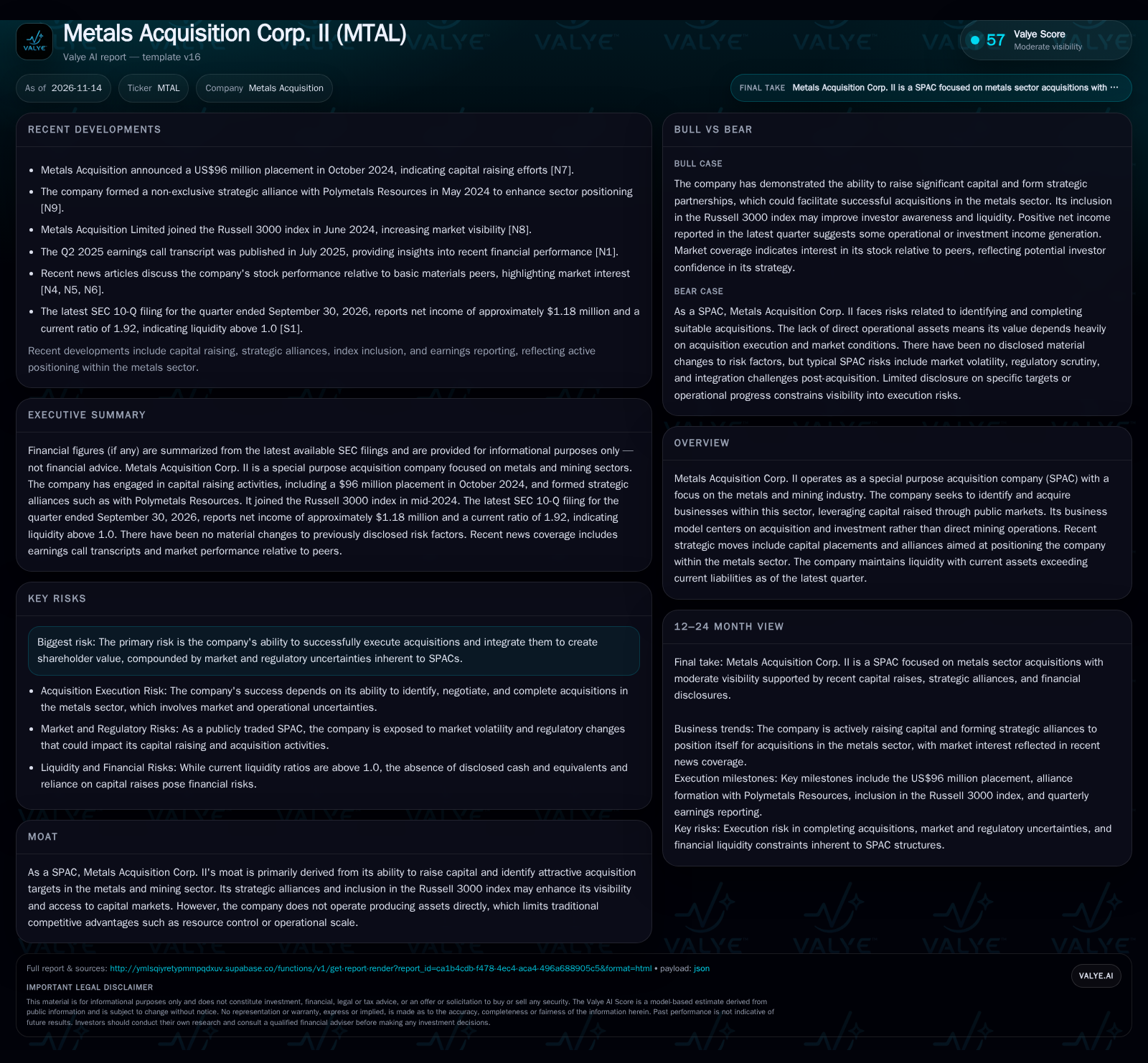
Metals Acquisition Corp. II stands out among metals-focused SPACs with a recent $96 million placement, a strategic alliance in the sector, and positive non-operating income as of Q3 2026. However, with no operating assets or revenues, all future value depends on the successful completion and integration of a target acquisition.
Metals Acquisition Corp. II exemplifies the SPAC model in its purest form: substantial capital raised, a clear sector focus, and a strategic partnership ecosystem, yet no direct operating assets or revenue streams as of Q3 2026. The coming quarters will be defined by the company’s capacity to source, negotiate, and execute a compelling acquisition in the metals and mining space.
Recent Capital Infusions and Partnerships Set the Stage for Upcoming Deal
Metals Acquisition Corp. II reported net income of $1,175,928 for the quarter ended September 30, 2026, entirely attributable to interest income on trust assets rather than operating activities [S1]. The company’s current assets totaled $1,679,832 with current liabilities of $874,648, yielding a current ratio of 1.92 as of the same date, reflecting a reported liquidity position [S1]. In October 2024, the company completed a $96 million placement, significantly expanding its financial resources for potential acquisitions [N7]. Complementing its capital base, Metals Acquisition entered a non-exclusive strategic alliance with Polymetals Resources in May 2024, suggesting an intent to deepen sector relationships and possibly gain access to proprietary deal flow. The company’s inclusion in the Russell 3000 index as of June 2024 further enhances its visibility among institutional investors [N8]. Collectively, these developments position Metals Acquisition with the financial and relational tools necessary to pursue a transformative metals-sector deal, but the absence of an executed acquisition remains the central fact shaping its forward trajectory.
Analyzing SPAC Financials: Deploying Capital to Generate Shareholder Returns
The economics of Metals Acquisition Corp. II are fundamentally those of a SPAC: value is realized through the successful identification, negotiation, and consummation of a business combination. Until such a transaction occurs, the primary sources of income are interest earnings on the funds held in trust, as evidenced by the company’s recent net income results [S1]. The $230 million gross proceeds from its IPO, augmented by a $96 million placement and private placement warrants, provide substantial dry powder for acquisition activity [S1] [N7]. However, these funds are largely restricted to approved deal activity and, ultimately, redemption obligations if a deal is not completed within the SPAC’s lifecycle.
Operating leverage for a SPAC is limited pre-acquisition, as expenses are mostly fixed (legal, compliance, due diligence, and public company costs) and not tied to revenue-generating operations. After a successful business combination, the economics shift dramatically and will depend on the acquired entity’s revenue mix, cost structure, and capital intensity. If the target is a producing mining asset, future economics could be highly sensitive to commodity prices, operational efficiency, and capital-expenditure cycles. Conversely, if the target is a development-stage company, additional capital needs and execution risk may be pronounced. The company reported cash and liquidity metrics for the period; these figures do not by themselves establish operating runway, investment capacity, financial flexibility, or financing capacity.
Positioning Amid Intense Competition in Metals-Focused SPAC and M&A Markets
Metals Acquisition Corp. II faces competition on two fronts: from other SPACs seeking attractive targets in the metals and mining space, and from traditional mining companies and private equity funds pursuing M&A. Its recent $96 million placement and alliance with Polymetals Resources may provide a slight edge in terms of capital scale and sector access compared to less well-capitalized or connected SPACs [N7]. The inclusion in the Russell 3000 could further facilitate capital access and trading liquidity, potentially making the SPAC a more attractive partner for acquisition targets [N8].
However, the competitive landscape is intense. Many SPACs and alternative capital providers are chasing a finite pool of high-quality mining assets, driving up valuations and increasing deal complexity. The non-exclusive nature of the Polymetals alliance suggests that Metals Acquisition does not have proprietary access to any single asset, and must compete in open processes. Traditional mining companies may also enjoy operational synergies and sector credibility that SPACs lack. The company’s ultimate advantage will depend on deal-making agility, sponsor relationships, and the ability to structure transactions that are both compelling to targets and accretive to shareholders.
Potential for Value Creation Through a Strategic Mining Acquisition
The upside case for Metals Acquisition Corp. II centers on its ability to deploy its substantial capital base into the acquisition of a high-quality, cash-generative mining asset or platform company. If the company successfully sources a deal with attractive resource potential, robust operating margins, and a credible management team, it could rapidly transition from a capital pool to an operating enterprise with intrinsic value. The alliance with Polymetals Resources could provide access to under-the-radar opportunities or facilitate due diligence, enhancing deal quality.
Confirmation of this scenario would come from the announcement of a signed definitive agreement for a business combination, ideally with clear disclosure of asset quality, expected production or cash flow, and alignment with sector trends such as critical minerals or decarbonization. Additional evidence would include positive market reaction, successful shareholder approval, and a smooth de-SPAC process. Falsification would be indicated by prolonged deal inactivity, failure to secure an attractive target, or the pursuit of a highly speculative or dilutive transaction that erodes shareholder value.
Progressing Through the SPAC Lifecycle While Searching for the Right Target
The most plausible near-term scenario is that Metals Acquisition continues its search for a suitable acquisition target, incurring ongoing public company and due diligence expenses while earning interest income on trust assets [S1]. The alliance with Polymetals Resources may yield additional deal flow or sector intelligence, but the non-exclusive nature of the relationship means there is no guaranteed pipeline.
This scenario would be confirmed by continued quarterly reports of net income driven by interest, ongoing expense control, and regular market updates regarding deal sourcing. Falsification would occur if the company announces a deal outside the metals sector, faces significant redemptions or shareholder dissent, or if market volatility undermines the economics of any potential business combination.
Risks from Delayed Transactions and Capital Attrition Impacting Investors
The adverse scenario is defined by failure to execute a business combination within the SPAC’s mandated timeframe, resulting in the return of trust assets to shareholders and the dissolution of the company. This could occur if competitive pressures, valuation mismatches, or regulatory hurdles prevent Metals Acquisition from securing a compelling deal. Rising sector valuations, driven by increased competition for critical minerals, may further narrow the pool of accretive targets.
Confirmation of this downside would be seen in repeated delays, the absence of deal announcements as the SPAC’s deadline approaches, or the pursuit of a suboptimal transaction that fails to gain shareholder support. Significant redemption activity, negative market sentiment, or adverse regulatory developments could also accelerate capital erosion and undermine any residual value.
Key Milestones Shaping the Future Path of Metals Acquisition Corp. II
Announcement of a signed letter of intent or definitive agreement for a business combination, including sector, asset quality, and deal structure details.
Updates on the pipeline of potential targets and the impact of the Polymetals Resources alliance—if disclosed by management.
Quarterly net income and expense trends, as ongoing interest income versus operating costs will determine capital preservation until a deal is executed [S1].
Material shareholder redemptions or changes in the trust asset base, especially as the SPAC lifecycle progresses.
Any regulatory, legal, or market shifts affecting SPACs or metals-sector M&A, such as changes in listing standards or sector-specific policy.
Market reaction and trading liquidity following any major announcements, including index inclusion or deal news [N8].
Disclaimer: This is research-only, informational analysis and not investment advice. It may include AI-generated interpretation and general industry context. Always verify important details using primary sources.

Comments